
Is Hyperliquid Truly A Decentralized Exchange or a Masquerading CEX?

0
0
Questions around whether Hyperliquid operates more like a decentralized exchange or a centralized platform have intensified as its validator structure comes under scrutiny.
Although the project markets itself as a fully on-chain perpetual futures exchange, critics have raised concerns about its decentralization model. They point to its relatively small validator count and concentrated stake distribution as signs of limited decentralization.
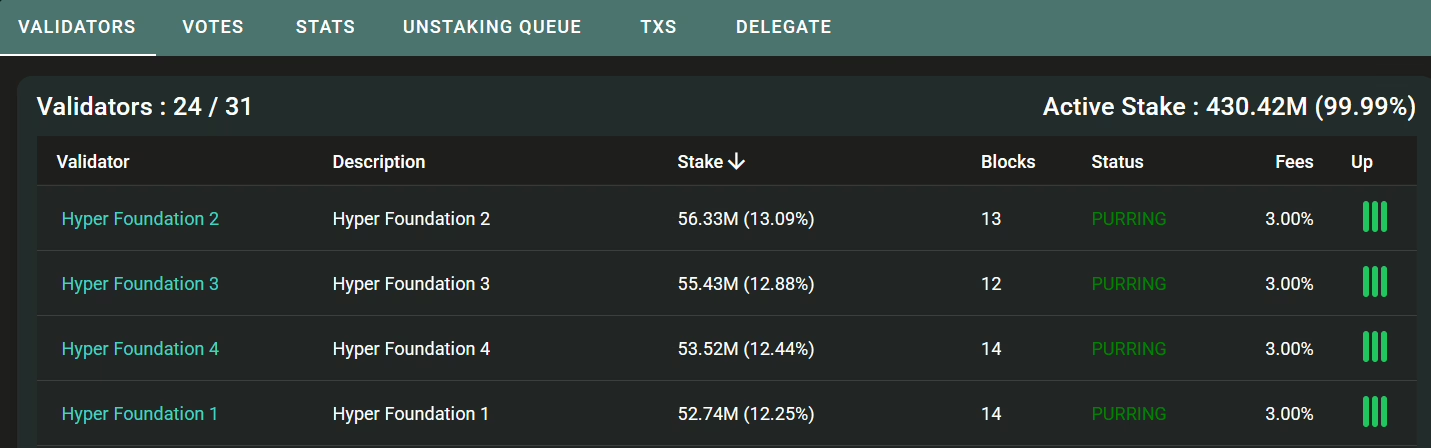
As of late May 2026, Hyperliquid runs its layer-1 blockchain with about 31 registered validators. Of these, an active set of 24 validators is responsible for producing blocks through HyperBFT consensus. Notably, several Foundation-linked validators reportedly hold large stakes, raising concerns about influence within the stake-weighted system.
Supporters, however, argue that the smaller validator structure is a deliberate design choice intended to maximize performance. They say the setup allows Hyperliquid to deliver extremely fast execution speeds and low-latency trading. The protocol supports up to 50x leverage, near-zero gas fees, and sub-second finality to compete with centralized exchanges.
Validator Concentration Fuels Centralization Concerns
Hyperliquid allows permissionless validator registration, requiring 10,000 HYPE self-delegation locked for one year before joining. Despite this open structure, stake ownership remains heavily concentrated among a small group of validators tied to the Hyper Foundation.
Around four Foundation-associated validators reportedly hold stakes exceeding 50 million HYPE each. Because Hyperliquid relies on stakeholder-weighted governance and consensus, those positions give the Foundation significant influence over network operations and decision-making.
Alongside this concentration, independent infrastructure providers, including B-Harvest, Imperator, Anchorage Digital, and Figment, also participate in validating the network. Their presence has helped broaden external participation, though Foundation-aligned validators still dominate the top ranks in terms of stake size.
The protocol plans to increase the active validator set from 24 to 27 in the coming weeks as part of a broader decentralization effort. Earlier versions of the network reportedly operated with between 16 and 21 active validators, while the total staked HYPE has reached roughly 430 million tokens.
Hyperliquid Compared With Major Layer-1 Networks
Ethereum remains the industry benchmark for decentralization with more than one million active validators distributed globally. Its broader validator diversity improves resilience, though slower finality and higher fees make it less suited for ultra-low-latency perpetual trading.
Solana also focuses on high throughput and low transaction costs while maintaining several hundred active validators. Although it has faced criticism tied to outages and validator concentration, its validator set still provides more redundancy than Hyperliquid’s compact structure.
NEAR Protocol uses sharding and rotating validators to balance scalability with broader network participation, while Avalanche supports hundreds to thousands of validators through its Primary Network and subnet model. Both approaches aim to improve scalability without relying on tightly concentrated validator sets.
Hyperliquid reflects a deliberate compromise between decentralization and performance optimization. While the protocol continues expanding validator participation and governance features, debate remains ongoing. Questions persist over whether its structure aligns more with decentralized finance ideals or centralized exchange mechanics.
Against this backdrop, HYPE has also seen notable market activity. The token trades around $62 as of writing. It is up 30% over the past 7 days, 45% over the past 30 days, and 142% year-to-date. Its market capitalization now stands above $13.7 billion.
The post Is Hyperliquid Truly A Decentralized Exchange or a Masquerading CEX? appeared first on CoinTab News.
0
0


 Manage all your crypto, NFT and DeFi from one place
Securely connect the portfolio you’re using to start.

0
0


0
0
