
Prosecutors reject dismissal bid in Tornado Cash co-founder’s case

0
0
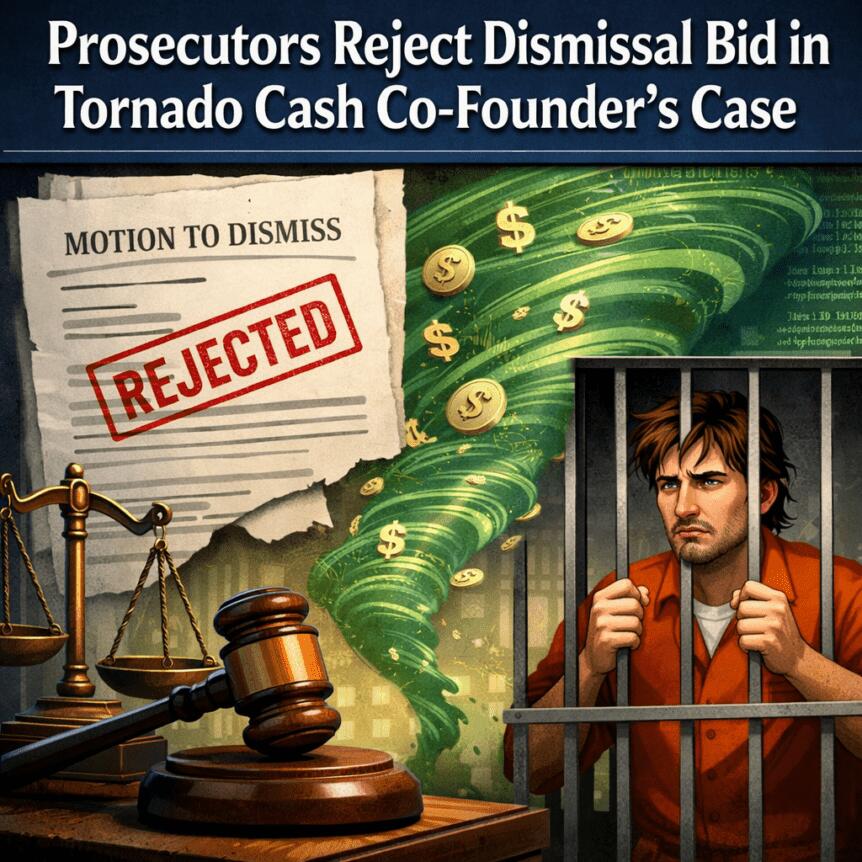
In a high-stakes move that sharpens the focus on developer responsibility in crypto tooling, prosecutors in the U.S. Attorney’s Office for the Southern District of New York have asked a federal court to reject Tornado Cash co-founder Roman Storm’s bid for acquittal. The filing centers on the contention that Storm’s alleged actions go beyond a civil copyright dispute and implicate conspiracies to commit money laundering and sanctions violations.
Jay Clayton, the SDNY attorney who previously led the U.S. Securities and Exchange Commission, argued in court papers that Storm’s use of Tornado Cash was “window dressing at best and outright misdirection at worst.” The filing criticized Storm’s attempt to frame his defense around a civil copyright case, insisting there is no evidentiary basis for equating his conduct with civil liability and that such a line of defense is irrelevant to the criminal charges at hand. The motion responded to Storm’s plan to cite a 2026 Supreme Court case, Cox Communications, Inc. v. Sony Music Entertainment, as part of an argument about Storm’s intent to participate in the criminal activity prosecutors allege.
According to the SDNY, Storm’s alleged conduct bears little resemblance to the facts in the Cox case, which dealt with copyright infringement in a civil context. The government contends there is no evidence that Storm or Tornado Cash’s developers implemented any effective anti-money-laundering controls, a point Clayton stressed in the filing.
“The defendant’s conduct simply is not comparable to the conduct at issue in Cox,” Clayton said. “In any event, a civil copyright case has no relevance here in the first place.”
Last August, a jury convicted Storm of conspiracy to operate an unlicensed money transmitting business, but the panel deadlocked on two other charges — conspiracy to commit money laundering and conspiracy to violate sanctions — leaving the possibility of a retrial on those counts. The case has become a flashpoint in the broader debate over whether developers of open-source crypto tools can be held legally liable for how their code is used in illicit finance schemes.
Prosecutors and Storm’s defense team were slated to meet on the following Thursday to discuss the path ahead, including the possibility of a retrial date. In the meantime, the government has signaled continued pursuit of the remaining charges, while the defense has pressed for a dismissal or a narrow resolution based on civil-law considerations.
In a contemporaneous political thread surrounding the case, the conversation extended beyond the courtroom doors. Last week, reports circulated that U.S. lawmakers were advancing proposals intended to shield blockchain developers from broad prosecution, signaling a regulatory ambition to distinguish between personal risk and platform-level liability.
Key takeaways
- The SDNY explicitly rejects Roman Storm’s attempt to leverage Cox Communications as a defense, asserting the criminal nature of the alleged activity is not comparable to civil copyright disputes.
- Storm was convicted on conspiracy to operate an unlicensed money transmitting business, while two related charges ended in a mistrial, keeping the door open for a retrial on those counts.
- The case amplifies the ongoing debate about whether developers behind open-source crypto projects can be held criminally liable for how others use their code.
- News of a potential October retrial underscores the government’s intent to pursue the remaining charges, even as questions about evidentiary standards and defense strategy persist.
- In parallel, U.S. policymakers continue to explore protections for blockchain developers, highlighting tensions between enforcement goals and innovation incentives.
- The evolving DOJ posture, including commentary associated with acting Attorney General Todd Blanche, could influence how aggressively prosecutors pursue similar cases and how they frame regulatory boundaries around crypto platforms.
Courts, cases and a shifting DOJ posture
Clayton’s filing frames the Storm case within a larger legal question: when, if ever, does enabling code cross the line into criminal participation? The defense’s tactic of invoking a civil copyright precedent appears designed to downplay Storm’s alleged role in facilitating illicit activity, but prosecutors argue that the underlying conduct extends far beyond such civil concerns. The government’s stance rests on an assertion that there was no adequate safeguard against abuse by Tornado Cash’s tools, a factor central to charges of money laundering conspiracies and sanctions violations.
The legal strategy in play here matters beyond one defendant. It tests the boundaries of developer liability for open-source projects and raises critical questions about how prosecutors evaluate intent and control in decentralized tooling. If civil analogies or civil-law defenses fail to translate to criminal contexts, the door may remain open for tougher scrutiny of developers whose code can be used for illicit ends—even when they claim no direct involvement in wrongdoing.
Meanwhile, the timing of the potential retrial adds a layer of strategic calculus for both sides. The SDNY has requested October as a possible window for re-presenting the evidence on the two previously deadlocked counts, but no date has been officially set as of now. The outcome could influence how similar cases are positioned in the future and how aggressively prosecutors pursue open-source projects that enable or facilitate illicit activity, including cross-border sanctions evasion.
DOJ policy signals and the broader regulatory backdrop
The Storm case sits at the intersection of criminal enforcement and policy signaling within a changing regulatory landscape. Last week, headlines centered on how a reshuffled Justice Department might recalibrate its approach to crypto. Acting Attorney General Todd Blanche, who has previously commented on the need to end what he termed “regulation by prosecution,” laid out a vision that could affect enforcement priorities in the crypto space. While Blanche did not name Storm specifically, he argued that the department should avoid pursuing actions against platforms that criminals leverage to conduct illegal activity and called for alignment between enforcement actions and overarching policy goals. The implications for Tornado Cash and similar tooling are indirect but notable, as prosecutors weigh how to apply anti-money-laundering and sanctions laws to decentralized technologies.
Storm himself has publicly framed the stakes in stark terms. In March, after prosecutors indicated a path toward retrying the two deadlocked counts, he argued that the charges could carry substantial maximum penalties — up to 40 years in federal prison — for actions tied to writing open-source code for a protocol he says he didn’t control and transactions he didn’t touch. The rhetoric underscores the tension between a developer-centric view of code as a public good and a prosecutorial view that code can be weaponized for financial crime when used in unintended or illicit ways.
Beyond the courtroom, the case feeds into a broader policy dialogue about how to balance innovation with enforcement. Lawmakers have floated measures designed to protect blockchain developers from punitive prosecution while maintaining guardrails against illicit finance. The tension between protecting innovation and deterring abuse remains a central theme in crypto regulation discussions, a dynamic that could shape how the industry negotiates risk, compliance, and governance in the years ahead.
As the legal process unfolds, observers will be watching the interaction between civil-law arguments, criminal liability standards, and the practical realities of open-source development. The Storm case is not just about a single set of charges; it is a bellwether for how courts interpret developer intent, how anti-money-laundering controls are evaluated in decentralized systems, and how policymakers balance the dual aims of fostering innovation and safeguarding financial integrity.
Readers should keep an eye on timing updates from the SDNY as it relates to potential retrial dates and any new motions from either side. The outcome could influence not only this case but the broader approach to crypto tooling and developer accountability as enforcement bodies navigate a rapidly evolving technical landscape.
For policymakers and market participants alike, the central question remains: where should the line be drawn between legitimate open-source development and actions that trigger criminal liability in an environment built on privacy, pseudonymity, and permissionless participation?
As the courtroom drama continues, the crypto community will be watching closely to assess how the balance between innovation and enforcement is negotiated in this era of rapid technological change.
This article was originally published as Prosecutors reject dismissal bid in Tornado Cash co-founder’s case on Crypto Breaking News – your trusted source for crypto news, Bitcoin news, and blockchain updates.
0
0
 Gestisci cripto, NFT e DeFi in un unico luogo
Connetti in sicurezza il portafoglio che usi per iniziare.