
Standard Chartered Flags 3 Signals for a Bitcoin Bottom After Monday Update

0
0
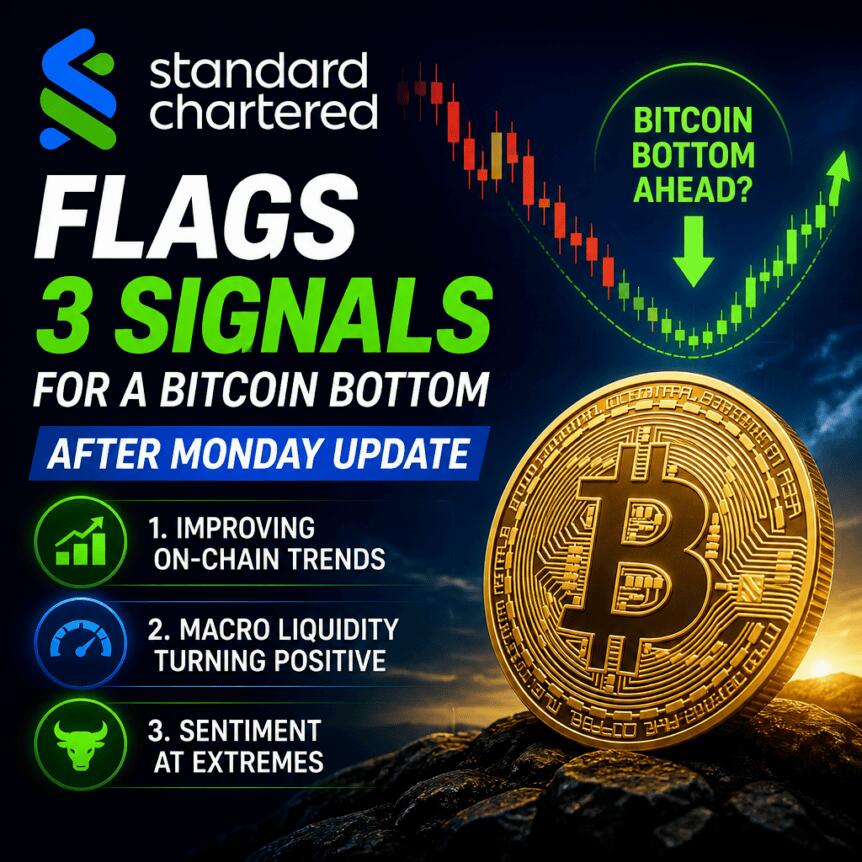
Standard Chartered’s Geoff Kendrick said he believes crypto prices have already traced the low for the current cycle, and he outlined three signals he wants to see to confirm that view. In a note to clients on Friday, Kendrick pointed to Strategy’s latest Bitcoin buying, renewed demand for US-listed Bitcoin exchange-traded funds (ETFs), and continued weakness in oil prices.
Kendrick anchored his assessment around Bitcoin’s drawdown from its prior peak, stating that the cycle low would correspond to roughly $59,000 for BTC, about 53% below a $126,000 high. CoinMarketCap data cited in the note showed Bitcoin trading around $63,704 at its last update on Sunday.
Key takeaways
- Geoff Kendrick (Standard Chartered) says crypto has likely already bottomed, tying the call to market and macro confirmation.
- Strategy’s reported Bitcoin purchases are presented as one of the three indicators that would support a bottom.
- SoSoValue data shows Friday’s Bitcoin ETF activity with $85.84 million in one-day net inflows.
- Crude oil weakness is included as a macro backdrop indicator, with futures falling for a second straight day on Friday.
- Kendrick’s “winter is over” framing depends on whether the ETF flows and macro trend persist.
Why Standard Chartered thinks the cycle low may be in
In his Friday client note, Kendrick argued that the market has already reached the low and that the next step is confirmation across multiple dimensions—positioning within crypto, how traditional investors are expressing demand, and whether broader risk appetite is supported by easing energy prices.
To him, the setup is reinforced by three developments happening around the same time. First, Strategy reportedly added to its Bitcoin holdings “last week,” a move that would signal continued institutional-like accumulation even after a sharp decline. Second, Kendrick highlighted Friday’s net inflows into Bitcoin ETFs, using data tracked by SoSoValue.com. Third, he linked the crypto outlook to crude oil futures, which were falling for a second straight day, citing Yahoo Finance data.
That combination matters because a “bottom” call in crypto tends to be fragile without evidence that demand is returning and that broader macro conditions aren’t worsening. Kendrick’s framework is essentially a checklist aimed at reducing the chances that the market’s lowest point is merely a pause before another leg down.
Bitcoin ETFs turn positive on Friday inflows
One of Kendrick’s most concrete inputs is the flow data from US Bitcoin ETFs. According to SoSoValue.com, Bitcoin ETFs recorded $85.84 million in one-day net inflows on Friday. Kendrick’s note further specified that investors directed capital into five funds, while eight of the ETFs saw no net change on the day.
While ETF inflows alone cannot prove a market bottom, they can serve as a useful proxy for whether mainstream allocation is restarting after a period of hesitation. For traders, ETF flow patterns are often watched for signs that dips are being actively bought rather than simply endured. For longer-term investors, sustained inflows tend to be read as a shift in willingness to hold Bitcoin exposure through regulated wrappers.
Still, the signal is time-sensitive: Kendrick’s thesis explicitly leans on confirmation. If subsequent days show continued inflow strength, it would fit his “cycle low” narrative; if inflows fade quickly, it may suggest Friday was more an interruption than a turning point.
Strategy keeps adding—despite its “sell” reality
Kendrick’s first indicator is also tied to Strategy, the corporate Bitcoin buyer most closely associated with CEO Michael Saylor’s public messaging. The note referenced Strategy’s reported additional Bitcoin purchase and framed it as part of the confirmation process for a bottom.
The background to this matters because Strategy’s Bitcoin strategy has been the subject of debate since it disclosed a first reported Bitcoin sale since 2022. In a June 1 filing with the US Securities and Exchange Commission, the company disclosed that it offloaded 32 BTC, a move that ran counter to the firm’s long-running “never sell your Bitcoin” messaging associated with Saylor.
Coverage from Cointelegraph described how Saylor defended the sale as necessary for Strategy’s “digital credit” model. At the BTC Prague conference, he argued that limiting the company to a “won’t sell the Bitcoin” policy could undermine the value of credit instruments issued against that treasury.
The core point attributed to Saylor was that Bitcoin treasury companies must retain the ability to sell holdings when necessary to support dividend-paying securities and other BTC-backed credit products. That explanation helps reconcile the apparent tension between rhetorical commitment to holding and the practical flexibility required to operate a credit business.
For investors tracking Kendrick’s view, Strategy’s behavior is a key variable: continued buying supports the notion that conviction remains even if prices have fallen. But readers should also recognize that the firm’s structure and financing strategy can still include transactions that are not perfectly aligned with an “only accumulate” storyline.
Macro check: oil weakness as a risk backdrop
Kendrick also tied his outlook to macro conditions, specifically the direction of oil prices. In his note, he cited that crude oil futures fell on Friday for the second straight day, based on Yahoo Finance data.
That choice reflects a broader pattern in market analysis: when energy prices cool, it can ease cost pressures and potentially improve risk sentiment, especially for assets that have historically behaved like higher-volatility bets. If crude continues to trend downward while crypto demand indicators—such as ETF inflows—remain supportive, Kendrick’s “confirmation” logic becomes more convincing.
Conversely, if oil rebounds sharply or if macro stress reappears, the bottom thesis would face a stronger challenge, regardless of one-off improvements in crypto-specific demand.
Investors watching this next should focus on whether ETF inflows persist beyond Friday and whether Strategy’s purchasing trend continues, while also tracking whether oil’s decline holds up. Kendrick’s “winter is over” framing is ultimately a conditional call—confirmation will come from consistency across both crypto and macro signals.
This article was originally published as Standard Chartered Flags 3 Signals for a Bitcoin Bottom After Monday Update on Crypto Breaking News – your trusted source for crypto news, Bitcoin news, and blockchain updates.
0
0


 Manage all your crypto, NFT and DeFi from one place
Securely connect the portfolio you’re using to start.


