
INK Token Mining End Confirmed: Price Prediction and Listing Outlook

0
0
The cPen Network INK token has been running its mobile mining experiment for over three years. First came $CPEN, then came exchange listings, then came the next chapter.
$INK is that next chapter, and its mining window is about to close for good.
What cPen Network Built After CPEN
cPen Network launched as a mobile-first blockchain project in May 2023 with a simple pitch: anyone with a smartphone should be able to mine digital currency without expensive hardware or heavy energy costs.
The first mining phase produced $CPEN, which was distributed to verified community members and listed on exchanges, including BitMart, in April 2025.
After $CPEN mining concluded, the team introduced the $INK as a secondary utility token within the cPen app.
Where $CPEN handles governance and staking, this utility token is designed for in-app transactions, platform features, and active user rewards.
It is earned through daily engagement rather than sold through a presale, and the project currently claims over one million KYC-verified miners in its community.
INK Token Tokenomics Breakdown
The INK token total supply follows a community-first model with zero presale allocation, meaning the entire supply enters circulation through mining rewards, community incentives, and ecosystem participation rather than early investor rounds.
| Category | Allocation |
|---|---|
| Community Mining | 70% |
| Treasury | 12% |
| Team (locked) | 10% |
| Ecosystem (locked) | 8% |
Team and ecosystem portions carry a 2% TGE release, followed by 2% per 30-day vesting cycle, limiting insider sell pressure and aligning long-term incentives with community rewards for holders.
INK Token Mining Ends July 30: What Happens Next
The cPen Network has officially confirmed that the token's mining phase closes on July 30, 2026. After that date, no new tokens can be earned through the daily mine mechanic.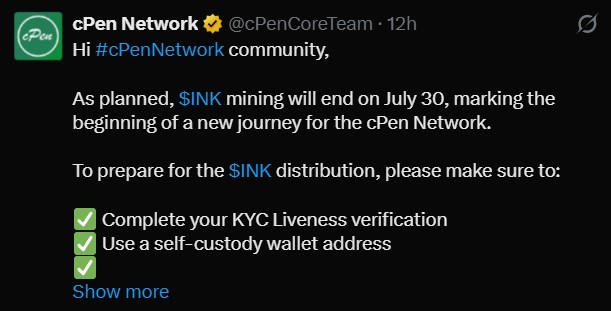
The INK token mining deadline triggers a specific distribution sequence. Miners must complete KYC verification through the liveness check system before the deadline.
A two-week grace period opens after July 30 for anyone who has not yet done this.
Once that window closes, the team runs verification across the full user base. After verification clears, tokens distribute directly to self-custody wallets ahead of the planned DEX listing.
Critical Wallet Requirement
Tokens will only distribute to decentralized wallet addresses such as MetaMask or Trust Wallet.
Centralized exchange deposit addresses are not eligible. Anyone submitting a CEX address risks missing their allocation entirely.
How cPen Sustains Value After Mining Ends
What separates cPen from most mobile mining projects is how it funds ongoing token value after it closes. Three mechanisms work together rather than relying on speculation alone.
Ad revenue generated through the cPen app flows into a public buyback wallet on Binance Smart Chain (BSC).
A quarterly burn mechanism runs on this smart contract: accumulated funds buy $CPEN from the open market and destroy it permanently on-chain
The inaugural quarterly burn in April 2026 eliminated approximately 266 million $CPEN in a single verifiable transaction, reducing circulating supply in a way any Web3 user can confirm on BscScan.
Burnchase and Chasepot Explained
Burnchase lets users voluntarily destroy tokens to earn platform credits called Dan. Each burn mechanism transaction splits 70% to permanent token burn, 20% to the referring ambassador, and 10% into the Chase Pot prize pool.
Chasepot is a free weekly lottery for active KYC-verified miners, funded by ad revenue and Burnchase contributions, using Chainlink VRF for provably fair draws.
It is currently paused during distribution preparations and expected to resume post-listing.
INK Token Price Prediction 2026
No confirmed exchange or listing date exists yet. Distribution completes first, with listing expected in the weeks after verification wraps up. Using August 2026 as a working estimate, three outcomes are worth weighing.
In a cautious outcome, the scale of the miner base creates heavy sell pressure the moment the token hits any exchange.
With over one million potential sellers and no confirmed major exchange, it could open at low fractions of a cent and struggle to hold without immediate in-app demand driving buys.
In a middle outcome, distribution completes cleanly, a mid-tier exchange picks up the pair, and Burnchase creates visible deflationary pressure.
Long-term miners hold rather than sell, Chasepot resumes and drives recurring engagement, and $INK finds a stable early range above its opening price.
The Bull Case for INK Token
In a stronger outcome, a recognizable exchange confirms the listing, broader crypto market momentum in late 2026 supports new launches, and the revenue-backed buyback model attracts buyers beyond the existing community.
That scenario could push $INK meaningfully above its opening price as the sustainable closed-loop economy narrative gains traction.
Expert View
Analysts tracking the cPen Network note that this token enters its listing phase with structural advantages most mining projects never built: a human-verified user base, on-chain revenue-funded burns, and a deflationary burn-chase loop that rewards participation.
The key risk is distribution scale. One million wallets receiving coins simultaneously creates selling conditions no sustainability mechanism fully offsets in the short term.
The listing venue quality and how quickly Chasepot resumes will determine whether early price action stabilizes or spirals.
Better structure than average does not guarantee price performance when a million wallets unlock on the same day.
Disclaimer: This article is for informational purposes only and does not constitute financial or investment advice. Cryptocurrency investments carry significant risk. Always conduct independent research before making any financial decisions.
0
0
 Gestisci cripto, NFT e DeFi in un unico luogo
Connetti in sicurezza il portafoglio che usi per iniziare.