
Solana (SOL) 101 Guide: Go From Beginner to Expert in Minutes

0
0
Solana is a popular decentralized blockchain platform in the cryptocurrency industry. Known for high performance and speed, this innovative network has garnered significant attention in the market over the years.
With high growth potential and low transaction fees, Solana serves as a suitable investment option for users, traders, and Non-Fungible Tokens (NFTs) collectors. Its high scalability feature also provides an attractive platform for developers to build Decentralized Applications (dApps).
As a crypto enthusiast ready to become a Solana expert in a few minutes, this article is for you. It is a detailed resource for everything you need to know about the blockchain network and its native cryptocurrency, SOL.
What is Solana?
Solana is a high-performance decentralized blockchain network designed to provide smart contract functionality and scale transactions with low cost. It is an open-source layer one blockchain built to host Decentralized Finance (DeFi) applications and NFTs.
Solana is highly scalable because it can process fast transactions with significantly lower fees. It is sometimes referred to as a third-generation blockchain. This is because Solana addresses some of the limitations involving scalability and transaction costs that earlier generations still have.
In this context, the first-generation blockchain is Bitcoin (BTC), and the second-generation blockchain is Ethereum (Ether). Another blockchain network described as third-generation is Cardano (ADA). It is more energy-efficient and environmentally friendly, thereby tackling the challenge of high power consumption
Brief History
Solana’s history can be traced back to November 2017, when former Qualcomm engineer Anatoly Yakovenko published the project’s whitepaper draft. For context, a cryptocurrency whitepaper is a document that contains key information about a specific blockchain network or cryptocurrency.
The document provides a detailed preview of a crypto project, including its technical and economic aspects. It describes its goals and the problems that it will solve. Technical terms are also explained concisely to help readers gain a clear understanding.
A whitepaper is not a one-size-fits-all document. Every whitepaper is different because every cryptocurrency has distinct features. For instance, no two cryptocurrencies can have the same name and native asset. So, it is usually one whitepaper for one cryptocurrency, except for Cardano, which does not have a single, traditional whitepaper.
Now, back to Solana.
The whitepaper explained the intricacies of the unique Proof-of-History (PoH) consensus model. Then, in 2018, Anatoly Yakovenko teamed up with other engineers to officially establish a technology company named Solana Labs.
Solana Labs is based in San Francisco, California, and is largely responsible for the ongoing development of the Solana blockchain. At the time of writing, Anatoly Yakovenko is the Chief Executive Officer (CEO), while Raj Gokal is the Chief Operating Officer (COO).
Solana’s mainnet network went live in March 2020. The Solana Foundation, based in Zug, Switzerland, was also founded in that year to support the ecosystem. Since then, the ecosystem has experienced continuous expansion, courtesy of Solana Labs and the Solana Foundation.
Did you know?
The project was initially given the name Loom but later changed to Solana. This was because another project named Loom Network already existed.
What Happened to Solana in 2022?
The year 2022 was quite a challenging year for Solana. First, the network experienced multiple outages at different times, which raised concerns about its reliability and stability. Then, in November 2022, cryptocurrency exchange FTX suffered a total collapse due to fraud.
This development dealt a huge blow to Solana. Why?
FTX and Alameda Research, its sister company, launched projects on Solana. An example is Serum, a decentralized exchange (DEX) software. Additionally, they had early investments in Solana-based projects and held large amounts of SOL. Thus, FTX’s collapse had a negative effect on SOL’s market value, causing it to fall sharply.
Partnerships
Solana has established strategic partnerships to fuel its growth. Here are two recent ones.
- Astra Fintech: In April 2025, blockchain infrastructure and fintech service provider Astra Fintech launched a $100 million fund. This fund was dedicated to accelerating growth and innovation within the Solana ecosystem.
- Dubai’s Virtual Assets Regulatory Authority (VARA): In June 2025, the Solana Foundation partnered with Dubai’s VARA to facilitate the blockchain’s adoption.
Market Capitalization of Solana
Market capitalization, also known as market cap, is a metric used to calculate the total value of a crypto asset. You can also describe it as the total dollar value of a crypto asset based on its circulating supply.
This is an important part of crypto analysis. For a clearer understanding, consider this:
The market price of a crypto asset alone cannot provide you with a detailed description of its value. To get a complete picture, you also need its market capitalization. Notably, market cap is usually unstable because crypto prices fluctuate due to market volatility.
To get the market capitalization of a particular crypto asset, multiply its circulating supply by its current market price. Mathematically, the formula for calculating it is:
Market Capitalization = Circulating Supply × Current Market Price/Value
At the time of writing, Solana’s market cap stands at $112,446,615,653 according to on-chain data from CoinGecko. This figure is derived from a market price of approximately $207 and a circulating supply of 541,884,646 coins.
Key Features
Explained below are some of Solana’s notable features that optimize its performance and make the blockchain to stand out in the competitive crypto market.
Scalability and Speed
The Solana blockchain is known to process tens of thousands of transactions per second (TPS). Data from Solscan reveals that the Solana network handles an average of 3500 TPS under normal circumstances. This is quite fast compared to other networks.
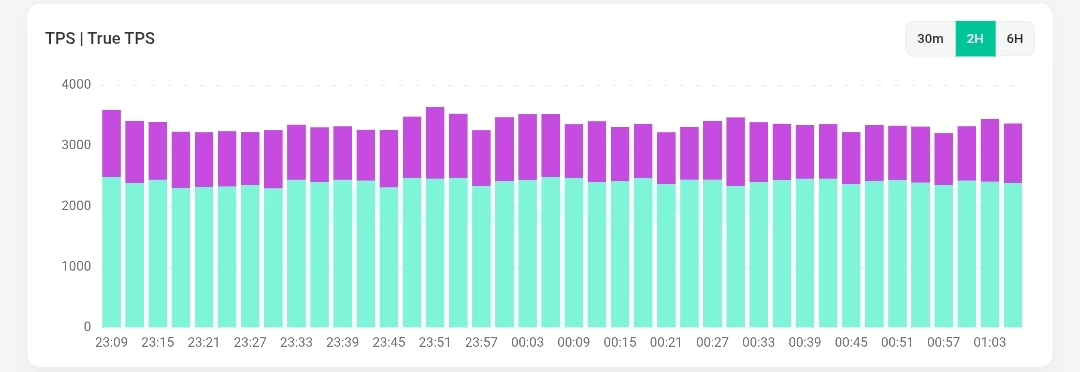
However, a Solana developer conducted an eye-catching experiment to prove that under certain conditions, the blockchain can process even faster transactions. In that experiment, the Cavey Cool validator was able to process a total of 104,562 transactions in four blocks. This pointed out that Solana’s mainnet has the potential to handle hundreds of thousands of transactions. This is an incredible show of speed and scalability.
Low Transaction Cost
Solana’s low transaction fees are significantly lower when compared to what is obtainable on other blockchain networks. Notably, these fees remain low even when there is an influx of transactions that lead to traffic congestion. This is an important feature that makes Solana attractive to active users, especially developers and traders.
Solana Memecoins
Solana memecoins can be described as a unique set of memecoins built on the layer one blockchain. What, though, are memecoins?
As the name implies, memecoins are crypto projects or assets that originate from internet culture, community engagement, trends, humor or memes. They gain rapid popularity from social media platforms such as X and Discord. This popularity leads to massive traction and recognition that declines with time.
Unlike other cryptocurrencies, memecoins generally possess no substantial value or real utility. They are mostly driven by market hype.
In the cryptocurrency space, Solana’s unique features create an ideal environment for memecoin development. The blockchain has experienced tremendous growth over the years since its launch. This large user adoption is a key factor considering the community driven nature of memecoins.
Being a leading blockchain network, Solana has also proven to be a viable option due to the existence of PumpdotFun. PumpdotFun is a Solana-based memecoin generator or launchpad that makes token creation on the platform quick, easy and highly accessible.
Top Solana Memecoins
- Bonk (BONK)
BONK, Solana’s most popular memecoin, was launched on December 25, 2022, with a massive airdrop. It is a dog-themed token that features the image of a cute dog as its logo. The token was inspired by the original “BONK” meme, where a dog character, Cheems, was bonked on the head.
The memecoin has a maximum supply of 100 trillion tokens with over 77 trillion in circulation at the time of writing. At the core of BONK’s unique features is the burning mechanism. Each time a BONK transaction is processed on the blockchain, a certain percentage of the token’s supply is permanently removed from circulation. Consequently, this approach gradually reduces the token’s total and circulatory supply and encourages BONK users to hold rather than sell. This might lead to future growth and a stronger market value.
- Dogwifhat (WIF)
Dogwifhat (WIF) is a community-driven Solana-based memecoin featuring a viral Shiba Inu dog wearing a distinctive pink knitted hat. Further emphasizing its simple, humor-oriented nature, the name WIF is an intentional misspelled version of the word with.
The WIF token was launched in late 2023. Despite its opportunity to leverage Solana’s advanced features, it does not employ the burning mechanism or staking. Unlike Bonk, Dogwifhat relies solely on community engagement, viral content and hype for sustenance.
- Popcat (POPCAT)
POPCAT is an animal-inspired memecoin launched on Solana in 2023. It features a domestic short-haired cat named Oatmeal. The token leverages Solana’s high speed and low cost characteristics. This enables instant and cost-effective POPCAT transactions.
- TROLL (TROLL)
TROLL is a memecoin inspired by the iconic self-mocking Trollface meme, which has become synonymous with internet mischief. It has a maximum supply of one billion tokens with zero intrinsic value.
- Pudgy Penguins (PENGU)
Launched in 2024, PENGU is a Solana memecoin with a strong connection to the Pudgy Penguins NFT collection. To learn more about PENGU, read this detailed article published on CoinTab.
Solana Pay
Solana Pay is an open, free-to-use payments framework designed to enable seamless commerce on the Solana blockchain. Built on Solana, this payment solution is of special benefit to developers and merchants. It allows them to integrate decentralized payments devoid of third-party involvement into their apps and services.
Crypto wallets that support Solana Pay include Phantom, Solflare, Decaf Wallet, Glow, Tiplink, and Espresso Cash. Entities such as Circle, CandyPay, Sphere, Kitepay, Ottr Finance, and others also back the initiative.
The payment platform enables fast transactions and near-zero gas fees. This allows businesses to utilize decentralized payments at the same speed as traditional payment networks with a direct merchant-to-consumer payment rail.
Developers can integrate Solana Pay into their applications by simply using the JavaScript SDK. Users can also use Solana Pay on Shopify. This is an e-commerce platform designed to help business owners scale their business and sell their products online.
Solana Seeker
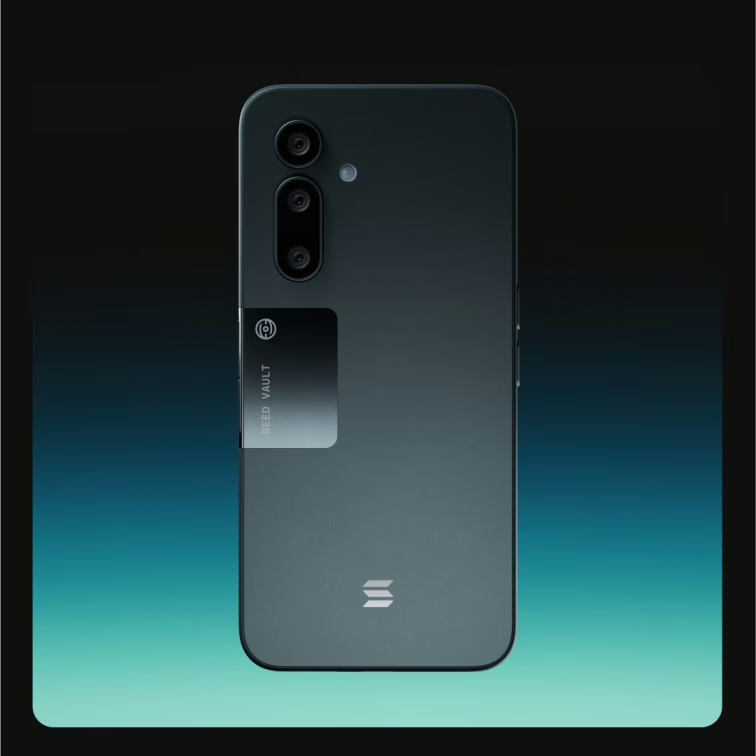
Solana Seeker is a Web3 smartphone built on Android by Solana Mobile to enhance access to the decentralized web. This definitive mobile device was designed to enable seamless interaction with blockchain-based applications and other Web3 features.
Solana Seeker underwent testing in early 2025. According to the official announcement, the Android device was released on August 4, 2025. On that day, tens of thousands of the product were sent out to users in over 50 countries.
Solana Seeker is referred to as the second-generation Solana phone because it poses as an improved version of Solana Saga.
Solana Saga?
Yes, Solana Saga is the first-generation Solana phone. To gain a full understanding, let us first delve briefly into Solana Mobile.
Solana Mobile is a mobile technology company and the subsidiary company of Solana Labs, the organization behind the Solana blockchain. Focused on integrating Web3 functionality into smartphones, it currently has two flagship phones: Solana Saga and Solana Seeker.
These Solana crypto phones have blockchain technology integrated into their operating systems. This makes it easier and safer for both beginner and expert users to explore crypto assets and manage decentralized applications.
Solana Saga was launched in 2023 with a 6.67-inch OLED display, 12GB RAM, and 512GB ROM. It features seed vault security for private keys and seed phrases, as well as the Solana Mobile Stack (SMS). It also has an app store for dApps and an in-built capacity to mint NFTs and trade cryptocurrencies seamlessly.
Solana Seeker’s Key Features
- Seed Vault Wallet
Powered by Solflare, the Seed Vault Wallet is a secure, hardware-backed mobile wallet integrated into Solana Seeker. It ensures security by hiding or protecting the users’ private keys and seed phrases. It also enables the use of fingerprints and double-tap actions on the device, ensuring secure and seamless on-chain transactions.
- Seeker Genesis Token
Each Solana Seeker device generates a unique Genesis Token upon setup. The goal is to ensure that future Solana mobile airdrops continue to benefit the device owner. This, in turn, provides the user with a long-term value that extends beyond the initial purchase.
- Seeker ID
This feature combines your wallet address, username, and Genesis Token into one simple, user-friendly ID in this format username.skr.
- Solana dApp Store 2.0
This is an inbuilt decentralized app ecosystem used to facilitate payments, DeFi, AI, DePIN, NFTs, gaming activities exclusive to Solana. It also erases traditional app store fees.
- SKR Token
The SKR token is the native asset that powers Solana Mobile’s economy. It is used to facilitate incentives, rewards and ownership within the ecosystem.
How Does Solana Work?
Solana operates using a unique hybrid consensus model. This combines both the Proof-of-Stake (PoS) and Proof-of-History (PoH) mechanisms. This is the first of its kind in blockchain technology because Solana is the first blockchain to leverage both algorithms.
The Proof-of-Stake algorithm uses validators to confirm new blocks of transactions, add them to the blockchain, and receive rewards in return. Proof-of History, however, takes a different approach. It first uses a cryptographic clock to create a hashed timestamp for each block. Then, it uses a Verifiable Delay Function (VDF) to prove that the timestamp was generated in a certain amount of time.
Solana Validator
A Solana validator is a specialized node within the blockchain. It is responsible for processing transactions and ensuring the network’s security. Data from the project’s official website reveal that there are over 1000 independent validators globally.
Solana validators are chosen at random from the validation pool. However, the probability of selection might increase based on the amount of staked crypto. For context, crypto staking generally means to lock or pledge some crypto to the blockchain.
What Makes Solana Unique?
Solana’s novel approach to consensus sets the blockchain apart. It leverages both PoS and PoH to ensure high scalability and speed. Additionally, Solana is home to a wide variety of dApps with minimal transaction costs.
What is SOL?
SOL is Solana’s native cryptocurrency. It has an initial total supply of 500 million coins.
What is SOL Used For?
- Transaction fees
Investors use their SOL coins to pay transaction fees when they perform transactions on the blockchain.
- Staking and rewards
SOL users can participate in the network’s Proof-of-Stake consensus mechanism and contribute to the network’s security by staking their coins. Validators responsible for confirming and adding new blocks of transactions can also earn rewards in the form of extra SOL.
- Investment
SOL coins are a viable investment option for individuals seeking to grow their financial portfolio. The crypto asset has seen tremendous growth over the years and has potential for future growth. To that effect, users may buy SOL with the anticipation that the market value will increase with the passage of time.
SOL can also be exchanged for fiat currency or another cryptocurrency on a crypto wallet or exchange.
How to Buy Solana (SOL)
You can buy Solana (SOL) on various cryptocurrency trading platforms that support the asset. This includes both centralized and decentralized platforms.
Below is a list of popular options you can choose from:
- Binance
- Bitget
- Coinbase
- Komodo Wallet
- Bybit
- OKX
- MEXC
- WEEX
- KuCoin
- Kraken
- Bitstamp
- Metal X
Here are the steps you can take to buy Solana (SOL) on Binance:
- First, open an account on the Binance app or website and complete the required identification verification process. The information you need to provide for this include your phone number, email address or Google/Apple account.
If you already have a Binance account, skip this step.
- Next, navigate to purchase SOL and choose your payment method on the platform. You can fund your account with fiat currency like USD using a credit or debit card. You can also choose to buy a stablecoin first and then use it to buy SOL. Still, if you are an existing Binance user, you can trade another cryptocurrency with Solana on the platform.
- After that, place your order. Enter the destination crypto address and the amount of SOL you want. Make sure the figures are correct.
- Next, confirm your transaction.
- Finally, transfer your crypto to a wallet like Trust Wallet or hold it in your Binance account. You can also trade your assets on the exchange.
How to Sell Solana (SOL)
You can sell Solana (SOL) on various trading platforms that support the cryptocurrency. To sell SOL on Binance, follow these steps:
- First, open your Binance account and navigate to the Trade section.
- Next, select Buy/Sell and click on Sell.
- Then, enter the amount of SOL you want to sell from your available balance.
- After that, select the available payment method and choose the channel or account to receive the payment.
- Finally, confirm your transaction.
Solana (SOL) Price Prediction 2025, 2026, 2027
According to data from CoinGecko, SOL reached a record high of $293.31 on January 19, 2025. It then dropped to around $106 in April 2025. However, the coin has since rebounded and surpassed $200 at the time of writing.
Asset manager VanEck believes that SOL could reach $520 at the end of 2025. They expect that Solana will gain a bigger share of the smart contract market and rise from 15% to 22%. The prediction also suggested that SOL could reach a $250 billion market capitalization before the end of 2025. With around 486 million tokens circulating, that points to a $520 price.
Another outlook comes from a Bitget crypto analyst who predicts that SOL will rise to $305 before 2025 ends. Looking ahead, the exchange’s analyst expects SOL to reach $321 in 2026 and $337 in 2027.
Top Solana Decentralized Applications
Due to its speed and flexible nature, Solana is a suitable host for many decentralized applications.
- Jupiter: Jupiter is arguably the largest DeFi product on Solana. The platform includes a suite of tools such as swaps, perpetuals, lending, portfolio aggregator, and much more
- Raydium: Raydium is an automated market maker or AMM on Solana. It helps provide liquidity and gives users opportunities to earn from their tokens.
- Serum: This is a decentralized exchange (DEX) where users can trade with low fees using an order-book system.
- Magic Eden: Magic Eden is an NFT marketplace. This tool enables artists and collectors to trade NFTs with low cost and an efficient manner.
- Star Atlas: Solana decentralized applications go beyond trading and NFTs. The blockchain also accommodates gaming platforms such as Star Atlas. This immersive, blockchain-based game leverages Solana’s fast network and allows players to trade in-game items for cryptocurrency.
Decentralized applications show off Solana’s capability to handle quick and reliable transactions at low costs. This makes the ever-growing ecosystem an attractive platform for developers and users.
Use Cases of Solana
Solana’s unique features make the blockchain attractive to different users. Let us now explore some of Solana’s use cases.
- Decentralized Finance (DeFi): Solana powers platforms for DeFi activities such as lending, borrowing, and swapping tokens. Transactions are executed almost instantly, making it easy for people to access decentralized financial services without delay. All these are done at little cost.
- NFTs and Digital Collectibles: NFT projects also benefit from Solana’s low fees. Artists and collectors can mint, buy and sell digital collectibles without worrying about high transaction costs. This makes Solana an attractive platform for creators who want to reach a wide audience affordably.
- Blockchain Gaming: Web3 gaming platforms leverage Solana’s speed for real-time gameplay and in-game economies. For example, Star Atlas enables players to interact seamlessly in immersive, blockchain-powered worlds. Fast transactions make gaming experiences smoother and more enjoyable.
- Enterprise Applications: Businesses can use Solana to track supply chains and payments and secure data. Its fast and reliable network reduces delays and ensures accurate records. As such, Solana’s efficiency opens the door for practical, real-world enterprise solutions.
- Web3 Social Media: Some Web3 social media platforms run on Solana, letting users share content on decentralized networks. This approach gives more control to users and reduces dependence on traditional platforms.
Solana Clusters
Solana clusters are networks of validators that run different environments of the Solana blockchain. In simpler words, clusters are like separate playgrounds that are used for testing, developing, and using Solana safely.
There are three main Solana clusters and each of them serve different purposes.
- Mainnet Beta is the live network where real transactions are processed with SOL tokens that have real value.
- Testnet, as the name implies, allows developers to try out or test new features before they go live.
- Devnet is used to experiment with tools without using real SOL tokens.
Understanding these clusters helps users and developers explore Solana safely, test applications and reduce risks when deploying new projects.
Solana Vs Ethereum
Solana (SOL) and Ethereum (ETH) are both popular blockchains but they work very differently.
Solana uses both PoS and PoH which allows the network to process thousands of transactions every second with very low fees. Although Ethereum is a highly decentralized and widely used blockchain, it uses only PoS. As a result, it is slower when compared to Solana with gas fees usually increasing during busy periods.
Ethereum also has more dApps and a more mature DeFi ecosystem than Solana. It prioritizes security and decentralization while Solana focuses on speed and efficiency. Both blockchains have unique strengths depending on the needs of the users and developers.
Solana Vs Bitcoin
Have you ever wondered why Bitcoin moves slowly compared to other blockchains like Solana? This is because in the cryptocurrency world, Solana and Bitcoin serve very different purposes.
Often referred to as digital gold, bitcoin (BTC) is mainly used as a decentralized store of value. Solana, by contrast, is a platform for building applications, supporting smart contracts, dApps, and NFTs with fast, efficient processing.
As earlier mentioned, Solana can handle tens of thousands of transactions per second (TPS) while Bitcoin processes an average of seven. Bitcoin uses PoW which consumes a lot of energy. Solana, on the other hand, relies on PoH and PoS, making it faster and more energy-efficient.
Bitcoin is ideal for long-term investment while Solana works best for active use in DeFi, gaming and Web3 applications.
Solana Staking Explained
To stake on Solana means to lock your SOL with validators to support the network and maintain its security. Validators are nodes that confirm transactions and maintain blockchain integrity.
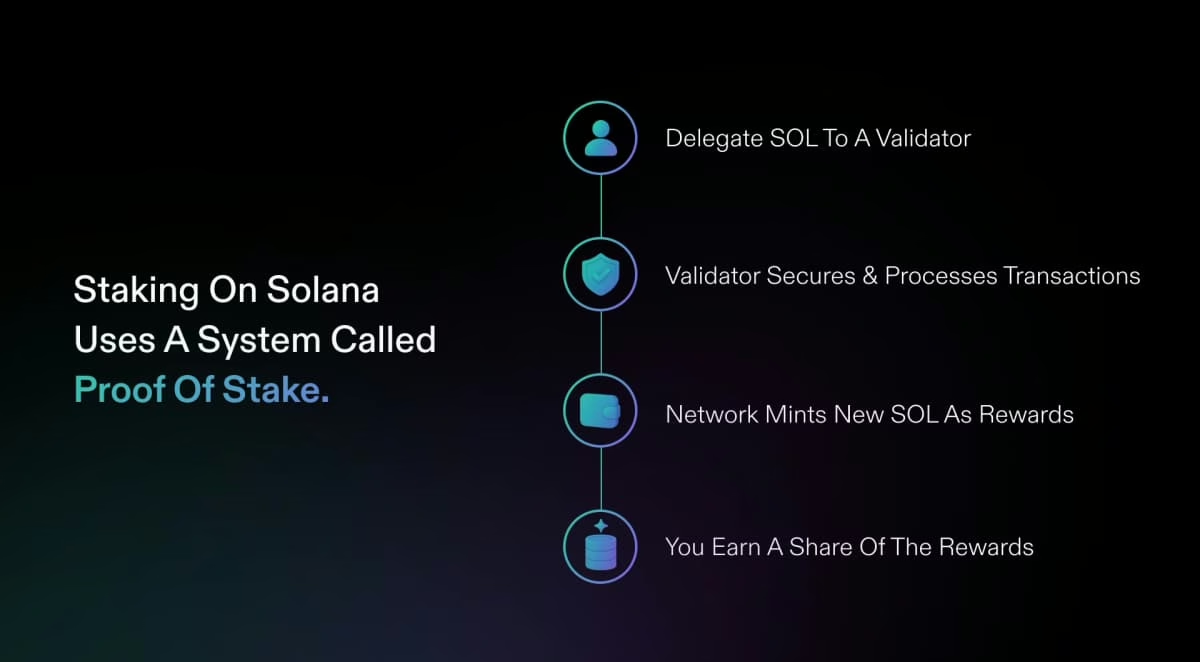
Users earn incentives or rewards in the form of extra tokens when they stake their SOL. They also enjoy additional benefits because staking allows SOL holders to take part in the network’s governance.
How To Stake Solana
Here are some simple steps to follow to stake Solana (SOL):
- First, choose a wallet that supports Solana, such as Phantom or Solflare.
- Next, transfer your SOL tokens into the wallet.
- Then, choose your preferred Solana validator.
- Next, follow the wallet’s staking instructions, which may include confirming the amount of SOL you want to stake and your preferred validator. Over time, you will start earning staking rewards.
You can also unstake your SOL, but it may take a few days for your tokens to become fully available again. If you do not want to use this option, you can learn about liquid staking. This method gives you a token that represents your staked SOL, which you can then use to explore DeFi products on Solana.
What is a Solana Wallet?
A Solana wallet is a digital tool used for storing, trading, swapping, sending, receiving and staking SOL on the blockchain. Acting as a gateway to the Solana ecosystem, it is essential for using dApps, NFTs, and DeFi platforms.
Popular Solana wallets include (but are not limited to) Phantom, Solflare, Binance and Ledger, each offering different security features.
Solana Swap, Everything You Should Know
Solana Swap is a Decentralized Exchange (DEX) aggregator operating on the Solana blockchain and powered by Artificial Intelligence (AI). It was designed to help users execute trades directly from their decentralized wallets without third-party involvement.
This tool uses an Automated Market Maker (AMM) model. Leveraging Solana’s high throughput and low transaction fees, it provides users with an efficient platform to swap digital assets within the ecosystem.
Types of Solana Wallets
Solana wallets are generally categorized into two types: hot wallets and cold wallets.
- Hot wallets: Also called online wallets or software wallets, hot wallets require internet access to function. They are suitable for frequent transactions and short-term storage. They come in the form of apps or programs that can be installed on your computer or mobile phone. They are very handy and convenient to use. However, they are not as safe as cold wallets.
- Cold wallets: Also referred to as hardware wallets, cold wallets are physical devices that store your private keys offline. They add an extra layer of protection to users’ digital assets because they do not require internet access. This is because they cannot be easily hacked.
Examples of Solana Wallets
- Solflare wallet: Solflare wallet is a specialized crypto wallet designed exclusively for the Solana blockchain. It is a mobile wallet that can be installed on both Android and iOS devices. Solflare is also a non-custodial wallet. This means that its users have full control over their private keys and investment funds.
- Phantom wallet: This is a non-custodial, multi-chain Web3 wallet available as a browser extension and mobile application for Android and iOS devices.
- Binance wallet: This is a non-custodial crypto wallet that offers a platform to trade various cryptocurrencies including Solana. The wallet can be accessed through its mobile application and website.
- Ledger: This is a hardware wallet that supports cryptocurrencies across multiple networks including Solana. The hardware device has different models including Ledger Flex, Ledger Stax and Ledger Nano range (X and S Plus).
Risks in Solana
Investing in Solana can be an exciting option for those seeking to diversify their financial portfolio. However, as with other cryptocurrencies, it is not without risks.
Here are some of the risks associated with Solana:
- Market volatility: Solana is characterized by price fluctuations due to high volatility. Thus, factors such as market hype and the overall market performance can affect the coin’s value. Additionally, the asset can experience sudden rises and falls in price, leading to financial losses if not well-managed.
- Regulatory challenges: Although the cryptocurrency space is decentralized, new regulations for digital assets evolve continually. As such, Solana could face legal challenges that might affect its price and user adoption in the future.
- Security breaches: In 2022, Solana reported a malicious attack that compromised more than 7,000 digital wallets, including those of Phantom and Slope. This shows that the project is not immune to security breaches and phishing attacks. Thus, to avoid losing your investment funds, you need to take steps to protect your crypto wallet. You should also learn how to report a cryptocurrency scam.
Frequently Asked Questions
- Who is Behind Solana?
Solana was built by Solana Labs, a company founded by Anatoly Yakovenko and other software engineers in 2018.
- How Much is 1 Solana in USD?
At the time of writing, Solana (SOL) is valued at approximately $238 per coin.
- Can I Mine Solana?
No, you cannot mine Solana.
Solana operates using a Proof-of-Stake (PoS) consensus mechanism where validators stake their coins to secure the network. Unlike Proof-of-Work (PoW), this algorithm requires no specialized mining hardware. In other words, PoS employs staking while PoW employs mining.
- Which wallet is best for Solana?
Before choosing a Solana wallet, you must consider some factors to pick one that best suits your needs.
First, you must choose a wallet that provides adequate security for your coins. Second, you must choose one that meets your investment needs; Solana-focused, multi-chain or hardware wallets. Convenience or security.
These factors will affect your choice. Thus, your preferred wallet is the best for your Solana coins provided you let thorough research guide you.
- Can I make money on Solana?
Yes, you can make money on Solana. Although you cannot mine SOL, you can still earn money on Solana in different ways.
For example, you can buy and hold some SOL for a long period of time and then sell when the market value appreciates. You can also participate in the network by staking or locking your coins to earn passive income. Additionally, you can engage in trading activities, that is, buying and selling SOL on a trading platform to make money.
- Is Solana an Ethereum Killer?
No, Solana is not an Ethereum killer.
Solana is often referred to as an Ethereum killer because it supercedes Ethereum in speed and energy efficiency. However, Anatoly Yakovenko disapproves of this description. According to his X post, he does not “see a future where solana thrives and somehow eth dies.”
- What is the Future of Solana?
Solana has experienced tremendous growth in the market since 2020. From upgrades and new products to accumulated market gains, the network’s efficiency positions it well for potential future growth.
However, Solana is a highly volatile project just like every other cryptocurrency. Hence, its future market action is highly unpredictable.
Final Thoughts
Solana is a fast and flexible blockchain network that supports a wide range of decentralized applications. It operates using both the PoS and PoH consensus mechanisms. Solana’s unique features, including low transaction fees, high speed, and scalability, sets it apart in the crypto space.
It is worth noting that Solana is a volatile asset. Therefore, users must do thorough research (DYOR) before investing and never invest more than they can afford to lose.
The post Solana (SOL) 101 Guide: Go From Beginner to Expert in Minutes appeared first on Cointab.
0
0

 Verwalten Sie alle Ihre Kryptowährungen, NFTs und DeFi an einem Ort
Verbinden Sie sicher das Portfolio, das Sie zu Beginn verwenden möchten.


0
0

0
0

0
0