
Ayni Gold vs Ondo Finance: Two Real-World Cash Flows

0
0
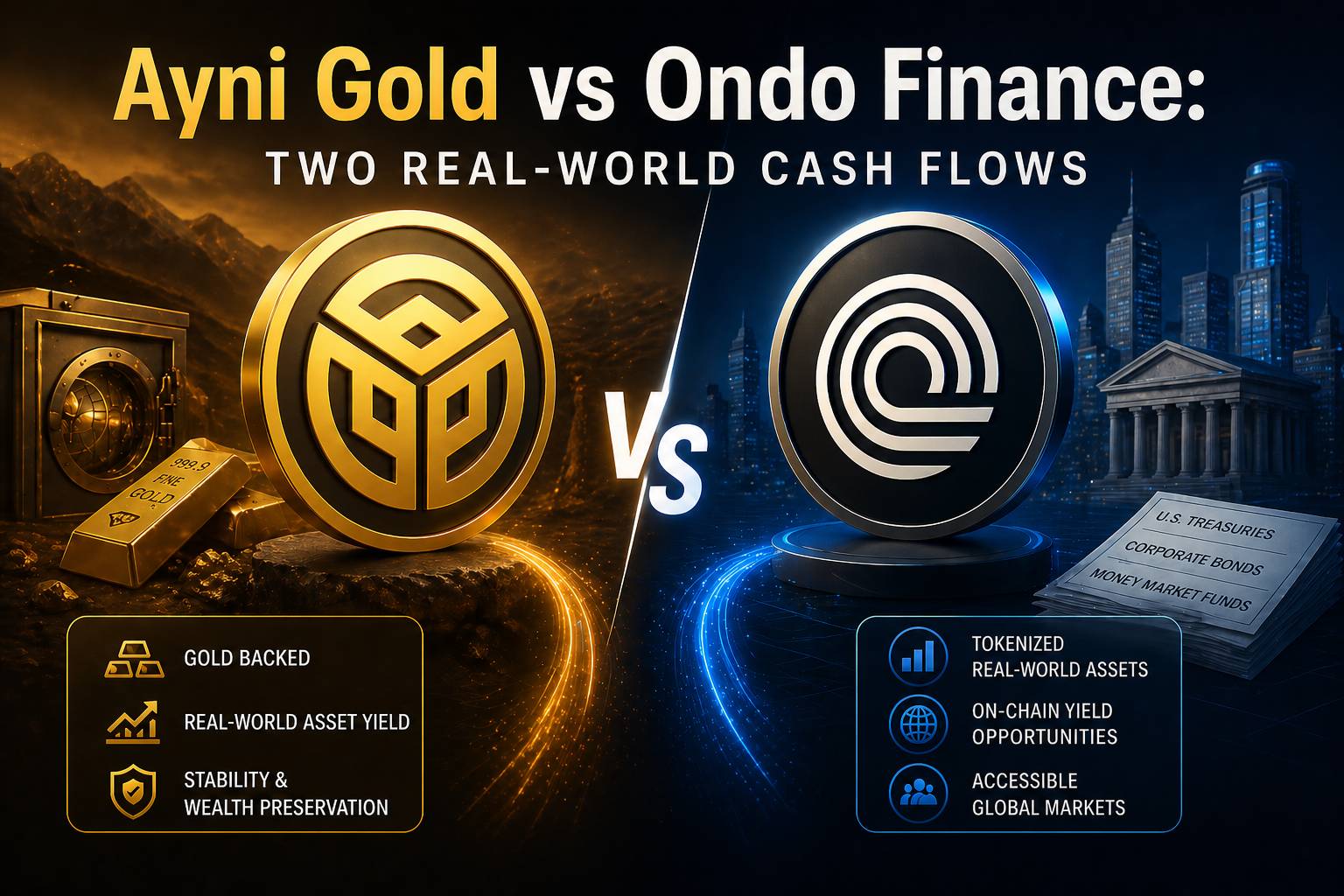
Real-world asset tokenization has stopped being a niche category. By April 2026, the broader RWA market crossed $58 billion in tokenized value, and on-chain yield products built on real-world cash flow have started competing for portfolio allocations once held in traditional finance.
Ondo Finance and Ayni Gold operate at opposite ends of that category. Ondo Finance tokenizes US Treasury yield anchored by partnerships with BlackRock, Franklin Templeton, and Wellington Management.
Ayni Gold tokenizes mining production at a Peruvian gold concession, paying quarterly PAXG rewards from extracted gold.
Both bring real-world cash flow on-chain. The mechanics could not be more different. This piece compares them on yield source and where each fits in a portfolio.
Government Cash Flow vs Operational Cash Flow
The two protocols share the real-world asset framing but tokenize fundamentally different cash flows.
-
Ondo's yield comes from short-term US Treasury bills and money market fund returns, channeled through institutional fund managers.
-
Ayni's yield comes from gold mining operations at a registered Peruvian concession, with rewards distributed in PAXG sourced from extracted gold.
One is sovereign debt; the other is commodity production. Both are real-world cash flows, but the underlying economic activity sits at completely different ends of the spectrum.
This contrast shapes everything that follows: who can access the products, where the risks come from, and how the yields behave across macro conditions.
Inside Ondo Finance
Ondo Finance was founded in 2021 by Nathan Allman, a former Goldman Sachs digital assets. The protocol brings institutional-grade Treasury yield on-chain while keeping the regulatory framework that traditional finance investors expect.
The platform operates two flagship products:
-
USDY: A tokenized note secured by short-term US Treasuries and bank demand deposits. Available to non-US holders. Pays approximately 3.69% APY in 2026.
-
OUSG: An institutional-grade Treasury fund structured as a 3(c)(7) fund under Regulation D Rule 506(c). Available only to qualified investors. Pays around 3.49% APY.
The OUSG portfolio invests across BlackRock (BUIDL fund), Franklin Templeton, Fidelity, WisdomTree, and Wellington Management, with USDC and bank deposits providing additional liquidity.
Currently, Ondo's combined TVL has passed the $3.5 billion mark. The regulatory profile also strengthened in late 2025.
The SEC closed its two-year investigation into Ondo without charges in November 2025, and the protocol acquired Oasis Pro Markets, an SEC-registered broker-dealer. Both moves cleared a path for accelerated US operations.
Inside Ayni Gold
Ayni Gold is a DeFi protocol that turns gold mining output into on-chain yield, with stakers receiving PAXG rewards quarterly from mining production at the Minerales San Hilario concession in Peru.
The protocol does not tokenize stored gold or government debt. It tokenizes operating mining capacity at a licensed concession.
Each AYNI token represents 4 cm³ per hour of processing capacity at the site, an 8 km² alluvial operation in Madre de Dios with two active concessions registered through INGEMMET.
Smart contracts have been audited by CertiK and PeckShield in October 2025. TurnKey handles institutional custody, and Kangari Consulting manages the geological assessments.
Settlement runs through Peru's banking system across four steps:
-
Extracted gold sells to local banks
-
Proceeds convert to fiat
-
Fiat buys PAXG via Paxos
-
PAXG distributes quarterly to staked AYNI proportionally
For investors evaluating PAXG yield staking as part of an RWA allocation, Ayni introduces exposure to a primary revenue source most tokenized assets cannot replicate.
How the Two Protocols Differ in Practice
The two protocols diverge across the dimensions that determine portfolio fit. Each subsection below covers one axis of that divergence.
Yield Source
Ondo's yield originates from short-term US Treasury bills and government money market funds. The cash flow tracks Federal Reserve policy and the broader interest rate environment. When rates rise, Ondo yields rise. When rates fall, yields compress.
Ayni's yield originates from physical gold extraction at a producing concession. The cash flow tracks operational variables: extraction volume and the local Peruvian gold market. Returns rise when production increases and tighten when output slows.
Risk Profile
Ondo carries minimal credit risk, since US Treasuries are considered among the lowest-risk assets globally.
The remaining risks sit in counterparty exposure to Ondo and the underlying fund managers, plus duration risk on the Treasury maturities. Smart contract risk applies but is structurally limited.
Ayni carries smart contract risk on the staking protocol itself, plus operational execution risk on the mining site.
Production volume and the broader Peruvian gold market both factor into yield outcomes. The verification stack reduces protocol risk but does not eliminate the operational variable.
Access Requirements
Ondo's flagship products carry meaningful access gates. OUSG is restricted to qualified institutional investors with a $5,000 minimum, KYC verification, and accredited status checks.
USDY is open to non-US retail holders, subject to KYC and a 40-50 day settlement window for new mints. Yield arrives through rebasing or NAV mechanics, depending on the product version.
Ayni operates as an open DeFi infrastructure. Staking AYNI requires only an on-chain wallet, with no KYC and no jurisdictional restrictions. Quarterly PAXG distributions arrive directly to staked positions.
Distribution Mechanics
Ondo's products accrue yield continuously, either through NAV appreciation (OUSG, USDY) or rebasing (rOUSG). Holders see returns reflected in token value or balance updates daily.
Ayni distributes quarterly. Stakers receive PAXG on a defined schedule instead of continuous accrual, which gives the position a different cash-flow shape. The yield is back-loaded to mining cycles, not smoothed across days.
Side-by-Side Snapshot
Dimension
Ondo Finance
Ayni Gold
Yield source
US Treasuries + money market funds
Gold mining production
Asset paid in
USDY, OUSG (USD-denominated)
PAXG (gold-backed)
2026 TVL
$3.5B+
Newer category
Backing
BlackRock BUIDL, Franklin Templeton, others
Operating Peruvian concession
Audit/attestation
Institutional fund managers
CertiK + PeckShield + Kangari Consulting
Access
Qualified investors (OUSG) or KYC + non-US (USDY)
Open DeFi access
Distribution
NAV accrual or rebasing
Quarterly PAXG distributions
Yield range
~3.49-3.69% APY
Variable, tied to mining output
How Each Fits a Real-World Yield Allocation
The decision between Ondo Finance and Ayni Gold comes down to which kind of cash flow fits the portfolio.
Ondo suits investors seeking a stable yield from a low-risk asset class with deep regulatory clarity. The yield tracks short-term US interest rates and benefits from BlackRock and Franklin Templeton's institutional plumbing.
Ayni Gold suits investors seeking non-correlated yield denominated in gold, with operational exposure to a producing mining concession. Returns come from physical extraction, sit outside the interest rate environment, and hedge against USD-denominated risk.
A portfolio holding both is also defensible. Ondo provides a USD-denominated stable yield on a larger allocation; Ayni adds gold backed crypto yield on a smaller one. The two cover different macro scenarios.
FAQ
What is the main difference between Ondo Finance and Ayni Gold?
Ondo Finance tokenizes US Treasury yield through products like USDY and OUSG, with returns tracking short-term interest rates. Ayni Gold tokenizes gold mining production at a Peruvian concession and pays quarterly PAXG rewards. Both are real-world cash flows, but the underlying economic activity is fundamentally different.
Does Ondo Finance pay yield in stablecoins?
USDY is itself a yield-bearing tokenized note backed by short-term Treasuries and bank deposits. OUSG accrues yield through NAV appreciation, with the rOUSG variant rebasing to pay out yield in additional tokens. Holders receive returns through token value or balance updates, not separate stablecoin distributions.
How is Ayni Gold's yield generated?
Ayni Gold's yield comes from physical gold extraction at the Minerales San Hilario concession in Peru. Extracted gold is sold to local banks, the proceeds convert to fiat, and the fiat buys PAXG through Paxos. Stakers receive quarterly distributions of PAXG proportional to staked AYNI.
Is Ondo Finance safer than Ayni Gold?
The two carry different risk profiles. Ondo's main risks are counterparty exposure to fund managers and duration on Treasury maturities, with minimal credit risk on US debt. Ayni carries smart contract risk and operational execution risk on the mining site. Neither is universally safer; the choice depends on which risks fit the portfolio.
Can I hold both Ondo and Ayni Gold?
Yes. The two serve different roles. A portfolio can hold Ondo for USD-denominated Treasury yield and allocate a smaller portion to Ayni Gold for gold-denominated production yield. The combination provides exposure to two different real-world cash flows on the same crypto rails.
Disclaimer: This article is provided for informational purposes only. It is not offered or intended to be used as legal, tax, investment, financial, or other advice.
0
0


 한 곳에서 모든 암호화폐, NFT 및 DeFi 를 관리하세요
시작하는 데 사용하는 포트폴리오를 안전하게 연결하세요.
