
Taiko Bridge Suffers $1.7M Exploit as Emergency Withdrawals Begin

0
0

Taiko bridge exploit has led the Ethereum layer-2 project to ask users to withdraw funds from all bridges deployed on its network after attackers compromised its chain state verification mechanism. The incident resulted in unauthorized withdrawals estimated at up to $1.7 million, according to blockchain security analysis and on-chain tracking.
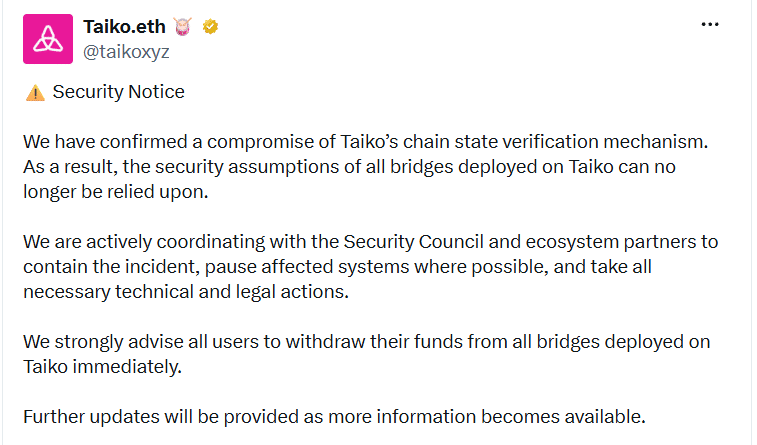
Taiko confirmed the security issue on Monday, June 22, 2026, saying the reliability assumptions behind its bridge infrastructure could no longer be considered secure. The project said it was coordinating with its Security Council and ecosystem partners to contain the incident and investigate the affected systems. The breach has brought renewed attention to security risks linked to blockchain bridges, which rely on verification systems to move assets between different networks.
What does the Taiko bridge exploit mean for users?
The Taiko bridge exploit involved a compromise of the chain state verification mechanism used by Taiko’s bridge system. This mechanism helps confirm whether transactions and messages coming from the network are valid before assets are released. Taiko said all users should withdraw their funds from bridges deployed on its network immediately.

The project also stated that affected systems had been paused while technical teams worked on the issue. The warning covered bridge activity connected to Taiko after the project determined that its previous security assumptions could no longer be relied upon. Users have been advised to follow official Taiko updates and avoid interacting with unverified messages or links claiming to provide recovery assistance.
How did attackers exploit the bridge verification system?
The attack appears to have resulted from a flaw in the way the Taiko bridge validated source signal proofs. Security firm Blockaid said crafted message proofs were accepted as valid on Ethereum even though there were no corresponding legitimate MessageSent events on the Taiko blockchain. Blockaid said this allowed the attacker to register fraudulent bridge messages and later retrieve them.
The process resulted in unauthorized asset releases from Taiko’s ERC20 Vault on Ethereum. The security firm initially estimated that more than $1 million had been stolen. Later analysis from Lookonchain and PeckShield suggested the total value of affected assets could be around $1.7 million. The different estimates reflect ongoing blockchain analysis as security teams continue monitoring the attacker’s activity.
Where did the attacker move the stolen assets?
Blockchain tracking showed that the attacker transferred 1.99 million Taiko tokens worth around $189,000 to the MEXC exchange, according to PeckShield. Arkham’s blockchain intelligence data showed exploiter wallets holding around $1.5 million in assets, with most of the remaining funds held in Ether.
The movement of these assets remains under observation. No public confirmation of full recovery or a final resolution has been announced. Taiko’s native token was trading at $0.084, which is 98% below its 2024 peak. The market data provides a snapshot of the token’s current value but does not establish that the security incident directly caused the decline.
What actions has Taiko taken after the breach?
Taiko said it was working with its Security Council and ecosystem partners to contain the incident and take necessary technical and legal actions. The project paused affected systems and released information related to attacker addresses as part of its investigation. It also requested centralized exchanges suspend TAIKO deposits until further notice.
The team has not provided a timeline for restoring bridge operations or completing its security review. Taiko is a Type 1 Ethereum-equivalent ZK-EVM rollup designed as a based rollup. The network launched its mainnet in May 2024 and supports Ethereum-compatible applications and tools.
Why are bridge security risks increasing across crypto networks?
The Taiko bridge exploit occurred during a month marked by several major crypto security incidents. Data from DeFiLlama showed at least 23 exploits recorded across the crypto sector in June 2026. Humanity Protocol recorded losses of more than $30 million, making it the largest reported exploit of the month. Syscoin Bridge also suffered losses exceeding $8 million.

Other incidents included a Secret Network exploit that resulted in $4.67 million in stolen assets and an attack on the OLPC/LABUBU liquidity pool on PancakeSwap that drained around $1.1 million. Security researchers have continued to highlight bridge systems as a key area of concern because they connect separate blockchain networks and often manage large amounts of user funds.
Conclusion
Taiko bridge exploit has highlighted the importance of strong verification systems in blockchain infrastructure after a flaw allowed unauthorized withdrawals estimated at up to $1.7 million. Taiko’s response has focused on protecting users, pausing affected systems and working with security partners to determine the full impact.
While investigations continue, the incident adds to a wider discussion around improving security standards for decentralized bridges. The case also shows why users and developers continue to monitor bridge designs closely as blockchain networks expand and handle increasing volumes of digital assets.
Glossary
Ethereum Layer-2- A scaling network that makes Ethereum faster and cheaper.
Blockchain Bridge- A system that moves assets between blockchains.
Chain State Verification- A check that confirms blockchain data is valid.
Message Proof- Digital proof that a blockchain message is authentic.
ERC20 Vault- A contract that holds and releases Ethereum-based tokens.
Frequently Asked Questions About Taiko Bridge Exploit
How much was stolen in the attack?
Attackers stole up to $1.7 million worth of assets.
Why did Taiko warn users to withdraw funds?
Taiko warned users because its bridge security could no longer be trusted.
What did the attacker do?
The attacker used fake message proofs to withdraw assets without permission.
Who investigated the exploit?
Security firms including Blockaid, PeckShield, and Lookonchain investigated the attack.
Has Taiko recovered the stolen funds?
No, Taiko has not announced a full recovery of the stolen funds.
Sources –
Read More: Taiko Bridge Suffers $1.7M Exploit as Emergency Withdrawals Begin">Taiko Bridge Suffers $1.7M Exploit as Emergency Withdrawals Begin
0
0


 Gestisci cripto, NFT e DeFi in un unico luogo
Connetti in sicurezza il portafoglio che usi per iniziare.


0
0

0
0

0
0