
BITCOIN ON THE GEOPOLITICAL STAGE
1
0
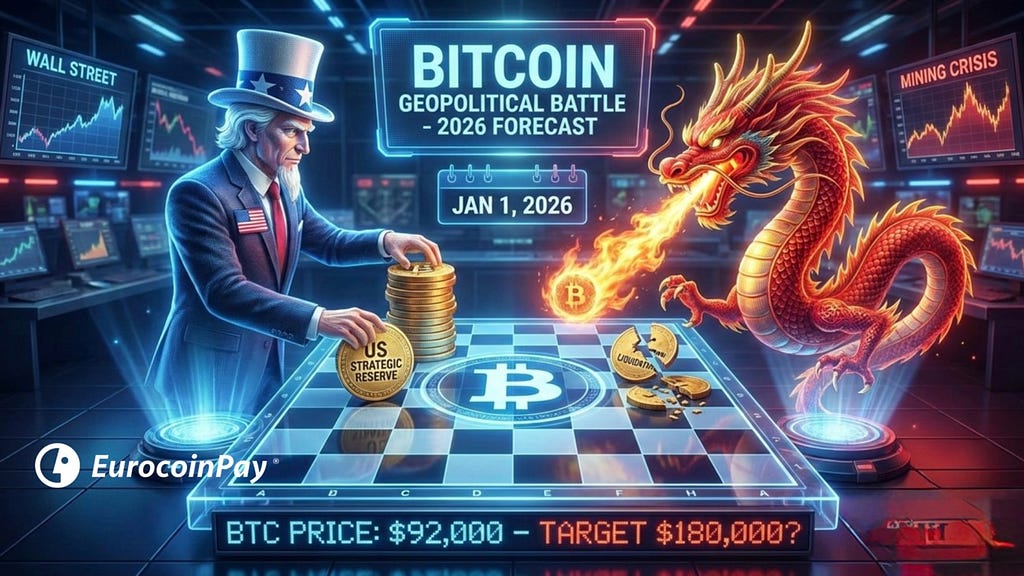
Why is Bitcoin’s value falling when everyone seems to be buying it?
At the end of 2025, the cryptocurrency ecosystem presents an intriguing paradox. Despite giants such as JPMorgan and Goldman Sachs incorporating Bitcoin into their portfolios and companies such as MicroStrategy making significant acquisitions, there has been unusual volatility in its price, accompanied by a downward trend in the last quarter..
So what is really going on? It is clear that this is not due to a lack of interest, but rather a war of attrition between the upper echelons of global power.
1. The Clash of the Titans: US vs. China
Bitcoin has ceased to be an ‘internet asset’ and has become a geostrategic chess piece.
In the US, under the Trump administration, the government seeks to establish Bitcoin as a ‘National Strategic Reserve’.
Meanwhile, China, seeing this move, has activated pressure mechanisms to destabilise the markett:
- Liquidating historical seized reserves (such as those from the PlusToken scheme) to saturate supply.
- Using BTC volatility as a ‘currency war’ tool to project an image of instability in the assets that the US is trying to validate.
2. The Economic Pincer: Tariffs and Interest Rates
US domestic policy also plays a contradictory role. Although the narrative is pro-Bitcoin, economic actions create friction:
- Strong dollar vs. liquidity: The 100% tariffs imposed on China have strengthened the dollar, but force the Fed to keep interest rates high.
- Risk capital flight: These high rates remove liquidity from assets considered ‘risky,’ directly affecting the price of Bitcoin.
- Politicisation: Now a ‘matter of state,’ Bitcoin is exposed to direct trade retaliation between nations.
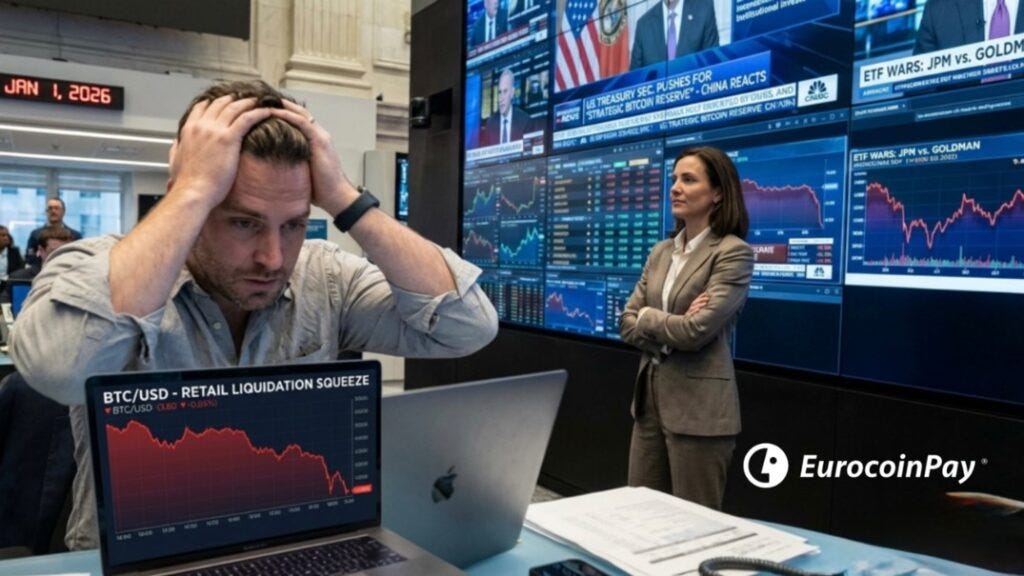
3. Wall Street and the ‘Squeeze’ on Retail Investors
We cannot forget the role of large financial institutions. Their strategy differs greatly from that of the average investor:
- Cleaning out ‘Weak Hands’: Financial institutions often cause or take advantage of declines to liquidate leveraged retail investors and buy that liquidity at lower prices.
- ETF War: Fund issuers compete fiercely to dominate the market, resulting in aggressive sideways movements that frustrate small investors.
4. The Mining Sector on a Tightrope
Miners, the backbone of the network, are undergoing their own transformation:
- Many have been forced to sell part of their production to finance the relocation of their operations due to new restrictions or conflicts.
- Mining power is becoming concentrated in large energy corporations, calling into question long-term decentralisation.

What to expect for 2026?
A pesar del panorama actual, las perspectivas a medio plazo mantienen un tono optimista, aunque con matices de precaución:

Conclusion
The current decline is not a system failure, but rather Bitcoin’s ‘entry cost’ into the global monetary system. What we are experiencing is the transition from a digital currency to an asset of state importance.
Disclaimer: The information set forth herein should not be taken as financial advice or investment recommendation. All investments and trading involve risk and it is the responsibility of each individual to do his or her due diligence before making a decision.
1
0


 Verwalten Sie alle Ihre Kryptowährungen, NFTs und DeFi an einem Ort
Verbinden Sie sicher das Portfolio, das Sie zu Beginn verwenden möchten.

0
0

0
0

0
0

0
0