
Hyperliquid and Pump.fun Drive 90% of $638M Record Crypto Buybacks: FT

0
0
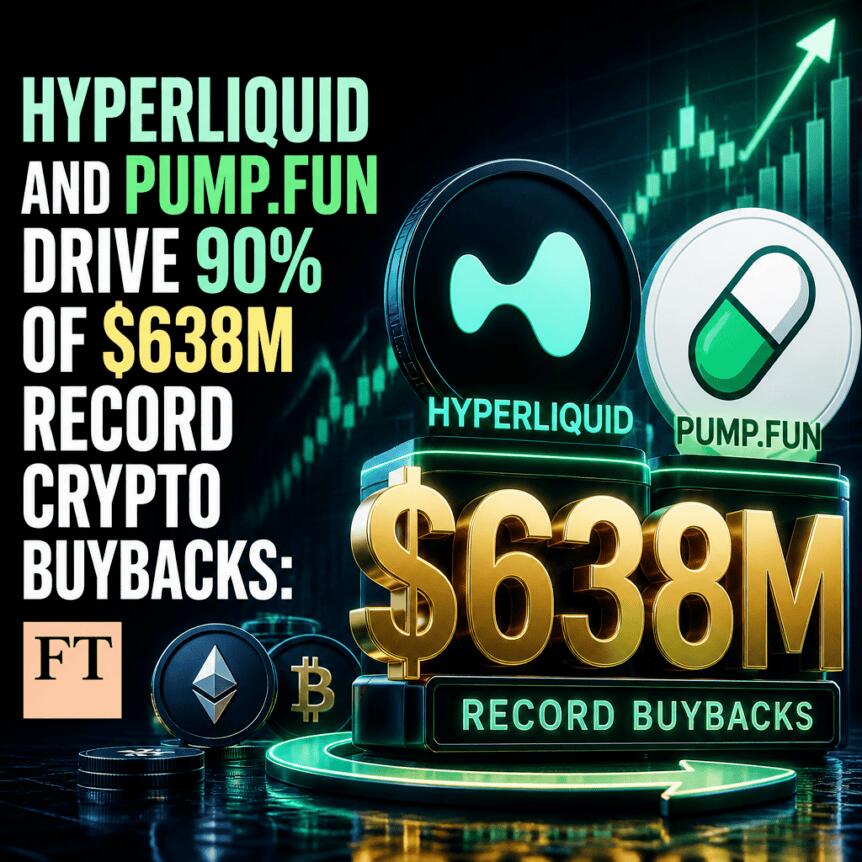
Crypto projects are leaning harder into a strategy more familiar from traditional finance: buying back their own tokens. So far in 2026, projects have reportedly spent a record $638 million on token buybacks, according to data compiled by Allium Labs and cited by the Financial Times in a report released Monday.
That total highlights a clear concentration. Hyperliquid and Pump.fun together account for the majority of the year-to-date figure, with Hyperliquid responsible for roughly $370 million and Pump.fun nearly $200 million, as reported by the Financial Times based on Allium Labs’ dataset.
Key takeaways
- Year-to-date token buybacks reached $638 million in 2026, per Allium Labs data cited by the Financial Times—up from $545 million over the same period in 2025.
- Hyperliquid and Pump.fun dominate the activity, together accounting for roughly $570 million of the $638 million total.
- Buybacks are still uncommon in crypto, but more issuers are now using revenue to fund repurchases and support token value.
- Following an Ethena Foundation vote proposal for fee revenue to be used for ENA buybacks, ENA rose 10.7% on the day after the announcement, according to the report.
- HYPE and PUMP have outperformed the broader crypto market decline so far in 2026, based on TradingView-reported performance data.
Record buybacks, concentrated among a few protocols
The Financial Times report framed token buybacks as the crypto analogue to share buybacks: instead of supporting equity prices directly, projects repurchase their own tokens in an effort to bolster token valuation and returns for existing holders.
While this approach remains relatively rare across the broader industry, the numbers show it is no longer an edge-case tactic. Allium Labs’ figures—reported by the Financial Times—indicate buyback spending has accelerated sharply over the past year, rising to $638 million year-to-date in 2026 from $545 million in the same period of 2025. The earlier baseline from Allium Labs cited by the Financial Times shows much lower activity in 2024, at just $366,000.
Crucially, the activity is not evenly distributed. Hyperliquid’s buyback spend of roughly $370 million and Pump.fun’s nearly $200 million together represent the bulk of the year’s token repurchase momentum, suggesting that revenue-rich protocols with clear treasury mechanics are currently driving most of the trend.
How Hyperliquid and Pump.fun are funding repurchases
The performance of HYPE and PUMP appears tightly linked to that repurchase intensity. According to TradingView data cited by the report, HYPE is up 145% year-to-date and PUMP is up 109% year-to-date during a period when Bitcoin fell 10% and total crypto market capitalization declined by 11.9%.
Hyperliquid’s structure is especially aggressive: the report states Hyperliquid spends about 99% of its revenue on token buybacks. It adds that Hyperliquid reported $169 million in second-quarter revenue on Aug. 6, directing $141 million toward HYPE buybacks, citing prior coverage from Cointelegraph (link provided in the source material).
Pump.fun’s approach is similar in spirit but less extreme in percentage terms. The report says Pump.fun allocates about 50% of its net protocol revenue for token repurchases. It also notes the launchpad has $420 million in annualized revenue, based on average daily revenue over the past 90 days, referencing data presented in the source article.
For investors, the key takeaway is that these are not one-off buyback announcements; both projects appear to embed repurchases into how they use revenue. That can matter because sustained buyback programs may influence token holder expectations differently than occasional treasury actions.
Ethena enters the buyback conversation
The broader market dynamic is also shifting. On Thursday, the Ethena Foundation opened a vote on a fee-switch proposal, under which 95% of the net revenue paid to it from Ethena’s core business lines would be used to repurchase ENA tokens, according to the report.
The same coverage noted that the ENA token rose 10.7% on the day after the proposal was opened, suggesting traders are actively pricing in the possibility that revenue earmarked for repurchases could tighten supply or otherwise support valuation.
This matters beyond one token. As governance proposals proliferate, buybacks could become a more common tool for protocols seeking to align treasury use with tokenholder interests—particularly when those protocols have measurable and recurring revenue streams that can be redirected.
Why this trend could spread further
Momentum around token buybacks is beginning to attract mainstream portfolio analysis within crypto. Earlier in August, Bitwise chief investment officer Matt Hougan said, as referenced in the source article, that “crypto valuations could double” in the next two years as protocols increasingly use revenue to fund token buybacks and burns, returning more value to investors.
That prediction is not a guarantee, but the underlying logic is straightforward: if revenue consistently converts into repurchases (and potentially burns), the token’s economic value proposition can become more direct, rather than relying solely on speculation about adoption or network effects.
Still, readers should treat this as an evolving sector experiment rather than a uniform playbook. The same data point can have different implications depending on how a protocol determines buyback size, whether repurchases are executed regularly, and how token supply mechanics work in practice. Even within the report’s examples, the buyback intensity varies—Hyperliquid’s stated near-total revenue dedication versus Pump.fun’s roughly half.
Going forward, the most useful signal to watch is whether the next wave of proposals and repurchase programs matches the consistency seen in Hyperliquid and Pump.fun—or whether buybacks remain occasional. As governance votes move from concept to execution, traders and long-term holders will likely focus on how reliably protocols convert revenue into buy pressure and how quickly markets respond when those programs begin.
This article was originally published as Hyperliquid and Pump.fun Drive 90% of $638M Record Crypto Buybacks: FT on Crypto Breaking News – your trusted source for crypto news, Bitcoin news, and blockchain updates.
0
0


 Gérez tous vos cryptos, NFT et DeFi à partir d'un seul endroit.
Connectez de manière sécurisée le portefeuille que vous utilisez pour commencer.


