
x402 Protocol Adopts Usage-Based AI Compute Pricing for Requests

0
0
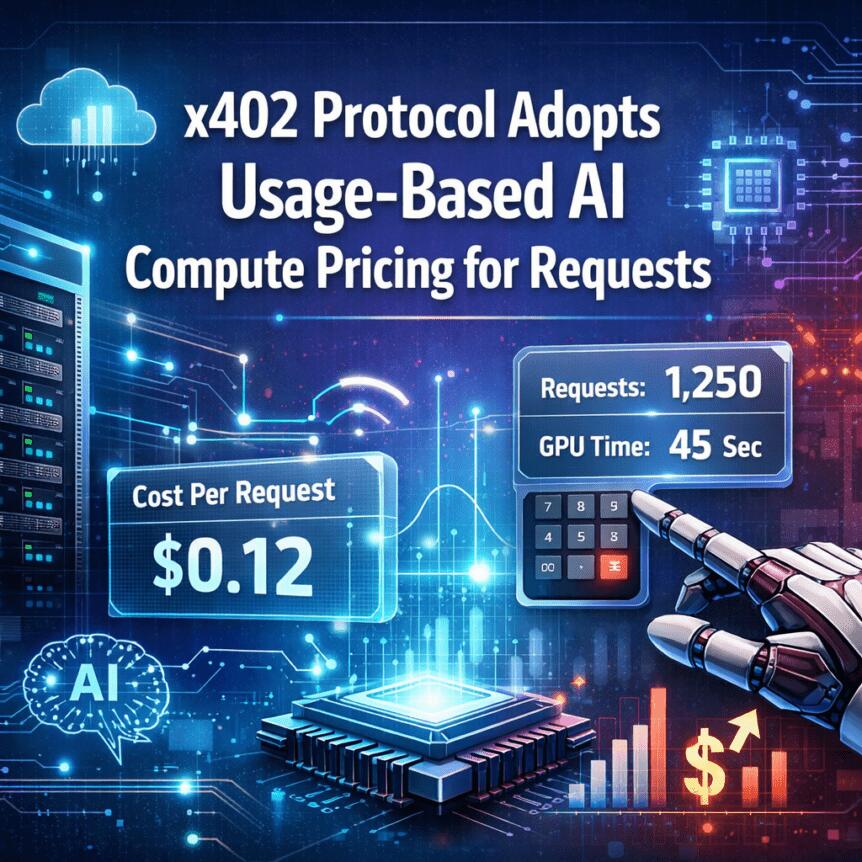
Coinbase has rolled out a notable upgrade to the x402 protocol, introducing usage-based pricing for agentic AI compute tasks and moving away from the longstanding flat-fee model. The new “Upto” scheme is live, according to Coinbase’s Developer Platform, and is designed to unlock variable-cost services such as large language model inference, data queries, and other AI-backed compute operations.
According to Coinbase, the change addresses a key limitation of the earlier model: fixed prices for all requests, which worked well for deterministic APIs but capped the economics of services where cost scales with usage, token counts, or query complexity. The Upto framework is built as an Ethereum-compatible layer, with ERC-20 support on the tokens side and the CDP Facilitator enabling fully gasless payments on the client side.
Key takeaways
- Upto introduces usage-based pricing on x402, replacing the prior fixed-fee approach for agentic AI tasks.
- Sellers can set maximum prices for tasks; buyers authorize these caps, while actual charges reflect the real resources consumed, potentially reducing overpayment.
- The scheme operates on an EVM-compatible layer and supports ERC20 tokens; the underlying CDP Facilitator enables gasless payments.
- Adoption of x402 has cooled since its November peak, with data from Dune Analytics showing a sharp decline in weekly transactions through Q1 2026.
- Governance has shifted toward broader industry participation, as the Linux Foundation now hosts the protocol, with major tech players like Google, Microsoft, and AWS holding stakes through the x402 Foundation.
From flat fees to flexible usage: what Upto changes for AI compute payments
Under the Upto scheme, sellers can cap the price they’re willing to accept for a given task, while buyers pre-authorize a ceiling. If costs are lower than the maximum, the system charges only what the task actually requires. This marks a shift from the previous regime, where simple and complex requests were priced the same, leaving users exposed to overpayment or underpayment depending on task complexity.
The practical effect for developers and AI operators is twofold. First, it introduces price discovery at the task level, aligning payments with real resource usage rather than a blanket rate. Second, it can reduce friction for experiments with agentic AI workflows, where costs can be highly variable based on token streams, compute duration, and the intricacy of the queries being processed.
In addition, the architecture remains compatible with existing crypto rails: Upto is described as an EVM-compatible layer, while the CDP Facilitator supports gasless transactions, which can streamline experiences for end users who expect near-instant, fee-free onboarding and execution from their wallets. These elements are crucial as developers explore widespread AI agent deployment, where the cost of inference and data access can swing dramatically over time.
Market backdrop: adoption trends and what this means for agentic AI payments
Even as Coinbase markets Upto as a practical remedy to pricing frictions, the broader x402 ecosystem has faced a notable retrenchment in 2026. Dune Analytics data shows that after peaking during a standout week in early November, the network’s activity faded considerably. During the week of November 4–10, x402 processed about 13.7 million transactions — its all-time high for weekly volume — but weekly transaction counts have since fallen below the 1 million mark in early January and continued to slide into the first quarter. By the last week of March, total activity stood at roughly 112,708 transactions, underscoring a sharp deceleration in adoption.
The shift matters for any assessment of agentic AI’s economics. A pricing regime that ties costs more tightly to actual usage could help rebuild demand if buyers and sellers can reliably predict costs for complex AI tasks. It also heightens the importance of on-chain efficiency, instant settlement, and cost transparency as usage grows. While Upto directly targets cost alignment for AI workloads, the broader question remains: will pricing flexibility alone reverse the recent downtrend, or will buyers demand additional incentives—faster settlement, more interoperable primitives, or deeper tooling support for AI agents?
Governance and industry backing: Linux Foundation and big-tech stake
In a significant governance development, the x402 protocol’s ownership was moved to the nonprofit Linux Foundation earlier this month. The shift signals an emphasis on open governance and standardization as AI agentic services expand. The ecosystem is already backed by a coalition of large technology companies that hold stakes in the protocol through the x402 Foundation, including Google, Microsoft, and Amazon Web Services. This collective involvement reflects industry-wide interest in creating interoperable payment rails that can scale with AI agent usage.
Beyond pure technical advantages, the move toward neutral stewardship and broad platform participation could influence how future deployments are designed and audited. For developers and enterprise users, such governance structures may offer greater assurances around compatibility, security standards, and long-term maintenance, which are critical as agentic AI services move from experiments to production workloads.
What to watch next
Several development vectors will shape x402’s trajectory in the near term. First, the uptake of Upto will be measured by real-world pilots and early adopters testing AI agent workloads with variable costs. Observers will be watching whether usage-based pricing can rekindle activity on a network that saw a steep decline through Q1 2026. Second, ecosystem momentum around the x402 Foundation will matter: any new collaborations, standardized interfaces, or tooling improvements could accelerate diffusion among developers and enterprises who want frictionless payment primitives for AI services.
Finally, the industry’s ongoing conversation about agentic AI economics—how to monetize autonomous compute, data access, and inference at scale—will intersect with pricing innovations like Upto. If the model proves durable, it could influence other protocols seeking to support dynamic workloads and near-instantaneous settlements in AI-driven ecosystems.
Readers should monitor updates from Coinbase and the x402 Foundation for pilots and performance metrics as usage-based pricing becomes more widely tested in practical AI workflows. As the market weighs these changes, the central questions remain: will usage-based pricing unlock renewed demand, and can governance-backed protocols deliver the reliability that builders and users require for agentic AI at scale?
This article was originally published as x402 Protocol Adopts Usage-Based AI Compute Pricing for Requests on Crypto Breaking News – your trusted source for crypto news, Bitcoin news, and blockchain updates.
0
0
 Manage all your crypto, NFT and DeFi from one place
Securely connect the portfolio you’re using to start.