
How much money do you need to start an S&P 500? A clear beginner’s guide

0
0
Use this article as a clear starting point: it will define key terms, show sample starter budgets, explain costs to watch, and give a step-by-step checklist to place your first trade. Before acting, verify current minimums and fractional-share policies with the broker and fund provider you plan to use.
How to start investing in S&P 500: quick overview and the two main routes
One-sentence answer
If you want the short answer: with how to start investing in s&p 500 exposure you can often begin with very small dollar amounts using an S&P 500 ETF and fractional shares, while index mutual funds commonly require larger, provider-set minimums.
ETFs and index mutual funds both give S&P 500 exposure, but the path you choose affects the practical starting amount, how orders execute, and the costs you face in the early years of investing. For many beginners the ETF route is the lowest cash barrier, while mutual funds can make sense if you prefer automatic, scheduled investing and meet the minimums.
Partner with FinancePolice on targeted advertising
Follow the step-by-step plan below to open an account, match your funding to the vehicle you choose, and place a first purchase with awareness of costs.
When to favor ETFs vs index mutual funds
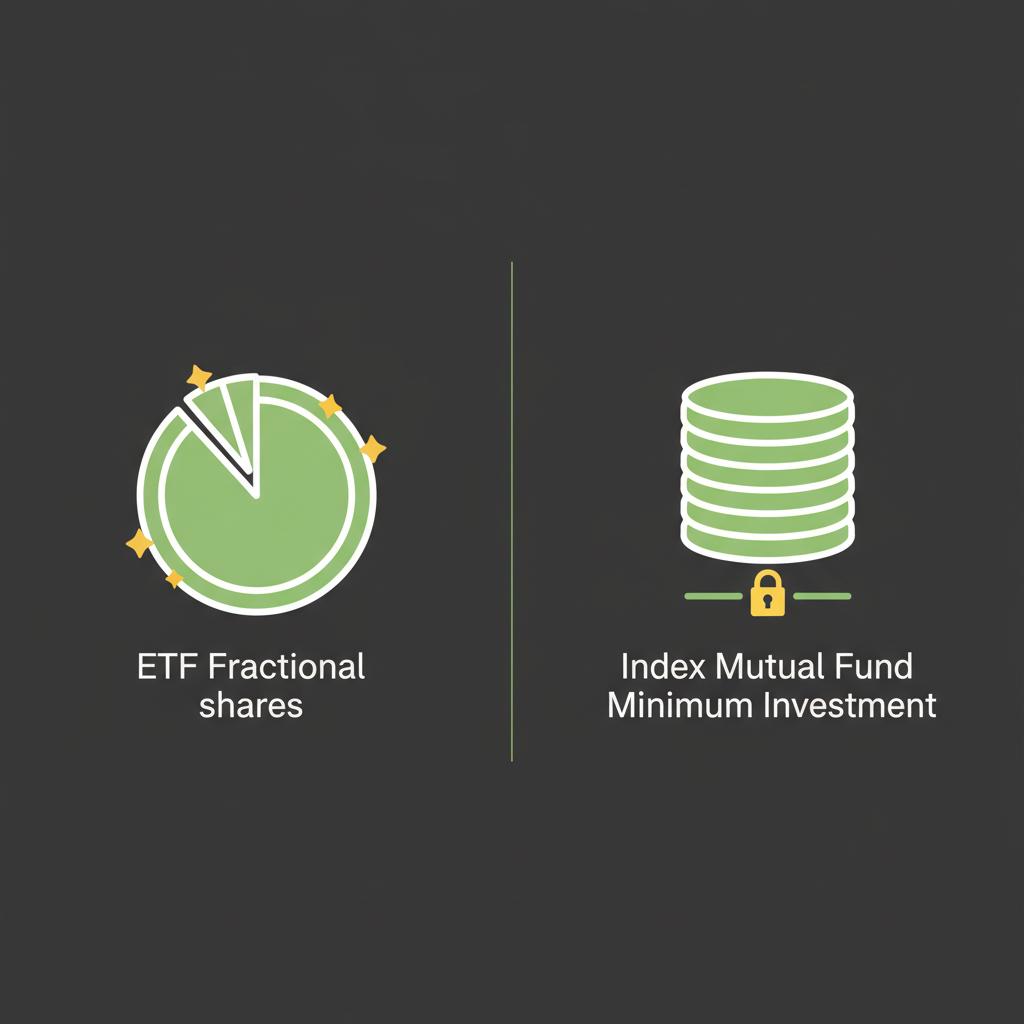
ETFs trade like single stocks throughout the day, so if your broker supports fractional shares you can start with a few dollars or a modest amount under fifty dollars and still buy S&P 500 exposure, subject to broker rules and spreads Fidelity fractional shares overview. See also Bankrate’s guide to fractional-share brokers.
Index mutual funds that track the S&P 500 sometimes impose minimum initial investments, commonly in the low-thousands at large providers, and that affects how much capital you need to start with a mutual fund Vanguard investor education on mutual funds vs ETFs.
Key terms you need to know before you start
What an ETF is
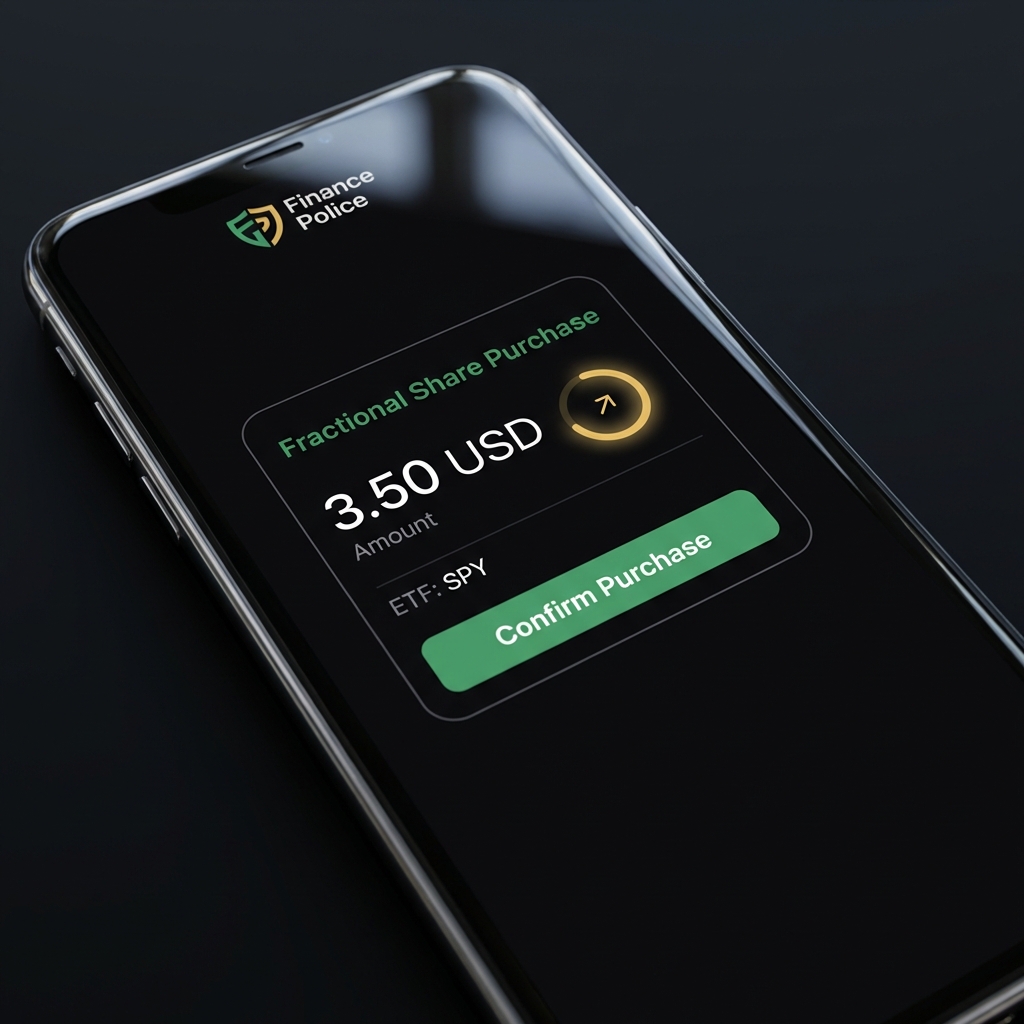
An ETF is an exchange-traded fund that holds a basket of stocks and trades on an exchange like a stock, so its price can fluctuate intraday and you can place market or limit orders during trading hours. This structural detail matters for execution and small purchases SEC investor bulletin on mutual funds and ETFs.
What an index mutual fund is
An index mutual fund also holds a broad basket meant to track the S&P 500 but it transacts differently: purchases and redemptions occur at the fund’s end-of-day net asset value, not intraday. That timing difference affects order certainty and the way recurring investments post to your account FINRA guidance on opening and funding a brokerage account.
Fractional shares, NAV, expense ratio, and bid-ask spread
Fractional shares let your broker allocate part of a share to your account so you can invest small amounts even when a full share costs more; check your broker for availability and any limits before assuming you can buy fractions at will Fidelity fractional shares overview. If you want a short comparison of apps that support tiny-dollar investing, see our best micro investment apps guide.
NAV is the end-of-day asset value used by mutual funds to price transactions, expense ratio is an ongoing percentage fee charged by funds, and bid-ask spread is the difference between buy and sell prices for an ETF at any moment. For small starting balances expense ratios and spreads are often the most important costs to watch iShares guide to ETF costs.
Why ETFs are often the most accessible way to start
How trading like a stock helps small investors
Because ETFs trade intraday, brokers that offer fractional-share investing let you place small-dollar orders that buy a portion of an ETF share, which lowers the practical cash barrier to entry compared with some mutual funds that require minimums Fidelity fractional shares overview. If you want a broker comparison, our M1 Finance vs Robinhood post can help illustrate differences in broker features.
That said, ETFs have execution costs you should understand. At the moment you buy, the bid-ask spread and the market price matter, and wide spreads on low-volume ETFs can be a meaningful cost when your purchase is small iShares guide to ETF costs.
You can often start S&P 500 exposure with very small amounts via an ETF and fractional shares, but index mutual funds often require provider minimums in the one-thousand to three-thousand dollar range; verify broker and fund rules before acting.
Many large brokerages removed commission fees for U.S.-listed ETFs, which helps, but you still want to compare expense ratios and watch execution spreads for tiny purchases Charles Schwab resource on ETFs vs mutual funds. You can also review Schwab’s fractional-shares product page for one example of broker implementation Schwab fractional shares details.
Before relying on fractional shares, verify your broker’s policy, whether recurring fractional purchases are supported, and whether any account fees or minimum balances apply. Broker terms can vary and the fund’s share price can change daily, so confirm details on the broker and fund pages before funding an account FINRA guidance on opening and funding a brokerage account. For a technical example of a platform with broad fractional support see Interactive Brokers’ fractional trading page Interactive Brokers fractional trading.
Index mutual funds: minimums and when they make sense
Typical provider minimums and why they exist
Many S&P 500 index mutual funds have provider-imposed minimums for the initial investment, commonly in the one-thousand to three-thousand dollar range at major firms, which means a mutual fund may require a larger up-front sum than an ETF route Vanguard guide on mutual funds vs ETFs.
Minimums exist for operational and shareholder accounting reasons and because some share classes are designed for regular savers or institutional investors. Always check the fund’s current page and prospectus for the exact minimum for the share class you plan to buy Charles Schwab resource on mutual fund details.
When automatic investing favors mutual funds
If you want a set-it-and-forget-it automatic investment plan tied to bank transfers or payroll, some index mutual funds make that simpler because they accept recurring deposits directly into the fund at set intervals and then buy at NAV. For savers who plan regular contributions and who meet the fund minimums, mutual funds can be a practical choice FINRA guidance on account funding and recurring investments.
Decide in advance which vehicle you prefer before funding an account, because mutual fund minimums will determine how much you need on deposit to start that option, while ETFs let you start smaller if your broker supports fractional shares Vanguard investor education on ETFs and mutual funds.
Sample starter budgets: realistic amounts you can begin with
Very small starts using fractional ETFs
With fractional-share support at many brokers you can often start S&P 500 exposure with a few dollars to fifty dollars, because your broker can allocate a fraction of an ETF share to match your cash contribution; check the broker’s fractional-share policy first Fidelity fractional shares overview.

For a very small starter, the biggest practical risks are execution costs and expense ratios: a wide bid-ask spread or a relatively high expense ratio can represent a noticeable portion of a tiny balance, so prefer low-cost ETF options and consider using limit orders to avoid poor executions on thinly traded tickers iShares guide to ETF costs.
Typical mutual fund minimum example ranges
If you plan to use an S&P 500 index mutual fund, expect that some providers set initial minimums commonly around one-thousand to three-thousand dollars for retail accounts; meeting that minimum is often the main barrier compared with the ETF route Vanguard guide on mutual funds vs ETFs.
That means if your immediate cash is limited, ETFs plus fractional shares can be a practical entry, while a mutual fund may make more sense once you have a larger sum to commit or if you prioritize automatic, scheduled investing features that the fund supports FINRA guidance on recurring funding.
Plan for recurring contributions
One common approach is to start small with fractional ETF purchases and then add recurring contributions on a schedule you can sustain, which spreads costs over time and avoids trying to time the market. Make sure your broker supports recurring fractional ETF purchases if you go that route Fidelity fractional shares overview.
With mutual funds, recurring deposits may post at NAV and may require you to meet or maintain minimum balances, so check the fund’s recurring contribution rules before committing to that vehicle Vanguard investor education on recurring investments.
Fees and costs that matter most for small balances
Expense ratios and why they compound over time
Expense ratios are ongoing percentage fees charged by funds and ETFs that reduce your returns slowly over time; for small starting balances even a small difference in expense ratio can matter because it compounds across years of ownership iShares guide to ETF costs.
When comparing options look at expense ratios first, then consider other execution costs. For tiny purchases a lower expense ratio and tighter typical spreads are generally preferable to a fund with a slightly different tracking approach but higher ongoing costs Charles Schwab resource on ETF and mutual fund costs.
Bid-ask spread and execution costs for ETFs
The bid-ask spread is the gap between what buyers and sellers are willing to trade at right now; when you place a market order you may cross that spread and realize that as an implicit cost. For very small purchases a wide spread can be a large percentage of your investment, so consider limit orders or buying when spreads are narrow iShares guide to ETF costs.
Also remember that some ETFs have low trading volume which can make spreads wider. If you find a fund with consistently tight spreads and a low expense ratio, that combination tends to be most efficient for small, frequent buys Fidelity fractional shares overview.
Broker commissions and other account fees
Many brokerages eliminated commissions on U.S.-listed ETFs, reducing a common barrier to small trades, but you should still check your broker’s fee schedule for account minimums, transfer fees, or inactivity costs that could affect small accounts Charles Schwab resource on broker fees.
Bottom line: commissions are less of a concern than they used to be for U.S.-listed ETFs, but recurring costs like expense ratios and occasional execution spreads remain important to manage when your starting balance is small iShares guide to ETF costs.
Step-by-step plan: open an account and place your first S&P 500 trade
Open and verify a brokerage account
Choose a brokerage that supports the trading features you want, complete identity verification, and link a funding source. The account setup and verification process is straightforward at most brokers and typically includes ID checks and a funding method confirmation FINRA guide on opening an account.
Simple checklist to set up account and recurring buys
Use limit orders when unsure of spreads
Fund the account and choose vehicle
Fund the account at a level that matches the vehicle you plan to use: a small cash amount for fractional ETF purchases or the provider minimum if you plan to buy an index mutual fund. Decide ETF versus mutual fund before funding where possible Vanguard guidance on choosing ETFs vs mutual funds.
Keep a small buffer to cover any unexpected holds on transfers and to ensure your first purchase clears. If you plan recurring buys, set the schedule and amount that fits your budget and verify how the broker executes recurring fractional purchases or mutual fund deposits FINRA guidance on recurring investments.
Place the first order and set recurring buys
For ETFs you can use a market order for immediate execution or a limit order to control the price you accept; for small orders a limit order can prevent buying at a temporarily wide spread. For mutual funds you submit an order that executes at the fund’s end-of-day NAV SEC guide on mutual funds and ETFs.
After your first trade set up recurring contributions if that matches your habit. Recurring contributions smooth the timing of purchases and are commonly supported for mutual funds and increasingly available for fractional ETF purchases depending on broker policy Vanguard investor education on recurring investing.
Order types and execution differences: ETFs vs mutual funds
Intraday trading and limit vs market orders for ETFs
ETFs trade intraday so you can enter market orders for quick execution or limit orders to specify a maximum buy price or minimum sell price; limit orders help protect small purchases from paying a wide spread on thinly traded funds SEC investor bulletin on ETFs.
When you use a market order on an ETF, the execution happens at the current market price and you implicitly pay the bid-ask spread. For small purchases, that implicit cost can be significant in percentage terms, so consider trading strategies that reduce execution cost iShares guide to ETF trading.
When you use a market order on an ETF, the execution happens at the current market price and you implicitly pay the bid-ask spread. For small purchases, that implicit cost can be significant in percentage terms, so consider trading strategies that reduce execution cost iShares guide to ETF trading.
End-of-day NAV orders for mutual funds
Mutual funds process orders at the end-of-day NAV; that means the price you will pay is not known at the moment you place the order and you do not trade intraday. This behavior removes intraday spread risk but introduces timing differences in how contributions are processed SEC guide on mutual funds.
If price certainty at the moment of order is important to you, ETFs with limit orders offer a mechanism to set maximum buying prices. If you prefer scheduled, end-of-day purchases with predictable post-trade accounting, mutual funds may be preferable when minimums are acceptable FINRA guidance on order execution.
Dollar-cost averaging and recurring contributions: pros, cons, and when to use them
How DCA smooths timing risk
Dollar-cost averaging, or regular smaller purchases, spreads your entry across different market conditions and can reduce the impact of buying right before a short-term drop; it is a behavioral tool that often helps beginners stick to a plan rather than a guarantee of better performance.

Many brokers support recurring contributions for mutual funds and some now support recurring fractional ETF purchases. If you choose DCA, automate the schedule and keep contributions at levels that make sense after accounting for any fees or spreads FINRA guidance on funding and recurring investments.
When lump-sum can be preferable
If you have a large amount to invest at once, historical analyses have found mixed results about whether lump-sum investing or DCA delivers higher returns; the right choice depends on your comfort with timing risk and your time horizon, so use conditional reasoning rather than assuming one method is always better.
For very small starter balances DCA into a low-cost ETF can be an efficient habit because it avoids trying to time the market and keeps early purchases modest while you build the position iShares guide to ETF investing.
Decision checklist: choose ETF or index mutual fund for your situation
If you have very little cash today, favor an ETF with fractional shares and watch spreads and expense ratios Fidelity fractional shares overview.
If you plan automatic, scheduled investing and meet the fund minimums, an index mutual fund may be more convenient for recurring deposits that buy at NAV Vanguard education on mutual funds.
Checklist items: compare expense ratios, confirm broker fractional-share rules, check fund minimums, decide order types you will use, and set a recurring contribution plan that fits your budget Charles Schwab resource on comparison.
Common mistakes and pitfalls beginners make
Beginners sometimes ignore spreads and expense ratios when making very small buys, which can erode returns quickly; always check both when your starting balance is small iShares guide on costs.
Another error is assuming every fund labeled S&P 500 is identical; track record, tracking method, and fees vary, so read the fund prospectus and compare expense ratios before choosing Vanguard guidance on fund differences.
Finally, do not assume your broker supports recurring fractional ETF purchases or has the same fractional rules as another broker; verify the broker’s help pages before planning your contributions Fidelity fractional shares overview.
Practical scenarios: step-through examples for different starter amounts
Starting with $5 or $10 via fractional ETF
With fractional-share support you could place a five or ten dollar order that buys a portion of an S&P 500 ETF; the order will allocate a fraction of a share, subject to the broker’s method for settling fractional buys, so verify the policy first Fidelity fractional shares overview.
For a five or ten dollar start, prioritize an ETF with a tight typical spread and a low expense ratio, and consider using limit orders or scheduled recurring purchases to reduce the chance your small buy faces an unusually wide spread iShares guide to ETF costs.
Starting with $500
With five hundred dollars you can build a meaningful initial position using ETFs and set up recurring monthly contributions; you still should compare expense ratios and typical spreads because these costs compound over time and influence growth from a small base Charles Schwab resource on costs.
If you prefer mutual funds, five hundred dollars may be below some providers’ initial minimums, so confirm fund minimums before assuming you can buy a specific index mutual fund with that amount Vanguard on mutual fund minimums.
Starting with $2,000 and using index mutual fund minimums
If you have two thousand dollars you will often meet the initial minimum for many S&P 500 index mutual funds at large providers, making the mutual fund route possible if you prefer automatic deposits and NAV-based purchases; always check the fund page for current minimums and share classes Vanguard guidance on mutual funds.
At that level compare whether buying an ETF and keeping the rest as a buffer or using the mutual fund directly fits your habit better; both approaches can work, so prioritize low ongoing fees and execution convenience Charles Schwab resource on comparison.
Where to verify current minimums, share prices, and broker policies
Fund provider pages and prospectuses
Always check the fund provider’s official page and prospectus for current minimums, expense ratios, and share-class details before making any deposit or order; these pages list exact requirements and are the primary source for fund rules Vanguard fund pages and education.
If a fund’s page lists multiple share classes, confirm which class your account will access, as minimums and fees can differ by class. Use the prospectus language for definitive details rather than third-party summaries Charles Schwab resources.
Broker account support and fractional-share policy pages
Check your broker’s support or help center for fractional-share policies, rules on recurring fractional purchases, and any limits on order types, because brokers implement fractional shares differently and the availability of scheduled fractional purchases varies Fidelity fractional shares overview.
Also review broker fee schedules for transfer fees, account minimums, and other charges that might affect a small starter balance. Confirm these items before funding the account to avoid surprises Charles Schwab resource on broker fees.
Regulatory investor education pages
For structural explanations of how mutual funds and ETFs differ, consult the SEC investor education pages and FINRA resources; these explain NAV timing, trading differences, and risk basics that matter when you choose a vehicle SEC investor bulletin on ETFs and mutual funds.
Use those regulatory pages as neutral references to understand mechanics before you dive into provider pages and broker rules FINRA learn-to-invest pages.
Conclusion: next practical steps and a simple checklist to begin
In short: how to start investing in s&p 500 exposure often depends on whether you choose an ETF with fractional shares, which can let you begin with very small amounts, or an index mutual fund, which commonly requires provider minimums; check fees, spreads, and minimums before you act Fidelity fractional shares overview.
Quick checklist to follow now: pick the vehicle that fits your cash and habit, open and verify a brokerage account, fund it according to the vehicle’s needs, place your first order with an order type that suits your tolerance for execution price, and set recurring contributions if that helps you stay consistent FINRA guidance on opening and funding accounts.
Verify the exact minimums and policies on the fund and broker pages before you fund or trade, and treat this guide as an explanatory starting point rather than a substitute for checking the provider details.
You can often begin with a few dollars to around fifty dollars using an S&P 500 ETF and fractional shares at many brokers, but index mutual funds frequently have provider minimums commonly in the one-thousand to three-thousand dollar range; check your broker and the fund page for exact current requirements.
ETFs with low expense ratios and tight bid-ask spreads are often the lowest-cost option for very small investments, while mutual funds may be more convenient for automatic contributions if you meet the minimums.
Open and verify a brokerage account, fund it at the level matching your chosen vehicle, choose a low-cost S&P 500 ETF or index fund, place a market or limit order as appropriate, and consider scheduling recurring contributions.
References
- https://www.fidelity.com/trading/overview/fractional-shares
- https://investor.vanguard.com/investing/etf-vs-mutual-fund
- https://www.investor.gov/introduction-investing/investing-basics/mutual-funds-and-exchange-traded-funds-etfs
- https://www.finra.org/investors/learn-to-invest/open-account
- https://www.ishares.com/us/education/how-etfs-work
- https://www.schwab.com/resource-center/insights/content/etfs-vs-mutual-funds
- https://financepolice.com/advertise/
- https://www.bankrate.com/investing/best-brokers-fractional-share-investing/
- https://www.schwab.com/fractional-shares-stock-slices
- https://www.interactivebrokers.com/en/trading/fractional-trading.php
- https://financepolice.com/best-micro-investment-apps/
- https://financepolice.com/m1-finance-vs-robinhood/
- https://financepolice.com/advanced-etf-trading-strategies/
0
0

 Gérez tous vos cryptos, NFT et DeFi à partir d'un seul endroit.
Connectez de manière sécurisée le portefeuille que vous utilisez pour commencer.


0
0

0
0

0
0