
Standard Chartered: Stablecoins Could End US 30-Year Bond Issuance | US Crypto News

0
0

Welcome to the US Crypto News Morning Briefing—your essential rundown of the most important developments in crypto for the day ahead.
Grab a coffee — because stablecoins may be about to reshape the US bond market. A new Standard Chartered report suggests rising demand for Treasury bills from digital dollar issuers could quietly force Washington to rethink how it finances its debt.
Crypto News of the Day: Stablecoin Demand Could Force Washington to Rethink US Debt Strategy
Stablecoins may soon reshape the US Treasury market, potentially forcing a radical shift in debt issuance, according to a new report from Standard Chartered.
The bank projects that stablecoin issuers could generate between $0.8 trillion and $1 trillion of fresh demand for Treasury bills (T-bills) by the end of 2028.
This trend, when combined with Federal Reserve purchases, could push total short-term Treasury demand to $2.2 trillion.
The report warns that the Treasury could use this emerging excess demand as justification to increase T-bill issuance while reducing long-term bond supply. Such a move could, in effect, allow the US government to suspend all 30-year bond auctions for the next three years.
“We think the US Treasury may use this potential excess demand as a reason to issue more T-bills,” wrote Geoff Kendrick in the latest Standard Chartered report, highlighting stablecoin issuers as increasingly significant buyers of short-term US debt.
Emerging market stablecoins are expected to drive the majority of this demand. Standard Chartered estimates that two-thirds of projected T-bill demand will come from emerging markets, representing net new demand. Meanwhile, stablecoins in developed markets largely substitute for existing holdings.
This pattern highlights the growing role of digital assets in global capital flows and their influence on traditional fixed-income markets.
The potential implications for the Treasury yield curve are substantial. Shifting roughly $9 billion from long-term bonds to T-bills could initially flatten the US Treasury curve.
Yield Curve Risks Mount as Treasury Weighs Expanding T-Bill Share
Standard Chartered notes, however, that long-term premia, fiscal deficit concerns, and market sentiment could influence investor reaction over time.
The bank cautions that a bull flattening at the front end may be the immediate response, but structural factors, including term premia and rollover risk, could shape yields differently in the longer term.
Treasury Secretary Scott Bessent could leverage this scenario to increase the share of T-bills within the overall debt portfolio.
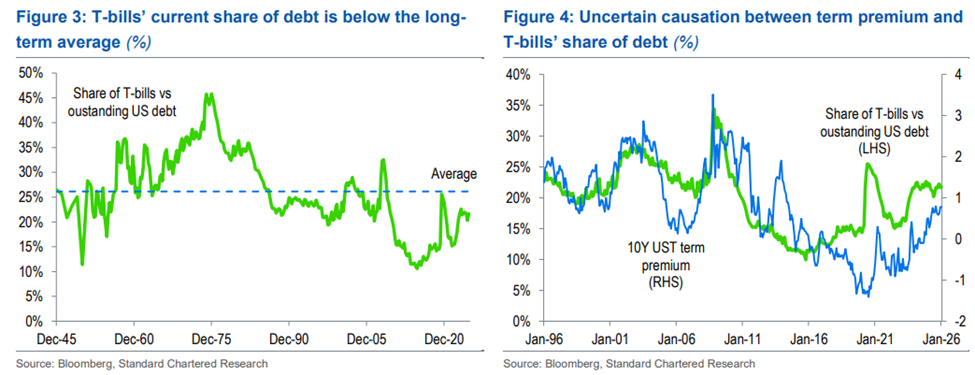
Raising the T-bill share by just 2.5% over three years would generate roughly $900 billion of additional T-bill supply, offsetting the projected excess demand.
This could ease scarcity at the front end of the curve while keeping the 10-year Treasury yield manageable.
The report also notes that historically, T-bills have averaged 26.1% of outstanding marketable debt. This is well above the Treasury Borrowing Advisory Committee’s recommended 15–20% range, suggesting room for an increase.
Despite short-term stagnation, stablecoin market capitalization is projected to reach $2 trillion by the end of 2028. Growth has recently stalled at around $304 billion, influenced by weaker digital asset markets and regulatory delays following the US GENIUS Act.
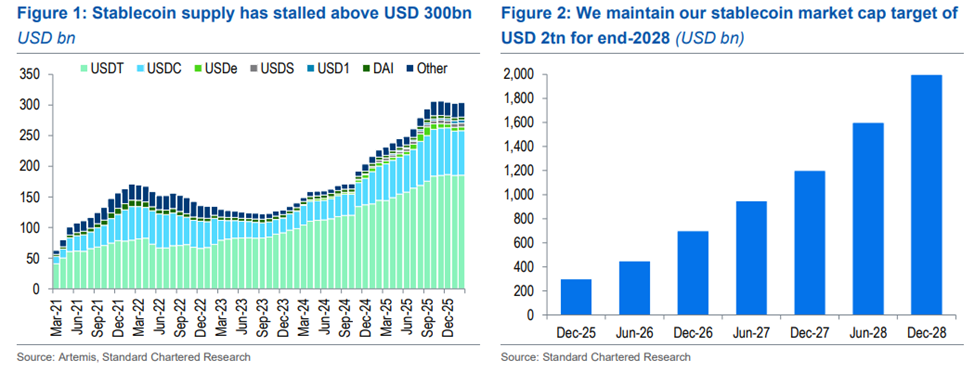 Standard Chartered Stablecoin Market Cap Projection. Source: Standard Chartered.
However, Standard Chartered considers these factors cyclical rather than structural. Stablecoin demand, combined with ongoing Fed Reserve Management Purchases and replacement of maturing mortgage-backed securities, could therefore drive a historic reshaping of short-term US debt markets.
The report concludes that while suspending 30-year bond auctions would not be unprecedented—the Treasury paused them from 2002 to 2006—the current deficit environment differs markedly.
Chart of the Day
Byte-Sized Alpha
Here’s a summary of more US crypto news to follow today:
- Tether (USDT) flashes a 2022-era signal: What does it mean for Bitcoin?
- XRP price breakdown makes bears cheer, but are they missing the $1.28 trap?
- Four US economic events that could move Bitcoin in the final week of February.
- XRP struggles as on-chain stress mounts: Is a bottom forming?
- Crypto funds see $288 million in outflows amid US-Europe divide.
- Grayscale Investments’ Chainlink (LINK) holdings hit a new high as the price falls over 70%
- Tether (USDT) flashes a 2022-era signal: What does it mean for Bitcoin?
0
0


 Administra todas tus criptomonedas, NFT y DeFi desde un solo lugar
Para comenzar, conecta de forma segura el portafolio que estés utilizando.


