
Why the Bitcoin CME Gap Remains Open Near the $60,000 Level

0
0

This article was first published in The Bit Journal.
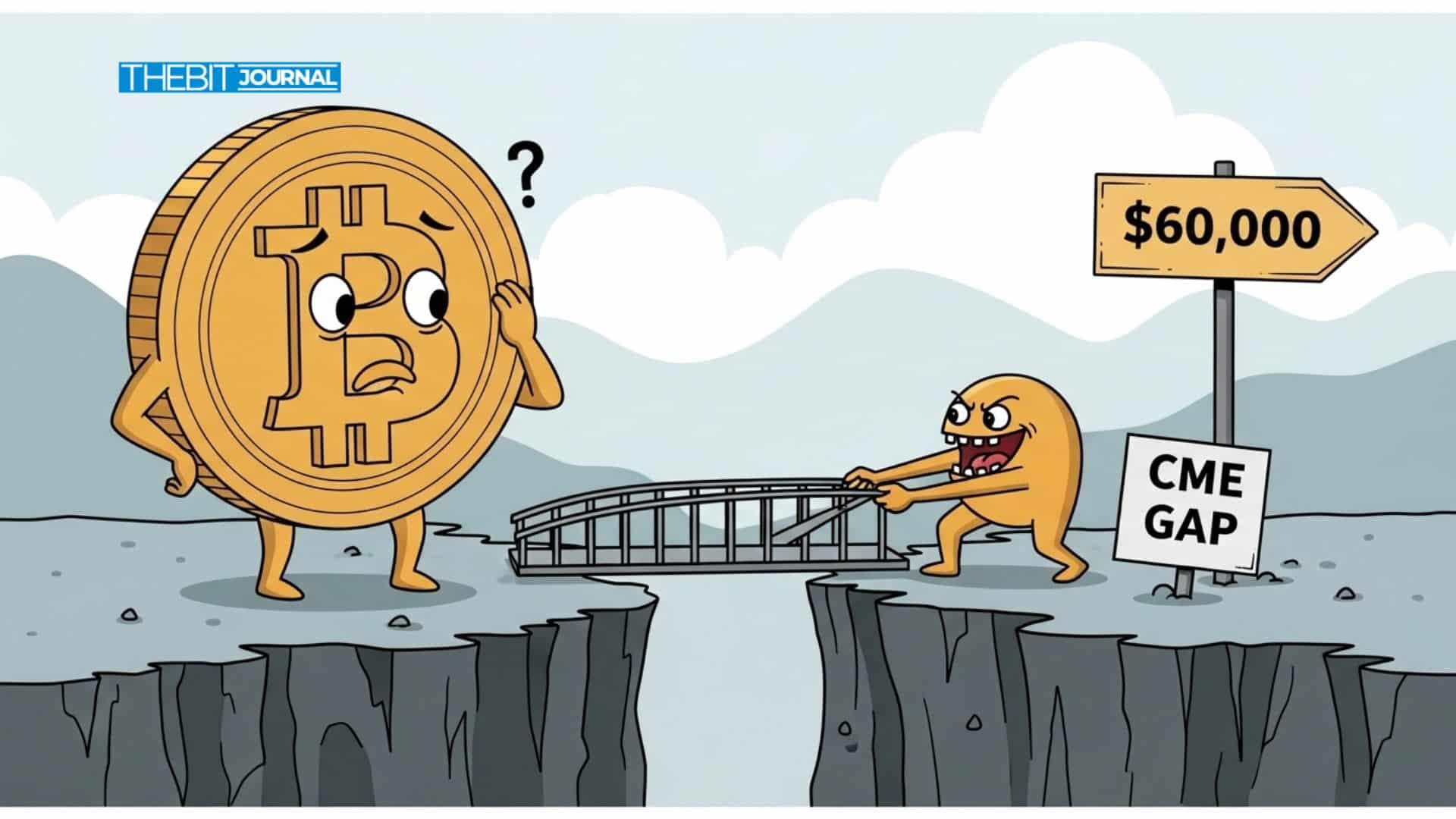
Traders and analysts are deliberating on what role the Bitcoin CME gap plays in extreme market movement. A CME gap occurs when the Chicago Mercantile Exchange (CME) Bitcoin futures markets close during weekends or daily breaks, while Bitcoin’s spot market continues to trade 24/7.
In the past, a lot of gaps have filled; in other words, the price has later retracted and made its way through the gap region.
However, recent volatility and a steep drop toward $60,000 has demonstrated that gaps do not always have to fill.
How a Bitcoin CME Gap Is Created
A CME gap exists on Bitcoin futures charts due to the fact that the CME futures market is not open at all times like a spot crypto market. The CME’s Bitcoin futures product is typically open from Sunday evening through Friday afternoon (in U.S. time), which makes weekends and breaks the times when nothing trades at all on the CME books.
If Bitcoin’s spot price changes while CME is not open, the reopening price can be far above or below where they last traded, creating a visible blank “gap” on the futures chart.
For example, a large gap formed when the CME closed on a Friday in late January 2026 with a value near $84,105 and reopened its futures market on Sunday evening with a value just below $77,730, more than $6,300 lower. Spot markets had continued to move during the holiday, leading to this discrepancy.
Historical Expectations vs. Recent Reality
Some traders regard CME gaps as “magnetic” levels that Bitcoin’s spot price will gravitate towards and subsequently ‘fill’ the gap.
This assumption is based on the fact that a large portion of the gaps in such manner are later revisited after the reopening of markets due to its arbitrage and convergence to liquidity between future pricing structure and spot prices.
Analysts also argue that once liquidity regains activity and arbitrage desks turn active, spreads have a tendency to then narrow, which would further create incentive for prices to revisit missing zones on the futures chart.
But history is not a guarantee, especially during wild price fluctuations. When Bitcoin began plummeting in early February 2026 and crashed below $72,999, then plunged down into the low $60,000s it never returned or came particularly close to the previous CME level at around just under $84,000 which caused the gap.
That open gap still remains unfilled after bouncing into the mid $60,000s because the week’s market direction was more about selling into market strength and extreme volatility than mean reversion focused on gap closure.
CME gaps are best understood as record points in time rather than automatic targets. In calm markets, price action can gravitate towards gaps, whereas in volatile or trend-driven markets, price can stray further and further before it moves back to old levels.
Why the $84,000 Hole Remained Open
The recent case proved why gaps don’t always fill. The spot market for Bitcoin continued to trade while futures were closed, creating a gap when the CME resumed. But then, a sharp selloff from start-of-week prices of about $72,999 to lows around $60,000 altered the market’s building blocks.
Instead of bouncing back toward the earlier $84,000 area, the price dropped below it even more to show that in strong trends or quick-panic phases, at least gap levels can be too distant to attract and work as a support now.
Participants in the market are responding to real-time macro stresses and liquidity conditions. What history has taught is that gaps fill more often when price ranges, and liquidity support a revisit.
But when mass liquidation-type pressure hits as well, as seen in the market during the February 5-6 sell-off, gaps may remain open because directional flow is operating with so much force that mean-reversion incentives are suddenly overwhelmed.
What Traders Should Know About Bitcoin CME Gaps Now
From an analytical perspective, having open Bitcoin CME gaps is still relevant, however traders are focusing more and more on not taking these as targets but rather reference levels.
A gap is not necessarily an obligation for the price to retrace but simply a period piece of futures market time-tables. It is not a definitive rule as to how the price will act in the future when put under bigger macro forces like huge volatility and leveraged selling pressure.
Seasoned traders still keep an eye on CME gaps for reference and possible areas of liquidity, but overall market conditions like spot price momentum, exchange inflows or outflows, or macro conditions, are taken under consideration, which usually override gap-based signals, especially in times of crisis or high volatility moves.
Conclusion
The recent price action this February has shown that the Bitcoin CME gap just below mid $80,000 has remained unfilled since Bitcoin didn’t return to this price range through a period of wild volatility and downside.
Gaps appear because there’s a difference in the structure of the CME futures calendar and that of the 24/7 spot market, though they don’t always have to be filled. Gaps represent timing differential markers, not mystical price magnets that sometimes align with later price action, especially in calm, range-bound conditions.
Glossary
Bitcoin CME gap: the difference that exists in price on Bitcoin futures chart of Chicago Mercantile Exchange from Friday’s last trading to Monday’s opening due to the trading break observed by CME.
Spot price: the real-time market price of Bitcoin on exchanges that trade 24/7.
Futures market: a regulated exchange where contracts on the future price of an asset are bought and sold, not always open as well.
Gap fill: describes what happens when the spot price, over time, ends up trading through the range left behind on a futures chart (it effectively “closes” the gap).
Frequently Asked Questions About Bitcoin CME Gaps
Do CME gaps always fill?
No. While it is true that when liquidity and price convergence occur, gaps can fill, they do not always close when the trend of the market goes strongly away from this price.
Why do Bitcoin CME gaps form?
This is due to the CME futures market closing for weekends and certain daily intervals, while spot Bitcoin continued trading, creating a divergence in price which can be seen as a gap on the futures chart.
Is an open gap a bearish signal?
An open gap is not necessarily bearish or bullish; it is simply a reflection of timing. It varies depending on the overall market mix.
How do traders use gaps?
Traders reference gaps as potential liquidity areas, along with larger price structures and surrounding conditions in their decisions.
Is there a price impact of an open gap on Bitcoin?
The gap does not directly cause prices to fall, but is a product of how futures markets work; its importance lies in how traders regard it.
References
Read More: Why the Bitcoin CME Gap Remains Open Near the $60,000 Level">Why the Bitcoin CME Gap Remains Open Near the $60,000 Level
0
0


 한 곳에서 모든 암호화폐, NFT 및 DeFi 를 관리하세요
시작하는 데 사용하는 포트폴리오를 안전하게 연결하세요.


