


3
0
Emerging Proof-of-Stake blockchains achieve high transaction throughput by spreading transactions reliably as fast as the network can carry them and accumulating them in a DAG. Then, participants interpret their DAG locally without exchanging more messages and determine a total ordering of accumulated transactions.
This post explores a simple and efficient DAG-based BFT Consensus ordering method – quite possibly the simplest way to embed BFT in a DAG. It operates in a view-by-view manner that guarantees that when the network is stable, only two broadcast latencies are required to reach a consensus decision on all the transactions that have accumulated in the DAG. Importantly, the DAG never has to wait for Consensus protocol steps/timers to add transactions.
Recent DAG-based systems (see suggested reading below) demonstrate excellent performance by separating the responsibility of spreading messages reliably and with causal ordering from the Consensus ordering logic:
The advent of building Consensus over a DAG transport is that each message in the DAG spreads useful payloads (transactions or transaction references). Each time a party sends a message with transactions, it also contributes at no cost to forming the total ordering of committed transactions. Parties can continue sending messages and the DAG keeps growing even when the Consensus protocol is stalled, e.g., when a Consensus leader is faulty, and later commit the messages accumulated in the DAG. Additionally, the non-equivocating property of DAG messages and the causality information they carry can remove much of the complexity in the design of Consensus protocols.
This post explores a simple method to build Consensus over a reliable and causally ordered communication transport. The method borrows from and builds on many previous works (see suggested reading below). However, uniquely it provides a minimalist and purist approach emphasizing the following key tenets:
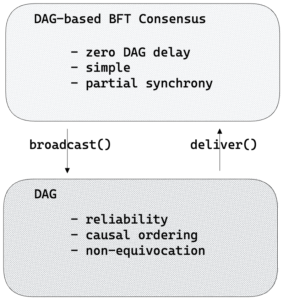
This post is meant for pedagogical purposes, not as a full-fledged BFT system design: we wanted a simple, minimalist approach to serve as an algorithmic foundation on which constructions like Fino (the subject of a future post) can be built and proven correct. Like most advances, the method described here stands on the shoulders of a long history of works (see suggested reading below). The main takeaway on the field is that Consensus on a DAG can be simple and highly performant at the same time.
In a DAG-based BFT protocol, parties store messages delivered via reliable and causally ordered broadcast in a local graph. When a message is inserted into the local DAG, it has the following guarantees:
Note that the DAGs at different parties may be slightly different at any moment in time. This is inevitable in a distributed system due to message scheduling. However, a DAG-based Consensus protocol allows each participant to interpret its local DAG, reaching an autonomous conclusion that forms total ordering. Reliability, Non-equivocation and Causality, make the design of such protocols extremely simple as we shall see below.
The lifetime of a DAG message. A DAG transport exposes two basic API’s, broadcast() and deliver().
broadcast() is an asynchronous API for a party to present payload for the DAG transport to be transmitted to all other parties. The main use of DAG messages in a DAG-based Consensus protocol is to pack meta-information on transactions into a block and present the block for broadcast. The DAG transport adds references to previously delivered messages, and broadcasts a message carrying the block and the causal references to all parties.deliver(m) is triggered when sufficiently many acknowledgments for it are gathered, guaranteeing that the message itself, the transactions it refers to, and its entire causal past maintain Reliability, Non-equivocation and Causal-ordering. Implementing a DAG. There are various ways to implement reliable and causally-ordered broadcast among n=3F+1 parties, at most F of which are presumed Byzantine faulty and the rest are honest.
We demonstrate the utility of a DAG through Fino’s core, a BFT Consensus ordering protocol embedding designed for the partial synchrony model, solving Consensus among n=3F+1 parties of which F may be Byzantine.
Given the strong guarantees of a DAG transport, the embedding is quite simple, quite possibly the simplest DAG-based Consensus solution for the partial synchrony model. It operates in one-phase, and is completely out of the critical path of DAG transaction spreading.
Briefly, the method works as follows:
view(r), and has a designated leader known to everyone. Each view consists of proposals, votes, and complaints embedded inside the DAG.view(r) it broadcasts proposal(r). A proposal is just like any message in the DAG, it contains transaction meta-information and causal predecessors. Each proposal is interpreted to include a batch: all transactions in its causal past, including those directly included in the proposal message, that haven’t been included in a preceding proposal already.view(r), after delivering proposal(r), broadcast a vote(r). A vote is just like any message in the DAG. It is interpreted as a vote by causally following proposal(r) in view(r).view(r) is not progressing, parties broadcast complaint(r). After complaining, a party cannot vote in view(r). Note that to guarantee progress during steady state, complaints are emitted only after allowing a leader sufficient time to propose and for votes to arrive.view(r) if there are F+1 votes for the leader proposal,view(r+1) is enabled either by a commit or by 2F+1 complaints.Importantly, proposals, votes, and complaints are injected into the DAG at any time, independent of layers. Likewise, protocol views do NOT correspond to DAG layers. This property is a key tenet of the DAG/Consensus separation, allowing the DAG to continue spreading messages with Consensus completely out of the critical path.
The solution is so simple due to the DAG properties: Consensus logic does not need to consider leader equivocation, because DAG prevents it. A leader does not need to justify its proposal because it is inherently justified through the proposal’s causal history within the DAG. Safety of a commit in a view is gated by advancing to the next view after F+1 votes or 2F+1 complaints, guaranteeing intersection with F+1 commit votes.
The full protocol is described in pseudo-code below in Pseudo-Code. A step by step scenario walkthrough is provided next.
Happy path scenario.
Every party enters view(r) by causally following a commit in view(r-1) or complaint(r-1) messages by 2F+1. Each view(r) has a pre-designated leader, denoted leader(r), which is known to everyone.
The first view(r) message by the leader is interpreted as proposal(r). The proposal implicitly contains a batch: all the transactions that causally precede the proposal (including itself) which haven’t been included in a preceding batch.
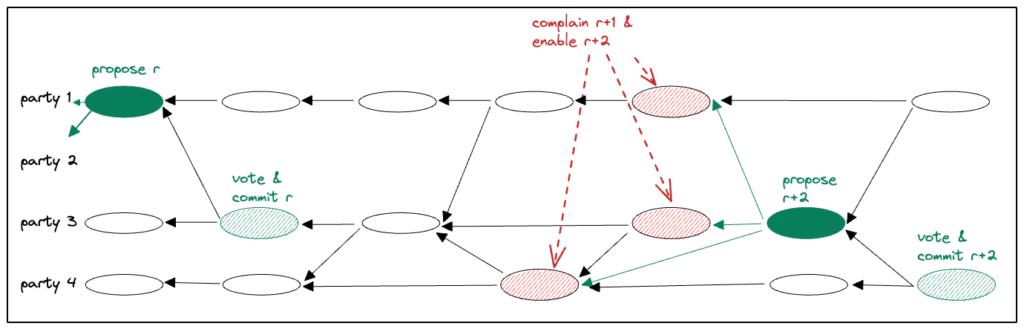
In Figure 1 below, leader(r) is party 1 and its first message in view(r) is denoted with a full green oval, indicating it is proposal(r).
After a party delivers proposal(r), its first message following the proposal is interpreted as vote(r). A proposal that has a quorum of F+1 votes is considered committed.
In Figure 1 below, party 3 votes for proposal(r), denoted with a striped green oval. proposal(r) now has the required quorum of F+1 votes (including the leader’s implicit vote), and it becomes committed. The batch of transactions in the causal past of proposal(r) are appended to the Consensus sequence of committed transactions.
When a party sees F+1 votes in view(r) it enters view(r+1).
Scenario with a faulty leader.
If the leader of a view is faulty or disconnected, parties will eventually time out and broadcast a complaint message. When a party sees 2F+1 complaints about a view, it enters the next view.
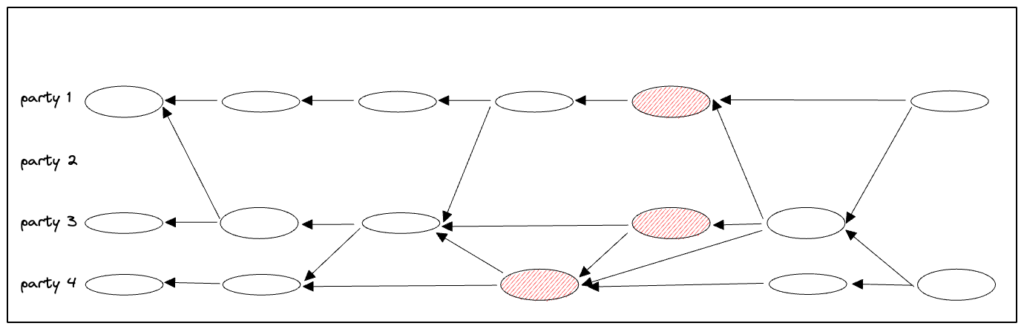
In Figure 1 above, the first view view(r) proceeds normally. However, no message marked view(r+1) by party 2 who is leader(r+1) arrives, showing as a missing ovals. No worries! As depicted, DAG transmissions continue, unaffected by the leader’s failure. Hence, faulty views have utility in spreading transactions. Eventually, parties 1, 3, 4 complain about view(r+1), showing as striped red ovals. After 2F+1 complaints are collected, the leader of view(r+2) posts a message that is taken as proposal(r+2). The proposal’s batch contains all messages that have accumulated in its causal history, all contributing to throughput.
Scenario with a slow leader. A slightly more complex scenario is depicted in Figure 2 below. This scenario is the same as above but with leader(r+1) actually issuing proposal(r+1), denoted as a full red oval, which is simply too slow to arrive at parties 1, 3 and 4. These parties complain about a view failure, enabling view(r+2) to start without committing proposal(r+1). However, proposal(r+2) causally follows proposal(r+1) and when proposal(r+2) commits, it indirectly commits proposal(r+1). First the batch in the causal history of proposal(r+1)is appended to the Consensus sequence of committed transactions, second the remaining causal history of proposal(r+2).
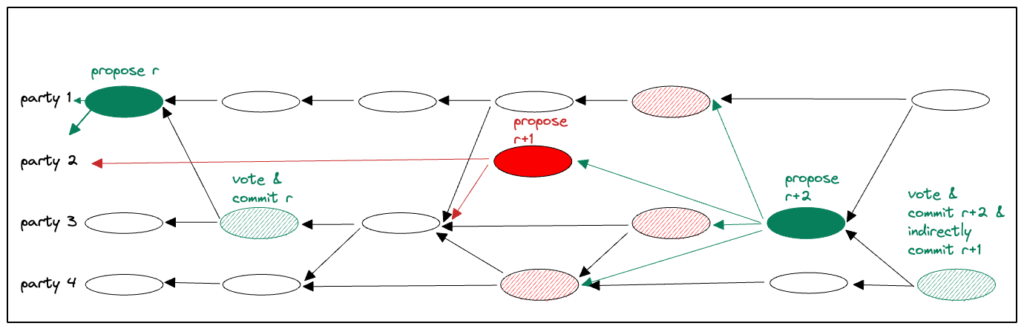
view(r+1) being indirectly committed in view(r+2).Messages are delivered in deliver(m) carrying a sender’s payload and additional meta information that can be inspected upon reception:
  - m.sender, the sender identity
  - m.index, a delivery index from the sender
  - m.payload, contents such as transaction(s) and BFT protocol meta-information piggybacked on transmissions
  - m.predecessors, references to messages sender has delivered from other parties, including itself
Party p performs the following operations for view(r):
1. Entering a view.
     A party enters view(r) if the DAG satisfies one of the following two conditions:
       (i) A commit of proposal(r-1) happens
       (ii) 2F+1 complaint(r-1) messages are delivered
     Initially, view 1 is entered.

2. Proposing.
     A message in the DAG is proposal(r) if it is the first broadcast of leader(r) in view(r).

3. Voting.
     A message in the DAG is vote(r) for the leader’s proposal(r) if:
     (i) It is the first broadcast of party p in view(r) that causally follows proposal(r) or it is proposal(r) itself
     (ii) It does not follow a complaint(r) message by p

4. Committing.
     A proposal(r) becomes committed if there are F+1 vote(r) messages in the DAG.
     Upon a commit of proposal(r), a party disarms the view(r) timer.

4.1. Ordering commits.
     If proposal(r) commits, messages are appended to the committed sequence as follows.
     First, among proposal(r)'s causal predecessors, the highest proposal(s) is (recursively) ordered.
     After it, remaining causal predecessors of proposal(r) including the proposal itself,
     which have not yet been ordered, are appended to the Consensus sequence of committed transactions.
     (Within this batch, ordering can be done using any deterministic rule to linearize the partial ordering into a total ordering.)

5. Expiring the view timer.
     If the view(r) timer expires, a party broadcasts complaint(r).
The method presented above is minimally integrated into the DAG, simply interpreting broadcasts carrying blocks of transaction-references, and presenting view-complaints for broadcast as needed. Importantly, at no time is the DAG broadcast slowed down by or waits for the Consensus protocol.
The reliability and causality properties of the DAG makes arguing about correctness very easy, though a formal proof of correctness is beyond the scope of this post.
Safety (sketch). If ever proposal(r) becomes committed, then it is in the causal past of F+1 parties that voted for it. A proposal of any higher view must refer (directly or indirectly) to F+1 vote(r) messages, or to 2F+1 complaint(r) messages of which one follows a proposal(r). In either case, a commit in such a future view causally follows a vote for proposal(r), hence, it (re-)commits it.
Conversely, when proposal(r) commits, it may cause a proposal in a lower view, proposal(s), where s < r, to become committed for the first time. Safety holds because future commits will order proposal(r) and its causal past recursively in the same manner.
Liveness (sketch) during periods of synchrony. After GST (Global Stabilization Time), i.e., after communication has become synchronous, views are inherently synchronized through the reliable DAG broadcast. For let Δ be an upper bound on DAG broadcast after GST. Once a view(r) with an honest leader is entered by the first honest party, within Δ, all the messages seen by party p are delivered by both the leader and all other honest parties. Hence, within Δ, all honest parties enter view(r) as well.
Within additional 2Δ, the view(r) proposal and votes from all honest parties are spread to everyone. So long as view timers are set to be at least 3Δ, a future view does not preempt a current view’s commit. For in order to start a future view, its leader must collect either F+1 vote(r) messages, hence commit proposal(r); or 2F+1 complaint(r) expiration messages, which is impossible as argued above.
We now remark about communication complexity during steady state, when a leader is honest and communication with it is synchronous:
Early DAG based consensus systems focused on data-center replication, e.g., Isis, Psync, Trans, Total and Transis. Total and ToTo are pre- blockchain era, pure-DAG total ordering protocols for the asynchronous model. These pure DAG protocols are designed without regulating DAG layers, and without injecting external common coin-tosses to cope with asynchrony. As a result, they are both quite complex and their convergence slow.
An intense debate over the usefulness of CATOCS (Causal and Totally Ordered Communication) from that era is documented in a position paper by Cheriton and Skeen [CATOCS, 1993], followed by Birman’s [response 1 to CATOCS, 1994] and Van Renesse’s [response 2 to CATOCS, 1994].
Recent interest in scaling blockchains rekindled interest in DAG-based protocols. Several blockchain projects are being built using DAG-based Consensus protocols high-throughput, including Swirlds hashgraph, Blockmania, Aleph, Narwhal & Tusk, DAG-rider, and Bullshark.
Swirlds Hashgraph is the only blockchain era, pure-DAG solution to our knowledge. It makes use of bits within messages as pseudo-random coin-tosses in order to drive randomized Consensus.
Narwhal is a DAG transport that has a layer-by-layer structure, each layer having at most one message per sender and referring to 2F+1 messages in the preceding layer. A similarly layered DAG construction appears earlier in Aleph.
Narwhal-HS is a BFT Consensus protocol based on HotStuff for the partial synchrony model, in which Narwhal is used as a “mempool”. In order to drive Consensus decisions, Narwhal-HS adds messages outside Narwhal, using the DAG only for spreading transactions.
DAG-Rider and Tusk build randomized BFT Consensus for the asynchronous model “riding” on Narwhal, These protocols are “zero message overhead” over the DAG, not exchanging any messages outside the Narwhal protocol. DAG-Rider (Tusk) is structured with purpose-built DAG layers grouped into “waves” of 4 (2) layers each.
Bullshark builds Byzantine Consensus riding on Narwhal for the partial synchrony model. It is designed with 8-layer waves driving commit, each layer purpose-built to serve a different step in the protocol. Bullshark is a “zero message overhead” protocol over the DAG, but advancing layers may be delayed by consensus timers.
Acknowledgement: Many thanks to Lefteris Kokoris-Kogias for pointing out practical details about Narwhal and Bullshark, that helped improve this post.
Pre-blockchains era:
Blockchain era:
The post BFT on a DAG appeared first on Chainlink Blog.
3
0
 Verwalten Sie alle Ihre Kryptowährungen, NFTs und DeFi an einem Ort
Verbinden Sie sicher das Portfolio, das Sie zu Beginn verwenden möchten.


0
0


