
Parallax Network Guide: Consensus, Tokenomics and PAX Explained

0
0

The Problem Parallax Network Set Out to Solve
Most crypto projects ask users to understand gas fees, seed phrases, and validator mechanics before they can participate.
Parallax Network is trying something different, and the way it goes about it says a lot about where mobile-first blockchain design might be heading.
It is a Layer 1 blockchain built to let ordinary users mine, hold, and eventually spend a native token called PAX without needing any technical blockchain knowledge upfront.
Parallax Network describes itself as a mobile-first decentralized network designed to make blockchain participation more accessible.
Sources [Official Parallax Network website]
According to the project's whitepaper, the chain's on-chain layer is built on Move, an open fork of the Open Libra and Diem lineage, while its consensus engine, called Proof-of-Trust, is original to Parallax.
The goal, as described in the whitepaper, is to make the underlying mechanics of a decentralized ledger invisible to the end user while keeping the chain genuinely decentralized underneath.
What Is Parallax Network?
The project describes itself as a decentralized multi-application network built to function as a single hub for digital ownership.
Users interact through a mobile app first, where they can mine PAX tokens, and the whitepaper says the app is designed to evolve into a full non-custodial wallet as the ecosystem matures.
The project frames its core problem as a UX trilemma. Early blockchains struggled with scalability, and later ones solved that but introduced complexity around private keys, gas fees, and transaction hashes.
Its answer is a free mining model, where mobile users generate what the whitepaper calls a trust score simply by interacting with the app, without expending computational power.
How Does Parallax Network's Proof-of-Trust Consensus Work?
Proof-of-Trust is used in lieu of Proof-of-Work and Proof-of-Stake, along with the Graph of Trust.
Trust-based groups of validators are chosen, and transactions are locally verified before confirmation, without competing on a global level for block rewards.
According to the whitepaper, each transaction is assigned to a validator committee fixed at 47 validators, drawn probabilistically based on trust weight.
Committees stay active for 10 finalized blocks, roughly 100 seconds at the network's target block time, before rotating.
A transaction is considered finalized once more than half the assigned committee approves it, a threshold the whitepaper describes as a localized Byzantine fault-tolerant agreement model rather than classical global consensus.
What Are Parallax Network's Node Tiers?
The network organizes participants into three tiers, each with a distinct role and reward structure, according to the project's documentation.
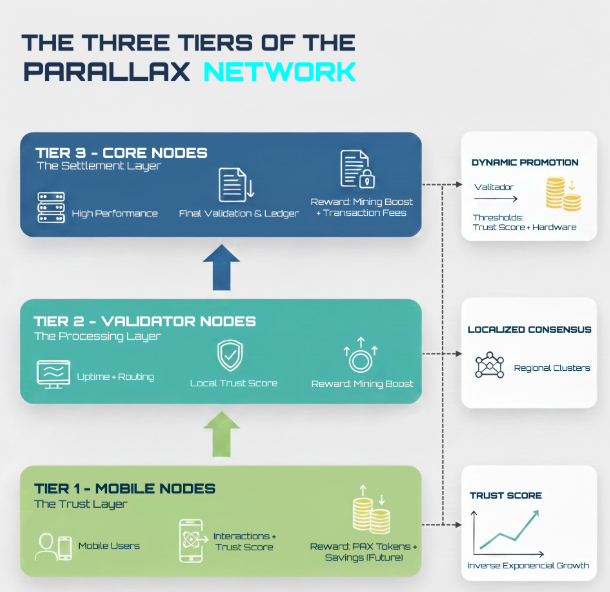
Tier | Role | Reward Mechanism |
Mobile Nodes | Build the Trust Score and Graph of Trust through app interaction. | Earn PAX proportional to mining activity. |
Validator Nodes | Run desktop software, process lightweight validation tasks | Receive a dynamic mining Boost tied to uptime and network trust |
Core Nodes | Aggregate validated transactions and stamp the canonical ledger. | Earn a share of network transaction fees. |
A validator node can be promoted to core status automatically once its trust score and validation reliability clear a network threshold and it locks a required amount of PAX as collateral, the white paper states.
How Are Validators and Core Nodes Selected?
Core Node selection uses a Verifiable Random Function, or VRF, applied to a shared entropy seed generated through a commit-reveal process among active validators.
The node with the lowest valid VRF output for that round assembles and stamps the next batch, and the whitepaper notes that trust score does not influence this particular selection, keeping the lottery equal across eligible Core Nodes.
To keep the underlying Trust Score credible, the network relies on what it calls a Fuzzy Biometric Hash: a liveness check followed by local facial feature extraction on the user's own device.
Only an irreversible hash of that data is stored, and no facial image is ever transmitted, according to the whitepaper.
This hash is required before mined tokens can migrate to mainnet, and it tolerates natural changes like aging without locking users out.
What Is PAX Tokenomics and Supply Model?
PAX has a planned maximum supply of 10 billion tokens, though the whitepaper is explicit that this figure is a ceiling, not a target.
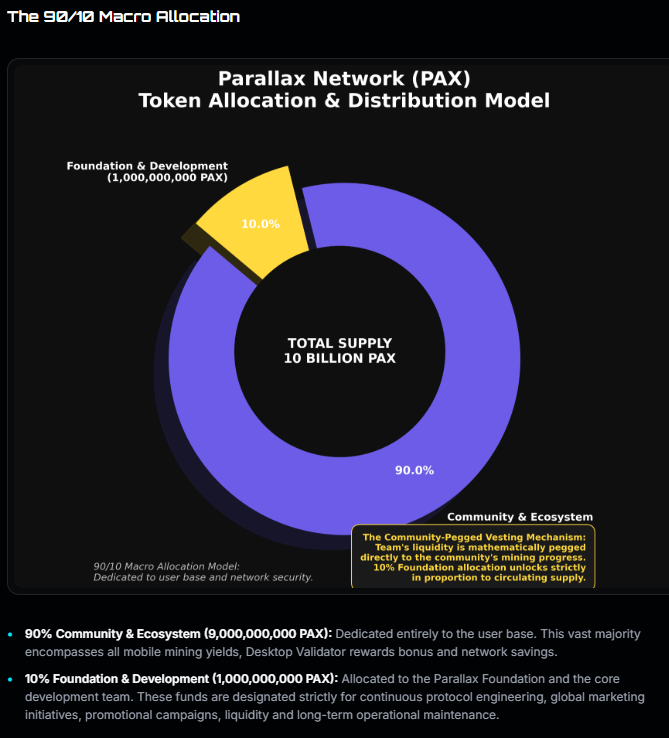
Emission follows a halving-style formula, where the base mining rate drops by 10% for every 100 million PAX emitted.
It will be done on a 90/10 basis, meaning that 9 billion PAX will be allocated to community mining, staking rewards, and the network reserve fund, and 1 billion PAX will go to the Parallax Foundation.
Notably, the whitepaper describes the Foundation's share as unlocking only in proportion to how much the community has mined, rather than on a fixed calendar schedule.
How Does Trust-Weighted Vesting Work at TGE?
Not all mined PAX will migrate to mainnet immediately. Migrations utilize a trust-weighted vesting schedule, whereby the vesting is dependent on a table that compares the mined balance of a user to their trust score.
Direct response: According to the Parallax Network white paper, migrations will see vested PAX released faster for high-trust-score individuals, while it will be released more slowly for people who have accumulated large amounts of balances organically within the network.
Under this matrix, a low balance paired with a high trust score unlocks close to immediately, while a high balance paired with a low trust score faces the longest vesting duration described in the document.
What Is the Parallax Network Roadmap?
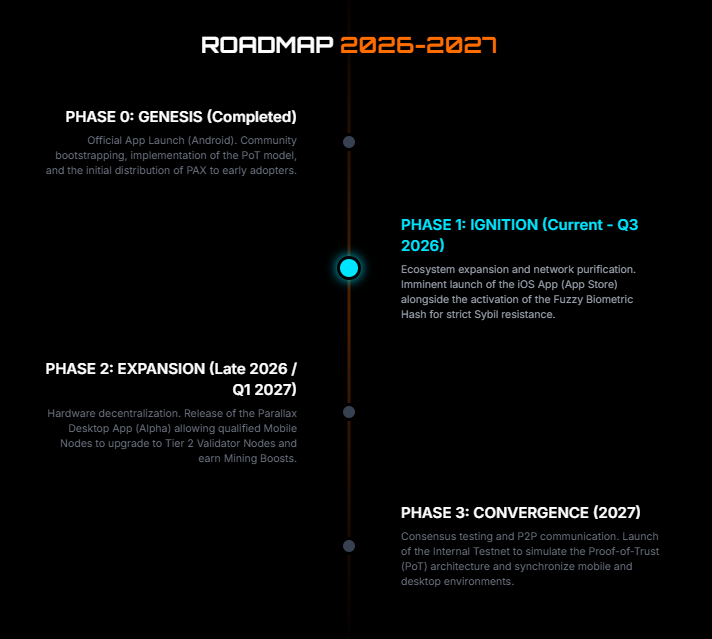
According to the project's public roadmap, Phase 0, called Genesis, is listed as completed, covering the Android app launch and initial PAX distribution. Phase 1, Ignition, is the current stage and centers on an iOS launch and activating the Fuzzy Biometric Hash for stronger Sybil resistance.
Later phases described in the whitepaper include a desktop validator app, an internal testnet to simulate proof-of-trust at scale, and a public testnet before any mainnet date is set.
The whitepaper is careful to tie phase progression to PAX emission milestones rather than fixed calendar dates.
Expert Opinion
Parallax Network's design choices point to a team more focused on validator economics and Sybil resistance than on typical marketing-first token launches, according to crypto analysts reviewing similar mobile-mining architectures.
The use by the project of community mining milestones as opposed to a time-based milestone for unlocking tokens is a security feature not often found in similar projects.
It should be noted that the network is still pre-mainnet, and its consensus mechanism, which includes the computation of the Trust Score, is closed source.
Disclaimer
The information provided within this article is purely informative in nature and cannot be taken as advice related to finances or investments. There is no possibility to use the PAX token at the moment; the token is neither exchangeable nor redeemable for anything in the real world, and its value is solely dependent on organic network growth as declared by the developers themselves. Cryptocurrency projects, especially those that are still being developed, are very risky due to possible technical issues or total loss of your mined balance.
0
0

 Gestisci cripto, NFT e DeFi in un unico luogo
Connetti in sicurezza il portafoglio che usi per iniziare.

0
0

0
0


0
0