
Cosmos Stack Ledger 2026.1: Why BlockSTM and Parallel Execution Matter for ATOM Builders

0
0
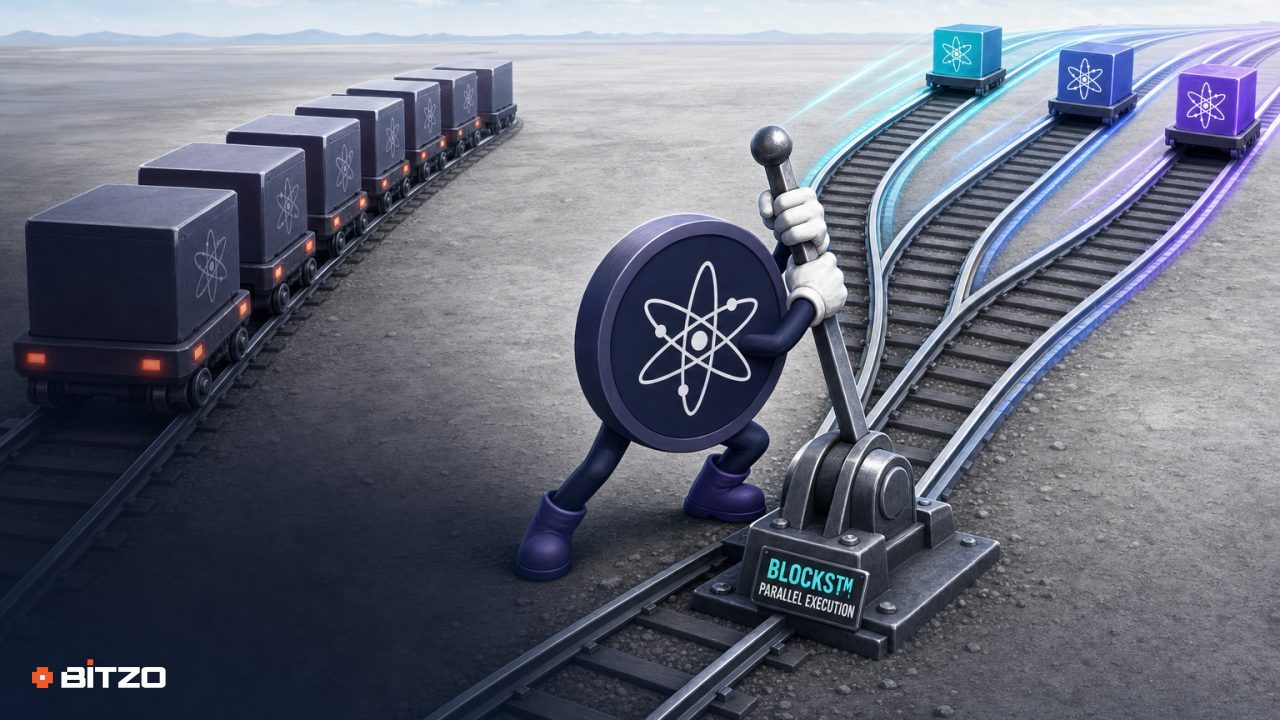
You flick a feature flag, restart your node, and suddenly blocks land faster than your logs can scroll. That was the vibe across a few Cosmos testnets the week the new release family dropped.
Cosmos announced the "Cosmos Ledger" 2026.1 set with CometBFT v0.39, Cosmos SDK v0.54 (now shipping BlockSTM), and Cosmos EVM v0.7.0. In their own tests, they reported roughly 2,000 transactions per second sustained with sub-second blocks on a 5‑validator, 32‑CPU network when BlockSTM and Krakatoa were enabled Cosmos (cosmos.network blog).
This is not just another benchmark tweet. Parallel execution changes how you design modules, how you think about conflicts, and how validators size their hardware. It is a building-time decision, not a marketing line.
Cosmos Ledger 2026.1 is a curated component set that says, in effect, here is a combination we validated together. The headline is BlockSTM landing in the SDK, but the context matters: CometBFT v0.39 and the Krakatoa path work alongside it, and Cosmos EVM v0.7.0 is part of the set. Builders who want multi-core gains and sub-second cadence now have a path that is official rather than experimental.
Parallel execution is a capability, not a guarantee. Your state layout and transaction conflicts decide whether you see 2x or 7x.
Who is affected? Pretty much everyone building or running a Cosmos appchain. Module developers need to think about access patterns. App teams need to plan migrations carefully. Validators will revisit CPU core counts and scheduler tuning. And EVM-style chains on Cosmos get a fresh reason to revisit mempool policies and fee markets.
What BlockSTM Actually Does on Cosmos
Optimistic concurrency, then conflict repair
BlockSTM is a software transactional memory approach wired into the Cosmos SDK. The idea is simple to say and tricky to get right: execute many transactions speculatively in parallel, track which keys they read and write, then fix up any conflicts by re-running losers after the winners commit. It is optimistic concurrency for blocks.
The SDK docs publish microbenchmarks that show real multi-core scaling. In a 10k transaction "no-conflict" workload, the peak speedup hits roughly 6.9x at 15 workers and about 6.6x at 10 workers. Even a worst-case, high-conflict workload shows around a 5x gain at 10 workers Cosmos SDK docs — Block‑STM (docs.cosmos.network). That does not mean your chain will see those exact numbers, but it sets a ceiling that looks meaningful.
Why Krakatoa shows up in the footnotes
The Cosmos team’s 2k TPS claim explicitly called out BlockSTM plus Krakatoa on a 5-validator, 32-CPU rig Cosmos (cosmos.network blog). You can read that as a reminder that parallel execution is only one part of the pipe. Proposer logic, mempool behavior, and consensus pacing all decide how much throughput you can actually feed into the executor.
It is still deterministic
All of this stays deterministic because the system resolves conflicts in a well-defined way. The order in the block plus the dependency graph guides validation and re-execution. When you cross-check on different machines, you land on the same state.
Inside Cosmos Ledger 2026.1: Components and Defaults
Cosmos Ledger 2026.1 is not a single binary. It is a release family, a validated set that slots together. Here is a quick snapshot of what is in scope:
Component Version Role What to watch Cosmos SDK v0.54 State machine framework BlockSTM is available and opt-in; new execution runner and wiring CometBFT v0.39 Consensus and networking Krakatoa path referenced in tests; contributes to sub-second cadence Cosmos EVM v0.7.0 EVM execution for Cosmos chains Validated alongside the set; consider EVM state access patterns
The Cosmos blog frames the sustained ~2,000 TPS number as a test outcome on a specific topology rather than a universal promise. That nuance matters and is worth repeating Cosmos (cosmos.network blog).
Parallel Execution in Practice: How to Turn It On
In SDK v0.54, BlockSTM is opt-in. The wiring is not hard, but there are gotchas you need to respect. The docs call out specific configuration rules that materially affect migration Cosmos SDK docs — Block‑STM (docs.cosmos.network):
- Set the block executor to BlockSTM. Config key looks like block-executor = "block-stm". If you wire this from code, use the provided helper such as SetBlockSTMTxRunner.
- Worker threads default to 0, which resolves to min(GOMAXPROCS, NumCPU). You can override with block-stm-workers if you want hard bounds.
- Enable pre-estimation. The flag is block-stm-pre-estimate and it should be true per docs.
- Disable the block gas meter. If the block gas meter stays on, the parallel runner will panic. Plan this change in your upgrade handler and clearly communicate it to downstream tooling.
- Re-validate your ABCI hooks and anything that expects single-threaded execution. Some modules might rely on implicit ordering. Make it explicit.
- Stage the rollout. Start on a devnet, then a canary testnet with production-like hardware before mainnet activation.
Here is a simple example of what a config stanza may look like in practice. Your app’s file layout may differ, so treat this as conceptual, not a copy-paste:
block-executor = "block-stm" block-stm-workers = 0 block-stm-pre-estimate = true # ensure block gas metering is disabled in your app wiring
Performance Reality: Where the 2k TPS Comes From
The Cosmos team’s measured result, roughly 2,000 TPS with sub-second blocks on a 5-validator, 32-CPU rig, came from a setup tuned for parallelism with BlockSTM and Krakatoa enabled Cosmos (cosmos.network blog). That gives us three takeaways.
Throughput is workload-shaped
If your transactions mostly touch separate parts of state, BlockSTM can scale. The SDK microbenchmarks show the ceiling: about 6.9x at 15 workers on no-conflict tests and around 5x even in worst-case conflict-heavy patterns Cosmos SDK docs — Block‑STM (docs.cosmos.network). Real apps land somewhere in between. A DEX with a single busy pool will conflict more than an NFT marketplace minting to millions of unique accounts.
Block time is not just execution
Consensus pacing, network hops, and proposer behavior contribute to sub-second cadence. That is where CometBFT v0.39 and Krakatoa matter. They set the rhythm for how quickly you can finalize a block once the executor has done its part.
Hardware sizing changes
On a single-core world, faster CPUs win. In a multi-core executor, more cores and cache-friendly layouts win. Validators will probably revisit their core counts and NUMA layouts once they see real mainnet load patterns.
What This Means for ATOM Builders and Appchains
Design for concurrency from day one
State key layout decides your parallel headroom. If you shard hot counters or avoid funneling every write through a single global store, BlockSTM has more space to work. Think in terms of per-user, per-pool, or per-market keys rather than one-size-fits-all accumulators.
Cosmos EVM chains need to test access patterns
Cosmos EVM v0.7.0 is in the validated set. Whether your EVM transactions parallelize well depends on how contracts touch storage. Heavy contention on the same contract slots will dampen gains, while broad, independent calls will benefit more. It is worth running realistic replay traces on your devnet to see where conflicts spike.
Fee markets and mempool policy will evolve
A parallel executor gives you room to prioritize different kinds of work. Chains might consider mempool lanes, hints, or fee multipliers that nudge low-conflict, high-throughput flows to the front, while not starving necessary but contentious operations.
Module authors should sanitize assumptions
If a module depended on implicit single-threaded ordering, make that ordering explicit. Document which store keys act as mutexes. Add tests that simulate conflicting writes and verify the outcomes.
Migration playbook for teams
- Profile today’s workload. Sample real blocks, tag transactions by touched keys, and estimate conflict rates.
- Stage a testnet on SDK v0.54 + CometBFT v0.39 with BlockSTM toggled. Mirror hardware from mainnet validators.
- Replay captured traffic. Compare wall-clock block times and end-to-end latency with BlockSTM on and off.
- Iterate on key layout. If hotspots show up, restructure keys to reduce write contention.
- Formalize rollout gates. Only schedule mainnet switch once telemetry is clean and external indexers are ready for any changes.
Tradeoffs, Tuning, and Things Nobody Mentions
Telemetry noise goes up before it goes down
When you parallelize, the logs look busier, and some operators interpret that as instability. Expect a period where you calibrate metrics, alert thresholds, and dashboards to the new execution path.
Gas remains policy, but meters change
Block gas metering must be disabled with BlockSTM, per the SDK docs Cosmos SDK docs — Block‑STM (docs.cosmos.network). That does not mean fees vanish. It means you should revisit any assumptions where block-level gas budgets influenced throughput pacing.
MEV dynamics shift
Parallel execution does not erase MEV, but it can change the shape of search strategies. If conflicts decide which transactions get re-executed or delayed, ordering games will adapt. Keep an eye on proposer policies and auction mechanisms if your appchain runs one.
Interchain effects
Faster local finality can improve cross-chain latency for IBC flows, but only if both ends tune similarly. If one chain sprints and the other jogs, end-to-end latency remains bounded by the slower leg.
Risks & What Could Go Wrong
- Hidden contention: A small number of hot keys can erase parallel gains and even increase variance.
- Incorrect wiring: Leaving the block gas meter enabled will panic the parallel runner and halt your node on activation.
- Module assumptions: Code that relied on implicit single-thread serial order may behave incorrectly under concurrency.
- Validator heterogeneity: Uneven hardware across the set can magnify proposer-vs-validator performance gaps.
- Operational complexity: More threads, more tuning. Misconfigured workers or scheduler parameters can underperform.
- Over-claiming performance: Marketing a lab number as a mainnet promise invites user frustration and trust hits.
Activate BlockSTM only after you can show, with your own traces, that conflict rates are low enough to justify it on your chain.
Frequently Asked Questions
What is Cosmos Ledger 2026.1 in plain terms?
It is a validated release family that pairs CometBFT v0.39, Cosmos SDK v0.54 with BlockSTM available, and Cosmos EVM v0.7.0. The Cosmos team published this set and shared test results showing roughly 2,000 TPS with sub-second blocks on a specific 5-validator, 32-CPU setup with BlockSTM and Krakatoa enabled Cosmos (cosmos.network blog).
Does BlockSTM change consensus or just execution?
Just execution. CometBFT still handles consensus and networking. BlockSTM sits in the SDK’s execution layer, attempting to run many transactions in parallel, resolving conflicts deterministically before commit.
How do I enable BlockSTM on my chain?
Set the executor to block-stm or call the helper to install the BlockSTM runner, enable pre-estimation, choose a worker count or leave it at 0 to auto-size, and disable the block gas meter. The SDK docs emphasize the gas meter point because leaving it on will trigger a panic in the parallel runner Cosmos SDK docs — Block‑STM (docs.cosmos.network).
Will I get the 2,000 TPS number on my mainnet?
Maybe, maybe not. That test ran on a 5-validator, 32-CPU lab with BlockSTM and Krakatoa enabled. Your throughput depends on workload conflicts, hardware, network conditions, and mempool policy. Use replay traces and profile first.
What do the SDK microbenchmarks actually say?
They report large gains for low-conflict loads, with peak speedup around 6.9x at 15 workers on a 10k no-conflict workload, and around 5x even in worst-case conflict-heavy tests at 10 workers. Treat these as ceilings, not promises Cosmos SDK docs — Block‑STM (docs.cosmos.network).
Is it safe to roll this into a live appchain today?
It is in the validated set, which is encouraging, but stability still depends on your code and operations. Stage on a testnet, measure conflicts, and ensure downstream infra and explorers are ready. Parallel execution introduces new failure modes if miswired.
How does this affect EVM-compatible Cosmos chains?
Cosmos EVM v0.7.0 is part of the 2026.1 set. Whether you see big wins depends on storage access patterns across contracts. If your flow fans out across many keys, expect better scaling. If it bottlenecks on a few hot slots, gains will be modest.
None of this is financial advice. Treat performance claims as starting points and verify on your own workloads.
Disclaimer: This article is provided for informational purposes only. It is not offered or intended to be used as legal, tax, investment, financial, or other advice.
0
0

 Gérez tous vos cryptos, NFT et DeFi à partir d'un seul endroit.
Connectez de manière sécurisée le portefeuille que vous utilisez pour commencer.

0
0

0
0


0
0