
Fed rate cut chance hits zero, threatening stagflation where Bitcoin thrives as a hedge against long term inflation

0
0

Wall Street has spent months debating when the Federal Reserve will cut interest rates. Now, traders are considering if the next move could be a hike.
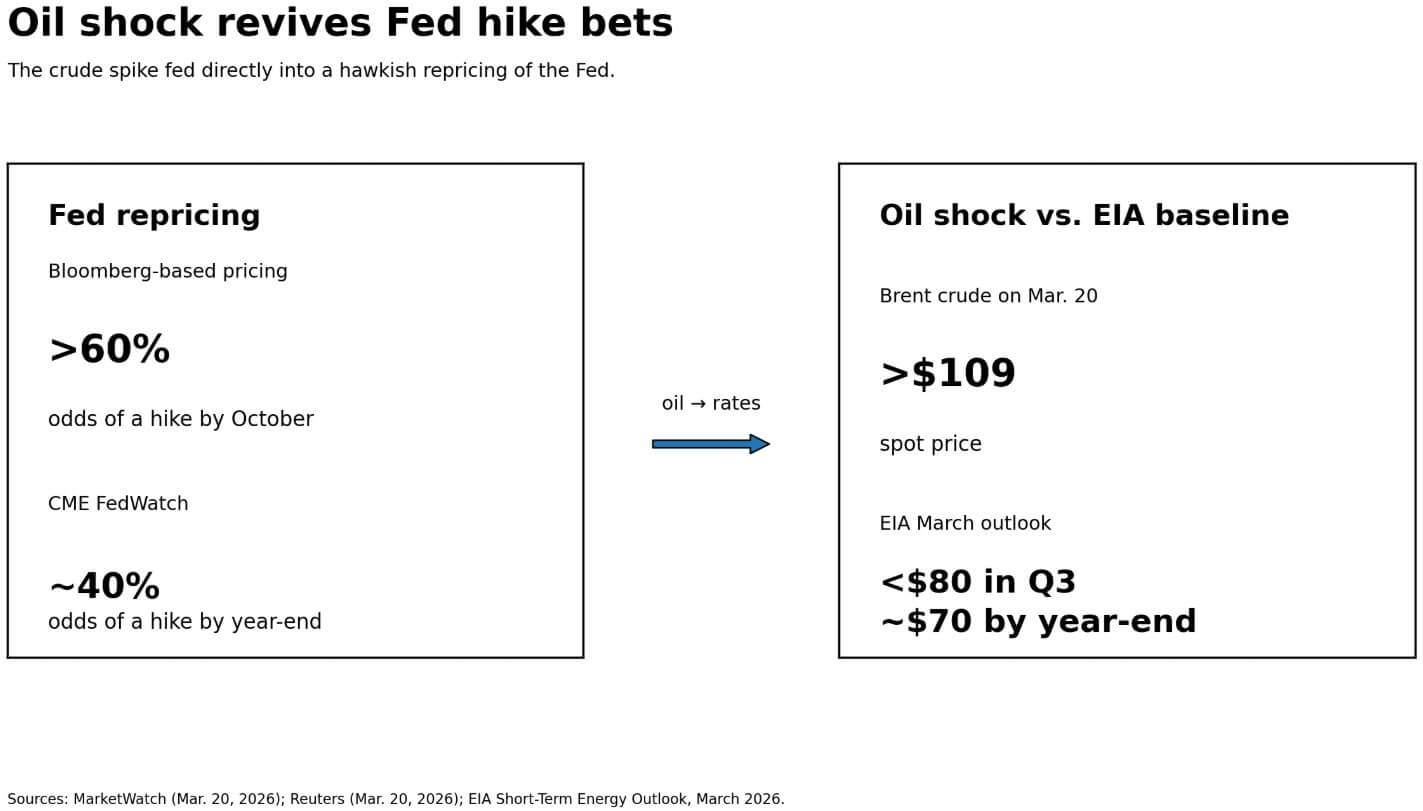
Two days past the Fed's Mar. 18 decision to hold its target range at 3.50%-3.75%, markets moved in the opposite direction. Bloomberg-based pricing climbed above 60% odds of a hike by October, with roughly 15 basis points of tightening priced by then. CME FedWatch put year-end hike odds closer to 40%.
The odds of a rate cut next month have fallen from 17% in February to 0% for April, while odds of a hike have risen to 6%.
Despite the spread that reflects genuine disagreement about timing and conviction, both measures point in the same direction. Hike bets, dormant for months, are back.
The accelerant is oil. Brent crude surged above $109, and US crude touched $98 on Mar. 20 as Middle East escalation stoked fears of disruption to the Strait of Hormuz, a chokepoint that handles nearly 20% of global oil supply.
The EIA's March baseline still assumes Brent eases below $80 by the third quarter and ends the year near $70 if disruptions ease. The market is currently betting that assumption is too optimistic, and that bet is flowing directly into rate expectations.
The 10-year Treasury climbed to roughly 4.37%, the 30-year reached its highest since September, and the S&P 500 headed toward a fourth straight weekly loss.
Global equity funds shed $20.3 billion in the week through Mar. 18, including $24.78 billion from US equity funds alone, while money market funds absorbed $32.57 billion globally.
Cash, yielding close to 4%, is pulling capital out of risk assets in real time.
The contradiction Bitcoin can't escape
Bitcoin hovered just below the $70,000 on Mar. 20, down alongside QQQ (-1.75%) and GLD (-1.93%).
The same session that repriced Fed policy as hawkish also pushed gold lower, despite a geopolitical backdrop that should support every hard-asset hedge.
Gold fell 1.8% as yields and the dollar rose. If the canonical inflation and war hedge couldn't hold ground, the reason is straightforward: tighter financial conditions are driving gold and Bitcoin lower in tandem, overwhelming whatever safe haven bid the geopolitical backdrop might otherwise support.
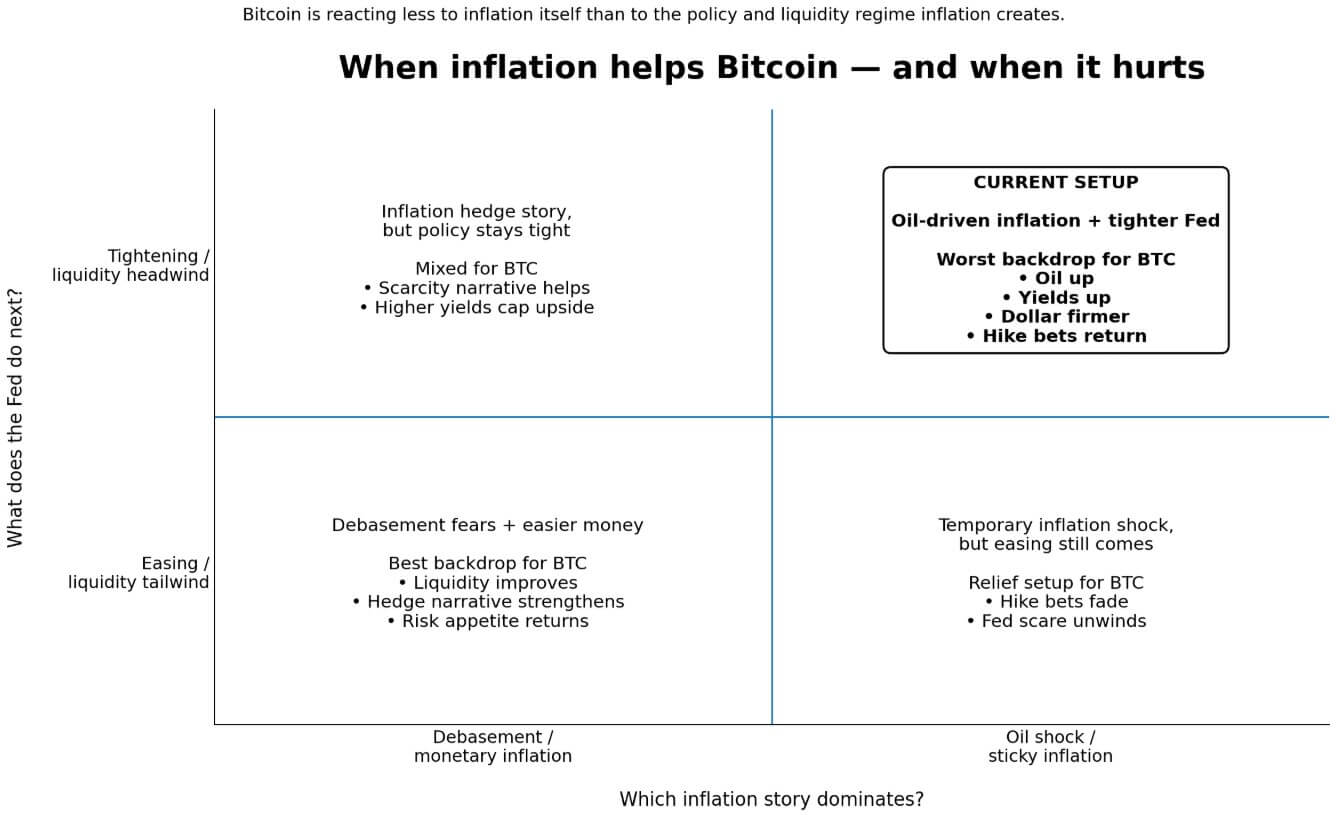
Bitcoin inflation-hedge pitch faces the same contradiction, as it works when inflation points move toward debasement fears and easier money ahead. It runs into trouble when inflation points to oil up, yields up, dollar firmer, and the Fed is unable to ease.
Fed Chair Jerome Powell said at the close of the March meeting that the central bank is watching whether higher fuel and input costs leak into core PCE inflation.
If core inflation drifts above 3.2%, Bank of America's threshold for a credible hike case, alongside unemployment holding near 4.5% and oil in the $80-$100 range, the Fed faces a setup in which inflation is sticky enough to keep policy tight.
However, growth is not yet weak enough to force emergency cuts. For Bitcoin, that moderate-inflation-without-recession corridor may be the most hostile macro environment of all.
An IMF working paper found that a single crypto factor explains 80% of the variation in crypto prices, and that Fed tightening reduces that factor through a risk-taking channel.
Besides, as more professional capital entered crypto, Bitcoin's correlation with equities rose. The BIS described crypto's recent drawdown, with Bitcoin falling roughly 50% from its 2025 highs amid a broader rotation away from growth assets, as tech stocks sold off.
Spot US Bitcoin ETF flows already show the turn: from $199.4 million in inflows on Mar. 17 to $253.7 million in outflows on Mar. 18 and 19 combined, per Farside Investors' data.
Bitcoin trades on which part of the inflation scenario dominates: whether rising prices give the Fed room to ease or force it to tighten.
Right now, the tightening side holds, as conditions are squeezing, the discount rate on speculative assets is climbing, and cash is more competitive.
Two paths forward
The bull case rests on the EIA baseline holding. If oil retraces faster than feared, labor softens into the Apr. 3 jobs report, and the February PCE data on Apr. 9 show no second-round effects bleeding into core, hike odds could deflate as quickly as they inflated.
One-year inflation swaps hit 3% this week, but the five-year forward swap fell to 2.35%, its lowest in nearly a year. The movement suggests that markets still see a path where this is a temporary energy disruption rather than a regime reset.
If that path materializes, Bitcoin regains a liquidity tailwind. Citi's 12-month framework sets a base-case target of $112,000 and a bull-case target of $165,000 under a scenario in which the Fed resumes easing.
| Scenario | Macro trigger | What happens to Fed expectations | What it likely means for Bitcoin |
|---|---|---|---|
| Bull case | Oil retraces faster than feared; labor softens into the Apr. 3 jobs report; Feb. PCE on Apr. 9 shows no second-round effects bleeding into core | Hike odds fade; markets move back toward pricing cuts or at least a less-hawkish Fed path | BTC regains a liquidity tailwind and can trade more on easing hopes than on tightening fears |
| Bear case | Oil stays in the $80-$100 range into summer; core PCE rises above 3.2%; unemployment holds near 4.5% | Hike bets harden into a durable higher-for-longer trade | BTC trades more like a duration-heavy risk asset, with tighter financial conditions and stronger cash competition weighing on price |
| What to watch next | Apr. 3: jobs report; Apr. 9: PCE; Apr. 28-29: FOMC | Soft data would weaken the hike narrative; sticky inflation and firm labor would reinforce it | These releases will determine whether Bitcoin’s inflation-hedge story regains traction or whether the liquidity headwind deepens |
The bear case requires only that the EIA is wrong. If oil stays in the $80-$100 range into summer, core PCE prints above 3.2%, and the April 28-29 FOMC meeting produces a statement that quietly validates the market's hawkish repricing rather than pushing back against it, hike bets will harden into a durable positioning move.
Money market assets are already near a record $8 trillion, and flows that moved into cash this week won't automatically rotate back. Under that scenario, Citi's recessionary bear case for Bitcoin puts the price at $58,000, and BTC trades as a duration-heavy risk asset for as long as the rate ceiling holds.
The global frame
Brokerages now see the ECB and the Bank of England potentially hiking as soon as April, with traders pricing 72 and 78 basis points of tightening through 2026, respectively.
The Hormuz chokepoint also handles about 20% of global LNG trade. A sustained disruption would push energy costs across Europe and Asia simultaneously, compressing the space for any major central bank to ease.
Bitcoin's correlation with global risk appetite, already deepened by institutional participation, means the tightening impulse comes from multiple directions at once within the same macro regime that carried crypto higher.
Longer-run inflation expectations have not broken out, and that containment is the only thing separating the current repricing from a full-blown stagflation trade.
Nevertheless, contained long-run expectations do not neutralize the near-term policy arithmetic.
The Fed's own dot plot leaves room for renewed hawkishness: participants' 2026 appropriate-rate range ran from 2.6% to 3.6%, and the dispersion at the top end is wide enough to absorb one or two upside inflation surprises before the median projection moves.
Bitcoin now faces a key test to determine whether it trades as an inflation hedge or as a concentrated bet on global liquidity.
The post Fed rate cut chance hits zero, threatening stagflation where Bitcoin thrives as a hedge against long term inflation appeared first on CryptoSlate.
0
0


 すべての暗号通貨、NFT、DeFiを1か所から管理
開始に使用しているポートフォリオを安全に接続します。


