
What Is Cardano (ADA)? How it Works, Use Cases, & Future Outlook

0
0

Over the years, Cardano has steadily risen to become one of the top 10 blockchain networks for running decentralized applications. Its native token, ADA, is currently performing among the top 10 tokens as the crypto market recovers. Considering user adoption and market interest, Cardano is performing optimally and could see significant growth in the near future.
To help you make informed investment decisions, this article explains what Cardano is, how it works, and the problems it solves, helping you decide whether investing in ADA fits your strategy.
What is Cardano?
Cardano is a third-generation blockchain designed to improve on the scalability, security, and sustainability issues that earlier networks like Bitcoin and Ethereum struggled with. The development of the Cardano blockchain was grounded in academic, scientific, and peer-reviewed research.
The project was started by co-founders Charles Hoskinson and Jeremy Wood, who previously worked in the early Ethereum ecosystem before launching Cardano blockchain. Their goal was to build a blockchain network that could evolve more methodically using evidence-based methods drawn from computer science and cryptography.
Unlike early networks that relied on proof-of-work, the Cardano network uses a proof-of-stake consensus mechanism called Ouroboros. This proof-of-stake design allows network participants to validate transactions, produce new blocks, and secure the decentralized network without the massive energy consumption associated with proof-of-work systems.
What problem does Cardano solve?
Cardano network primarily addresses key limitations in earlier blockchains like Bitcoin and Ethereum, focusing on scalability, sustainability, and interoperability. It tackles high transaction fees and slow speeds during peak demand through its layered architecture and Ouroboros Proof-of-Stake (PoS) consensus, which is far more energy-efficient than Proof-of-Work.
This enables better scalability without compromising security, supporting up to millions of transactions per second via solutions like Hydra. Unlike energy-intensive networks, Cardano’s PoS reduces environmental impact while maintaining decentralization, making it viable for long-term global use.
How Does Cardano Work?
Cardano’s Two-Layer Architecture
A major part of how the Cardano blockchain works is its two-layer architecture. This design splits the platform into two main components: the Cardano settlement layer and the Cardano computation layer.
The settlement layer handles the movement of the native cryptocurrency, ADA, including transfers between wallets and the calculation of transaction fees. It is responsible for recording transactions on the blockchain and ensuring that balances remain accurate across the Cardano network.
Meanwhile, the Cardano computation layer is where developers create smart contracts and build decentralized applications. This separation allows the smart contract platform to evolve without disrupting the core accounting system.
Ouroboros — Cardano’s PoS Consensus
The Cardano network relies on a proof-of-stake system, the Ouroboros consensus mechanism, to secure the blockchain and produce new blocks. Unlike proof of work, where miners compete using computational power, proof of stake consensus selects validators based on the amount of ADA tokens they control or delegate.
In this proof-of-stake (PoS) model, ADA holders can participate by delegating their ADA to stake pools. These pools help validate transactions, maintain the decentralized network, and add new blocks to the chain.
Governance and Community Participation
Another important aspect of Cardano’s operation is its approach to network governance. Instead of relying on a central authority, the Cardano ecosystem allows network participants to influence upgrades and protocol changes.
Because ADA functions as both the native cryptocurrency and a governance token, ADA holders can vote on proposals that shape the future of the Cardano platform. This governance model is intended to support a self-sustaining blockchain ecosystem in which the community guides development over time.
How Staking Works on Cardano
Staking is central to how the Cardano network secures its blockchain. Because Cardano runs on a proof-of-stake system rather than proof-of-work, ADA holders can participate in the staking process to help validate transactions and produce new blocks.
Instead of mining, users delegate their ADA to stake pools that operate on the decentralized network. When these pools successfully add blocks to the Cardano blockchain, participants can earn ADA rewards proportional to the amount of ADA they delegate.
What Is the ADA Token?
ADA is the native cryptocurrency of the Cardano blockchain and the primary asset used across the Cardano platform. The ADA token powers transactions, staking, and governance within the Cardano network. Like many major assets in blockchain technology, it also trades on global markets.
The protocol caps total issuance at 45 billion ADA, and at the time of writing, roughly 35 billion ADA are already in circulation. ADA holders can delegate their coins during the staking process to help maintain the decentralized network and validate transactions. In return, they receive ADA rewards for supporting the system.
What Is ADA Used For?
- Paying transaction fees: Every transfer on the Cardano network requires a small fee in ADA, which compensates network participants who maintain the blockchain and process transactions.
- Staking and earning rewards: ADA holders can delegate their coins to stake pools in the proof-of-stake system and earn ADA rewards when the pool produces new blocks.
- Governance: ADA functions as a governance token, allowing holders to vote on upgrades and proposals that shape the Cardano platform.
- Powering smart contracts and dApps: Developers pay execution costs in ADA when interacting with smart contracts and decentralized applications on the Cardano blockchain.
- Supporting DeFi: Within the Cardano ecosystem, ADA is commonly used as collateral, liquidity, or a trading asset in decentralized finance (DeFi) protocols.
- Trading and investment: ADA is widely available on major platforms, allowing users to buy, hold, or trade it on cryptocurrency exchanges.
ADA Token Price & Market Performance
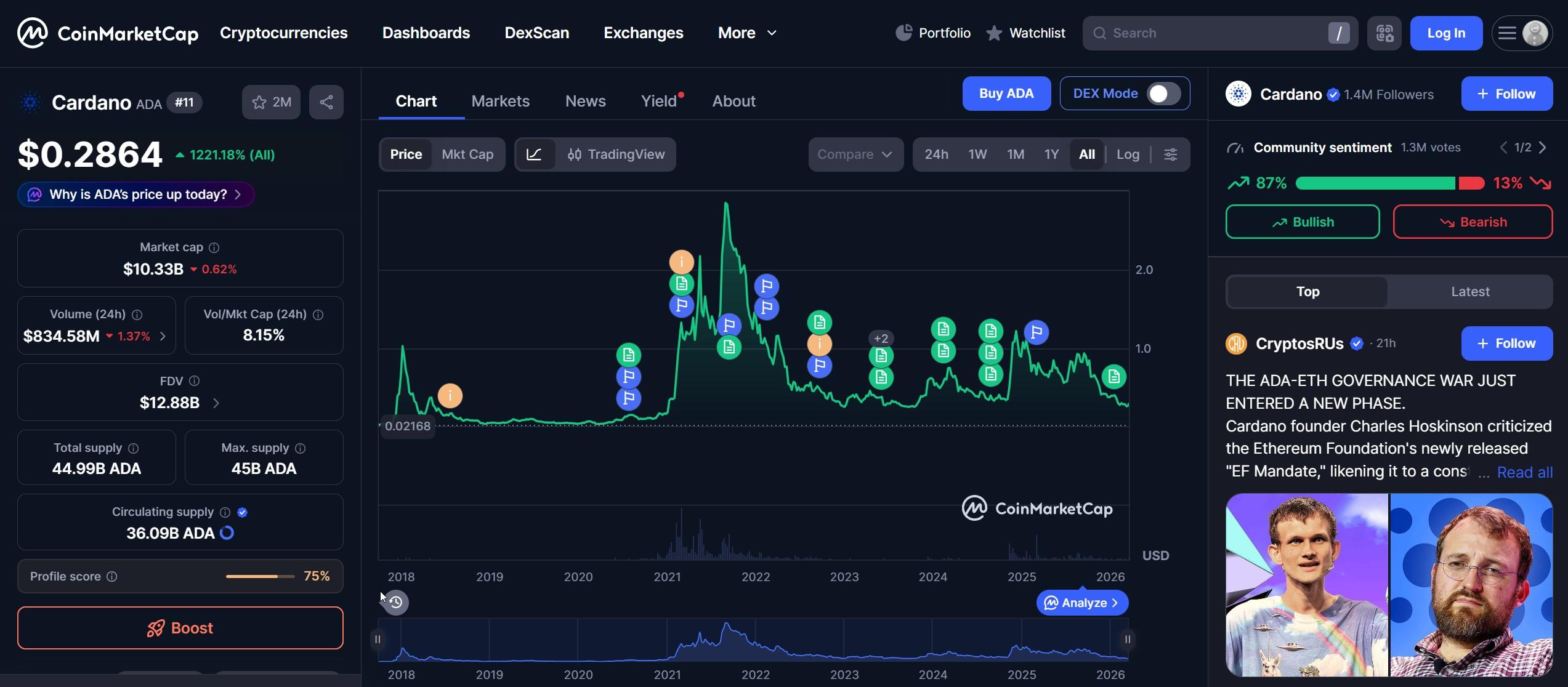
The ADA price today is hovering around $0.28, reflecting relatively modest movement over the past 24 hours as the crypto market stabilizes.
- Current ADA price: Approximately $0.28.
- 24-hour change: ADA has gained roughly 1-2% in the past day, suggesting mild upward momentum as traders step back into the market.
- 24-hour trading volume: Around $450-$500 million, indicating healthy liquidity across major exchanges.
- Market cap: Roughly $9 billion, keeping Cardano ADA among the top cryptocurrencies by total valuation.
Current market sentiment and expert price prediction for Cardano appear cautiously optimistic. Community discussions highlight the network’s ongoing development, expanding Cardano ecosystem, and long-term focus on peer-reviewed research. At the same time, traders are watchful of broader market momentum and adoption across decentralized applications, which will likely influence where the ADA price moves next.
What Makes Cardano Different from Other Blockchains?
Cardano vs Ethereum
Here’s a breakdown of how Cardano compares to the Ethereum blockchain:
| Feature | Cardano | Ethereum |
| Launch Year | 2017 | 2015 |
| Founders | Charles Hoskinson and Jeremy Wood | Vitalik Buterin and others |
| Blockchain Type | Third-generation blockchain is focused on scalability | Second-generation blockchain platform |
| Consensus Mechanism | Proof of stake using the Ouroboros consensus mechanism | Transitioned from proof of work to proof of stake |
| Architecture | Two-layer architecture with Cardano settlement layer and Cardano computation layer | Single-layer execution environment |
| Native Cryptocurrency | ADA | Ether (ETH) |
| Development Approach | Built through peer-reviewed academic research and scientific research | Faster development driven by community and open experimentation |
| Ecosystem Size | Growing Cardano ecosystem with expanding decentralized applications | Large and mature decentralized applications and a decentralized finance ecosystem |
Cardano vs Bitcoin
Here’s a breakdown of the differences between Bitcoin and Cardano:
| Feature | Cardano | Bitcoin |
| Launch Year | 2017 | 2009 |
| Primary Purpose | Smart contract platform and infrastructure for decentralized applications | Digital store of value and peer-to-peer payments |
| Consensus Mechanism | Proof of stake using the Ouroboros consensus mechanism | Proof of work mining |
| Energy Consumption | Lower due to proof-of-stake design | Higher due to proof-of-work mining |
| Native Cryptocurrency | ADA | Bitcoin (BTC) |
| Maximum Supply | 45 billion ADA | 21 million BTC |
| Smart Contracts | Built-in support for smart contracts on the Cardano platform | Limited support without external layers |
| Governance | Community-driven network governance involving ADA holders | Informal governance among miners and developers |
| Ecosystem Focus | Expanding Cardano ecosystem, decentralized finance, and decentralized applications | Primarily focused on secure monetary transfers |
The Future of Cardano Ecosystem
The Cardano ecosystem could see major development in the coming years, with founder Charles Hoskinson describing 2026 as a “do-or-die” period for the network’s growth. The Cardano platform is pushing to accelerate decentralized finance adoption, with proposals to allocate 70 million ADA from the treasury to support infrastructure upgrades and stablecoin integration across the Cardano network.
On the technical side, upgrades like Ouroboros Leios aim to increase throughput on the Cardano blockchain while maintaining its proof-of-stake design. These improvements are expected to support more decentralized applications and strengthen the Cardano ecosystem’s competitiveness among major smart contract platforms.
Conclusion
For potential investors, ADA, Cardano’s native cryptocurrency, offers opportunities through staking, governance, and participation in the growing Cardano ecosystem. While the project’s research-driven approach and sustainability focus are promising, weigh market volatility, adoption trends, and broader crypto cycles before you decide to buy ADA.
FAQs
ADA shows potential as a long-term investment due to its ongoing upgrades and energy-efficient design, but it carries high risks from market volatility and competition. So, whether it is a good investment or not depends on your risk tolerance, as crypto investments are speculative.
Unlike older networks like Bitcoin or early Ethereum, it uses a two-layer architecture separating the Cardano settlement layer from the Cardano computation layer. It also runs on the Ouroboros proof-of-stake consensus, which allows ADA holders to participate in network validation without a central authority.
Ethereum has a larger developer ecosystem and higher adoption in decentralized applications, while Cardano emphasizes peer-reviewed academic research, energy-efficient proof-of-stake, and a layered architecture to improve scalability and reduce transaction fees. Which is “better” depends on your priorities: Ethereum for established DeFi activity, Cardano for long-term research-driven development.
You can buy ADA on most major centralized and decentralized cryptocurrency exchanges, including Binance, Kraken, Coinbase, Bybit, Minswap, and Splash. Once you decide on an exchange, learn how to buy Cardano to avoid mistakes, such as sending ADA to the wrong network. Additionally, always ensure the exchange is reputable, offers secure storage, and complies with the regulatory guidelines for your region.
Cardano enables developers to create smart contracts, execute financial transactions at low fees, and participate in a decentralized network governed by ADA holders. Its research-driven approach aims to build a self-sustaining blockchain ecosystem with a scalable, secure foundation for global applications.
For ADA holders, official options include the Daedalus wallet, a full-node desktop wallet, and the lightweight Yoroi wallet. These wallets allow users to hold ADA, participate in the staking process, and interact with smart contracts securely. Always use wallets that support Cardano’s network governance features and protect private keys.
The post What Is Cardano (ADA)? How it Works, Use Cases, & Future Outlook appeared first on NFT Plazas.
0
0


 すべての暗号通貨、NFT、DeFiを1か所から管理
開始に使用しているポートフォリオを安全に接続します。


