
Bitcoin Holds $68,300 While Gold Extends Selloff and Asian Stocks Turn Lower

0
0

Bitcoin market resilience is being closely watched as global markets remain under pressure, with the digital asset holding near $67,773.22 even as traditional safe assets weaken and stock markets point toward further declines. The current situation shows a clear divide in performance across different asset classes.
Gold has fallen to $4,147.00, continuing a rare nine-day losing streak, while Asian stock markets keep declining and are moving closer to correction levels. At the same time, signals from S&P and European futures indicate that more losses may come, highlighting the fragile and uncertain global market environment.
How does Bitcoin market resilience reflect the current market structure?
Bitcoin market resilience shows a change in how investors are reacting to geopolitical tensions, with the asset staying relatively stable compared to traditional markets. Bitcoin is currently trading around $67,773.22. It is down 1.75% over the past 24 hours and remains lower by about 6% for the week.
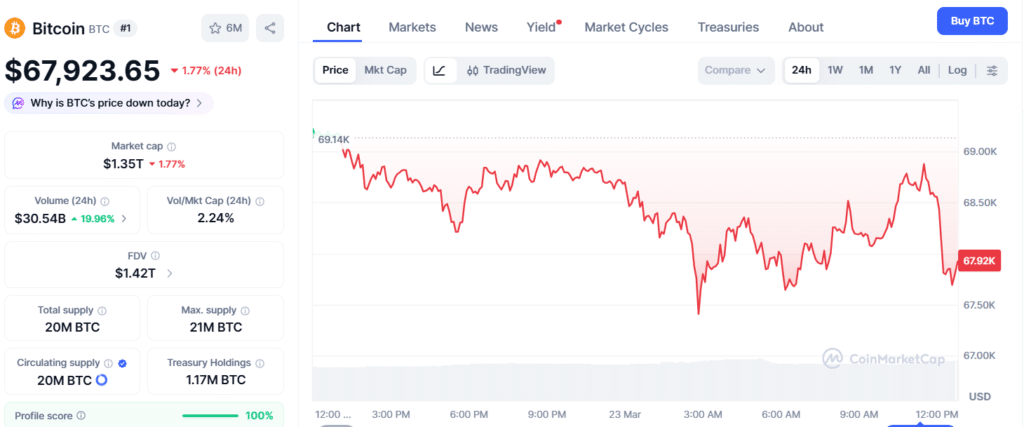
Despite this decline, it continues to hold above the important $66,000 support level, which has stayed intact through every major sell-off linked to the ongoing conflict since late February. At the same time, most global assets are facing pressure. Bond yields are moving higher due to rising inflation concerns. Central banks are now dealing with the possibility of increasing interest rates instead of cutting them, which is adding more uncertainty to the market.
Why are traditional safe havens failing to hold?
Gold’s recent performance is raising fresh questions about its role during times of crisis. The metal has dropped nearly 18% from its recent highs and is now trading around $4,147.00, marking its longest losing streak in years. This decline is notable because geopolitical tensions would usually increase demand for safe-haven assets like gold.
Alexander Blume, CEO of Two Prime, said, “The gold rally and the BTC collapse are more structural than market-based.” He explained that earlier large-scale buying by countries such as China has now reversed, as liquidity has become more important during the ongoing conflict. This shift shows that investors may be moving away from traditional static hedges and focusing more on flexible and liquid strategies.
What is happening across the broader crypto market?
The broader crypto market is showing mixed movement, while Bitcoin market resilience continues to stand out as relatively stronger. Ethereum is currently trading at $2,031.45, down 3.84% in the last 24 hours and 10.26% over the past week. XRP is at $1.36, falling 3.27% in 24 hours and 7.99% on a weekly basis. Tron is trading around $0.3063, down 1.21% in the last 24 hours, but it remains the only major token with a weekly gain of 3.05%.
On the other hand, several major tokens are facing stronger selling pressure. BNB is at $621.47, down 2% over the past 24 hours and 8.51% for the week. Solana is trading at $85.36, declining 3.29% in 24 hours and 8.9% over the week. Dogecoin stands at $0.09000, down 2.03% in the last 24 hours and recording the steepest weekly loss of 11.92%. Despite this broader weakness Bitcoin continues to fall at a slower pace than both traditional assets and most major cryptocurrencies.
What role do derivatives and institutional strategies play?
Blume stated that both Bitcoin’s price action and derivatives activity “have held up decently well” given the macro backdrop. He added that Two Prime is positioned for an increase in funding and futures rates in the coming months.
He further noted that “an upside surprise is more likely than the market expects,” signaling a contrarian institutional view despite current volatility. This positioning suggests that some market participants are preparing for a rebound rather than extended downside.
How is the geopolitical situation influencing markets?
The ongoing conflict is a key driver of current volatility across asset classes. A 48-hour ultimatum regarding the Strait of Hormuz is set to expire Monday evening, adding urgency to market sentiment. Iran has warned that any escalation could lead to a prolonged closure of the waterway and retaliatory actions targeting energy infrastructure.
Oil markets are already reacting. Brent crude is trading at $113 per barrel and has surged more than 70% this year. Goldman Sachs has raised its forecasts, describing the situation as the largest-ever supply shock to global crude markets. These developments are fueling inflation concerns and tightening financial conditions globally.
What should investors take away from current trends?
The current market environment reveals a disruption in established correlations. Gold prices are declining rather than appreciating. Equities are experiencing weakness, with futures indicating additional losses ahead. Bond yields are rising amid escalating concerns over inflation.

In this setup, Bitcoin market resilience stands out as a relative strength sign, even with a weekly price drop. strength sign, even with a weekly price drop. Investors rethink how they split up assets, some see Bitcoin as a backup choice during big economic uncertainty.
Conclusion
Bitcoin market resilience continues to stand out in a market where most assets are under pressure. While Bitcoin is not immune to declines, its ability to hold above $66,000 during a broad sell-off underscores its evolving role. Structural support from derivatives markets and cautious institutional positioning are adding to its stability.
Concurrently, the broader market remains vulnerable. The resolution of geopolitical tensions and central bank responses will prove pivotal in determining the trajectory ahead. At present, Bitcoin market resilience indicates a potential evolution in investor strategies for navigating uncertainty, though its endurance will face rigorous testing as events develop.
Glossary
Liquidity: Ease of buying or selling assets without affecting price
Bond Yields: Returns on government bonds, often rising with inflation fears
Derivatives Market: Trading of contracts based on underlying asset prices
Correction: Market decline of around 10% from recent highs
Inflation Pressure: Rising prices reducing purchasing power
Frequently Asked Questions About Bitcoin Market Resilience
Why are global markets falling right now?
Global markets are falling due to rising war tensions and economic uncertainty.
Why is the $66,000 level important for Bitcoin?
The $66,000 level is important as it acts as strong support where the price stays stable.
Why is gold falling during this crisis?
Gold is falling because investors are focusing more on liquidity instead of safety.
Which crypto is performing better right now?
Bitcoin is performing better as it is falling slower than most other assets.
Why are bond yields rising?
Bond yields are rising due to growing inflation concerns and possible interest rate hikes.
Sources:
Read More: Bitcoin Holds $68,300 While Gold Extends Selloff and Asian Stocks Turn Lower">Bitcoin Holds $68,300 While Gold Extends Selloff and Asian Stocks Turn Lower
0
0


 すべての暗号通貨、NFT、DeFiを1か所から管理
開始に使用しているポートフォリオを安全に接続します。


