
Nice Chart gets smarter: VWAP, order-book execution, and reliable market-making statistics
0
0
In the previous article, we introduced Nice Chart — a premium market-making mode designed to turn raw exchange activity into a chart that looks more natural, more trustworthy, and more aligned with how real markets behave.
The main idea is simple: liquidity alone is not enough. A market can have volume, but still look artificial. It can have trades, but still feel mechanical. It can have an order book, but still fail to create confidence for traders, investors, and project communities.
Nice Chart was built to solve that problem.
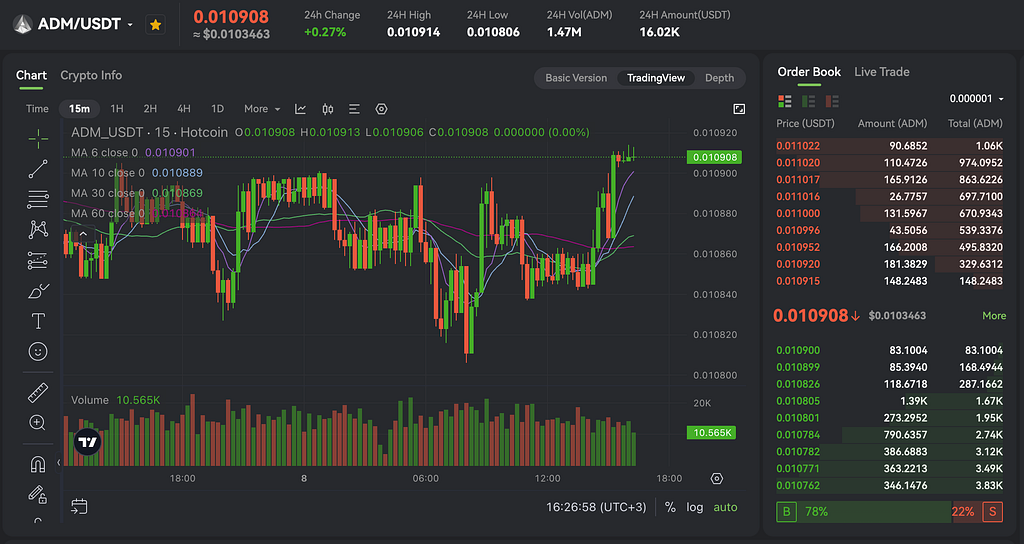
Now, with the latest improvements in adamant-tradebot version, Nice Chart becomes significantly more advanced under the hood. The update improves VWAP spread tracking, order-book execution logic, fill attribution, trader statistics, configuration flexibility, and internal type safety.
This is not just a cosmetic upgrade. It is a major step toward making automated market-making behavior more measurable, explainable, and production-ready.
From “Trading Activity” to Execution Quality
A simple market-making bot can place orders and create trades. But a serious market-making system needs to answer much deeper questions:
- Is the bot trading inside a reasonable spread?
- Is the execution aligned with market conditions?
- Are fills coming from our own strategy or from third-party market participants?
- Is the current volume healthy, or does it only look active on the surface?
- Can we explain the difference between planned trading behavior and actual execution?
The latest Nice Chart update focuses on these questions.
Instead of only generating activity, the execution engine now tracks more context around each trade, evaluates projected VWAP spread more precisely, and reports more detailed statistics about trader behavior and recently closed orders.
This helps operators understand not only what happened, but also why it happened.
Better VWAP Spread Tracking
VWAP — Volume-Weighted Average Price — is one of the most important indicators for understanding execution quality.
For Nice Chart, VWAP spread tracking helps estimate whether a potential trade fits the intended market-making corridor and whether it can be executed without making the chart look distorted.
The new update improves VWAP handling in several ways.
First, VWAP spread display precision has been fixed. Previously, the spread representation could be misleading because of percentage precision formatting. Now the display is more accurate and better suited for basis-point-level analysis.
Second, the allowed VWAP spread threshold has been adjusted to 0.6%. This gives the strategy more practical flexibility when matching orders in real market conditions, especially when spreads are not perfectly tight.
Third, the engine now handles negative projected VWAP spread scenarios more carefully. This matters because certain order-book situations can look acceptable at first glance, while the projected execution would actually distort the intended trade logic.
Together, these changes make VWAP-based decision-making more realistic and easier to monitor in production.
Smarter Order-Book Execution
One of the most important improvements is the new order-book execution policy.
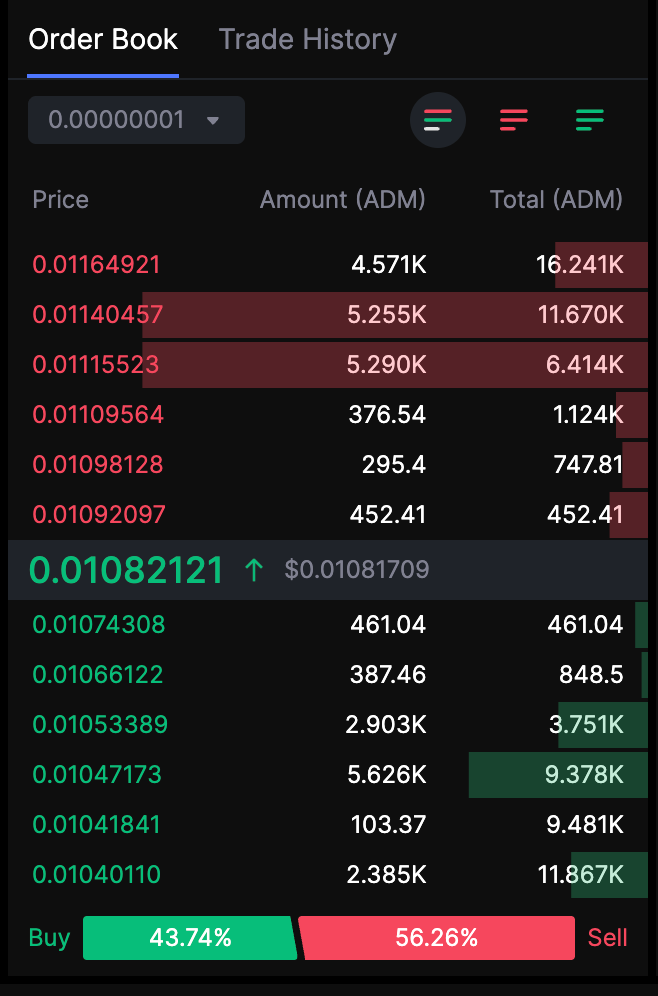
Market-making execution is not only about choosing a price. It is also about deciding where the trade should happen:
- Should the bot execute directly through the order book?
- Should it create or use synthetic orders?
- Should it limit the amount executed against existing liquidity?
- Should the trade be routed differently depending on current market conditions?
The updated Nice Chart engine introduces more explicit execution routing. This makes the strategy easier to reason about, easier to debug, and safer to operate.
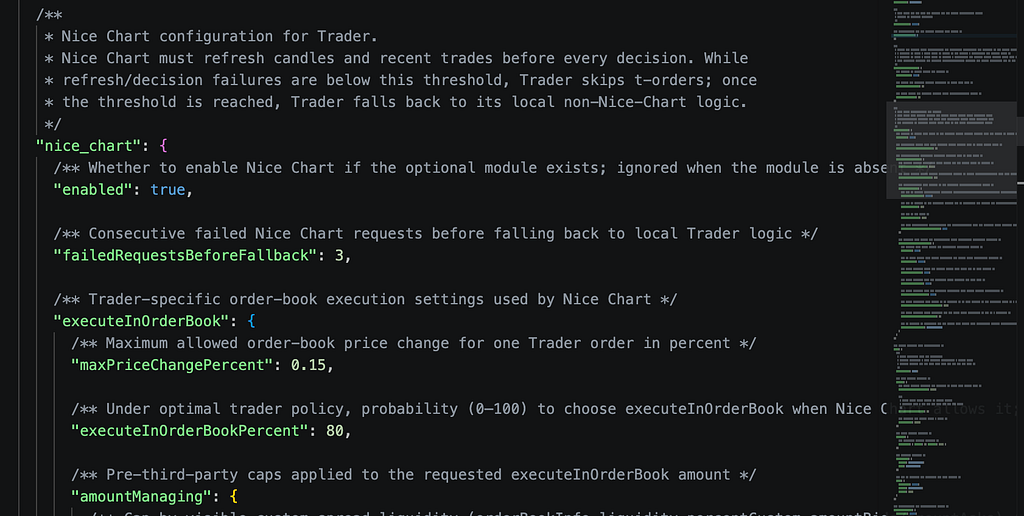
A new configuration parameter, executeInOrderBookPercent, allows operators to control what portion of a trade may be executed directly through the order book. This helps avoid overly aggressive consumption of visible liquidity and gives more control over how much of the trade should interact with existing orders.
This is especially useful for markets where the order book is shallow, uneven, or partially controlled by third-party traders.
Instead of blindly executing the full amount, Nice Chart can now apply amount caps and make more careful decisions.
More Transparent Execution Tracking
Automated market-making can become difficult to analyze when the logs do not clearly explain what the engine is doing.
This update adds more detailed execution tracking for Nice Chart order processing. The bot now provides clearer logs around order-book actions, routing decisions, amount limiting, and trade execution behavior.
This is important for two reasons.
First, it helps operators verify that the bot is following the intended strategy.
Second, it makes production monitoring much easier. When something unexpected happens — for example, a trade is partially filled, replaced, skipped, or matched differently — the logs provide more context.
Good logs are not just developer convenience. For trading systems, they are part of operational safety.
Improved Trader Statistics
The /orders t full command has also been enhanced.
Previously, trader statistics were more limited. The new version adds more context around recent closed orders, all-time statistics, trading volume, and epoch-based tracking. This gives operators a better view of current and historical performance.
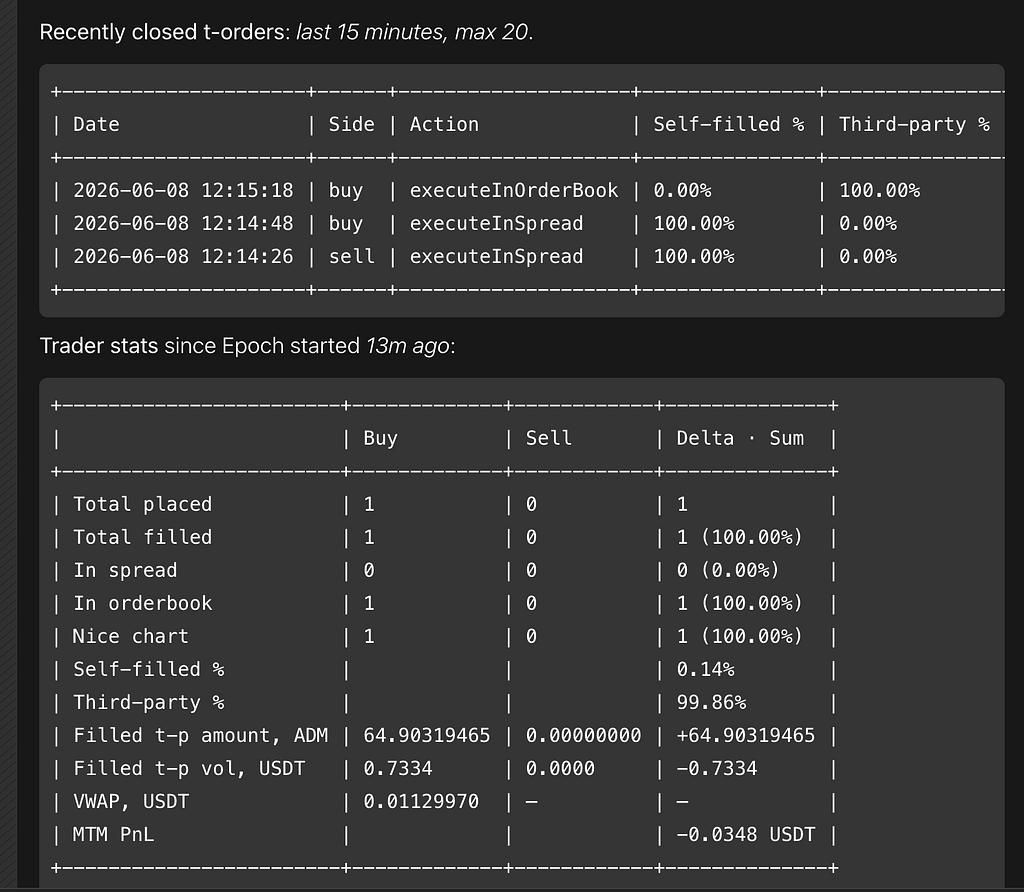
The updated statistics now make it easier to answer questions such as:
- How much volume has been generated since the current epoch started?
- How many recent orders were closed?
- What does current activity look like compared with all-time behavior?
- Is the strategy producing the expected amount of trading activity?
This is especially useful when Nice Chart is used as part of a premium market-making setup, where reporting quality matters almost as much as execution quality.
Projects, exchanges, and operators need visibility. The bot should not be a black box.
Better Fill Attribution
Another major improvement is third-party fill attribution.
In real markets, not every fill comes from the bot’s own direct action. Some fills happen because third-party orders interact with the market-making strategy. Others happen as part of planned execution. Some may be partial, delayed, or matched in ways that are not immediately obvious.
The new function attributeThirdPartyFillFromMatchPlan improves how the fills engine attributes third-party fills when order-book execution is involved.
This makes statistics more accurate and helps separate internal strategy behavior from external market interaction.
MTM PnL and USD Cashflow Improvements
The update also improves Mark-to-Market PnL calculations.
MTM PnL is useful because it estimates the current value of open positions based on market prices, rather than only realized profit or loss from closed trades.
The new version enhances MTM calculations with USD cashflow properties. This makes reporting clearer, especially for pairs where operators need to understand performance not only in base or quote assets, but also in USD terms.
Better reporting helps avoid false confidence.
Stronger Type System and Safer Development
This release also introduces several type system improvements.
New and updated type definitions were added for candlestick chart data, order-book information, execution configuration, price requests, trader settings, and Nice Chart configuration.
Although the project remains JavaScript-based with JSDoc type annotations, better type definitions help catch mistakes earlier, improve editor support, and make complex trading logic more understandable for developers.
For a trading bot, type safety is not just a code-quality preference. It reduces the risk of subtle execution bugs.
Better Testing and Mock Scenarios
Nice Chart now has broader test coverage for order-book actions, amount limiting, fill processing, VWAP behavior, and utility functions.
Mock data was also expanded to cover more realistic order-book situations.
This matters because trading logic is full of edge cases. A function may work correctly in a simple scenario, but fail when the order book is thin, when third-party orders appear before execution, when amounts are limited, or when fills are only partial.
Configuration Updates
The default configuration has been extended with new Nice Chart execution settings.
New parameters make it easier to tune order-book execution behavior without changing code. This is especially important because different markets require different execution policies.
No database migration required: The update is backward-compatible with existing order data. No database migration is required, and new configuration parameters have sensible defaults.
This makes the upgrade easier for existing installations. Operators can update to version 23.0.0 and begin testing the new Nice Chart behavior without restructuring stored data.
If needed, Nice Chart order-book execution can also be disabled or rolled back while keeping the rest of the system operational.
What Operators Should Monitor
Because this release improves core execution behavior, operators should monitor several areas after upgrading.
The first area is VWAP spread behavior. The new 0.6% threshold may affect matching logic, especially in tight or unstable spreads.
The second area is order-book execution frequency. The new routing logic and amount caps may change how often trades are executed directly through existing liquidity.
The third area is fill attribution. Third-party fills should be compared with exchange records to confirm that statistics match real execution.
And finally trader statistics. The enhanced output should be checked to confirm that volume, recent closed orders, epoch metrics, and all-time statistics are displayed correctly.
Conclusion
With improved VWAP tracking, explicit order-book execution policy, better fill attribution, stronger statistics, more complete tests, and safer type definitions, adamant-tradebot makes Nice Chart a more mature tool for premium market-making operations.
The first version of Nice Chart introduced the concept: market-making should not only create volume, but also produce a chart that people can trust.
This update improves the engine behind that idea.
Nice Chart now has better execution control, better reporting, better attribution, and better developer safety. It gives operators more insight into what the bot is doing and more tools to tune how it behaves in real market conditions.
For projects that care about liquidity, visual market confidence, and long-term trading credibility, this is an important step forward.
Nice Chart is becoming not just a feature, but a professional market-making layer focused on realistic execution and transparent performance.
Nice Chart gets smarter: VWAP, order-book execution, and reliable market-making statistics was originally published in ADAMANT on Medium, where people are continuing the conversation by highlighting and responding to this story.
0
0
 すべての暗号通貨、NFT、DeFiを1か所から管理
開始に使用しているポートフォリオを安全に接続します。