
QuarkChain 2025 Annual Report
0
1

2025 marked a decisive inflection point for QuarkChain — a year in which we deepened our alignment with the Ethereum ecosystem and advanced the vision of the Super World Computer (SWC) from concept to reality. The direction of SWC was further validated as Ethereum progressed toward the Fusaka upgrade and reinforced its long-term trajectory, strengthening QuarkChain’s role as a contributor to the broader Ethereum roadmap.
Product Updates
1. Super World Computer Layer 2: From Testnet Beta and Gamma to Mainnet
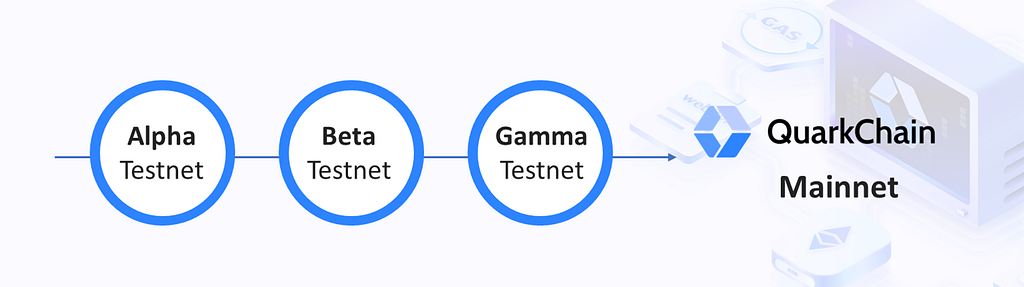
QuarkChain launched the Super World Computer (SWC) Layer 2 Beta Testnet in March 2024, marking a major milestone in our transition toward becoming an Ethereum-aligned Layer 2. Over the following seven months, the Beta Testnet underwent extensive validation across reliability, security, and developer experience.
In August, the Gamma Testnet was introduced as the final stage before mainnet and the first to validate our production-ready codebase and phased mainnet rollout strategy.
Today, the SWC is deployed on the Ethereum mainnet and is currently undergoing staged testing as we prepare for broader developer onboarding and ecosystem integration.
- Mainnet explorer link: https://explorer.mainnet.l2.quarkchain.io/
2. Web3:// — A Year Defined by Outages That Highlighted the Critical Need for Decentralized Access
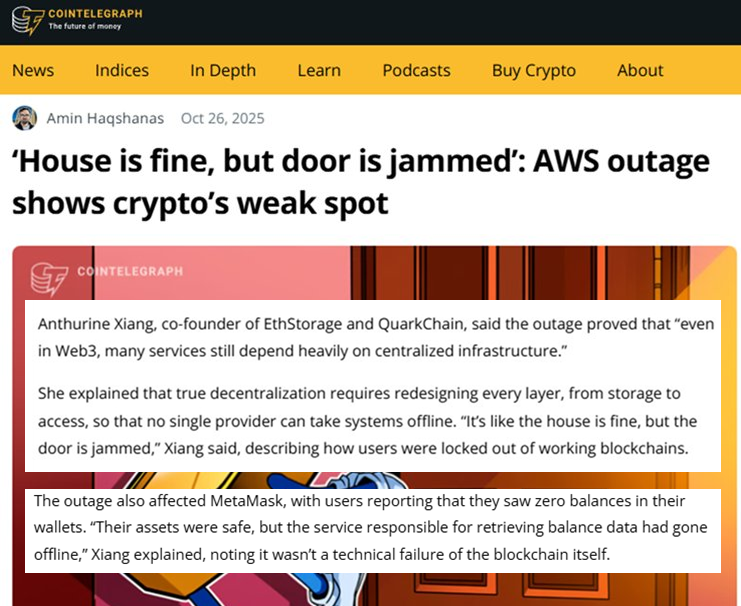
A series of major outages — including AWS, Bybit, Cloudflare, and the Aerodrome DNS incident — revealed a critical truth: even “decentralized” apps fail when their access layer depends on centralized infrastructure. These incidents brought renewed attention to web3:// (ERC-4804), a decentralized access protocol proposed by the QuarkChain team. By placing the frontend fully on-chain, web3:// removes reliance on DNS or centralized servers and enables direct, censorship-resistant on-chain access to dApps across ecosystems.
See Cointelegraph’s coverage featuring insights from QuarkChain’s co-founder:
- Cointelegraph — AWS outage and decentralization risks
- Cointelegraph — Cloudflare outage and the need for end-to-end decentralization
- Analysis of the Bybit incident and how web3:// could have prevented the attack
3. QuarkChain’s New Website Is Now Live
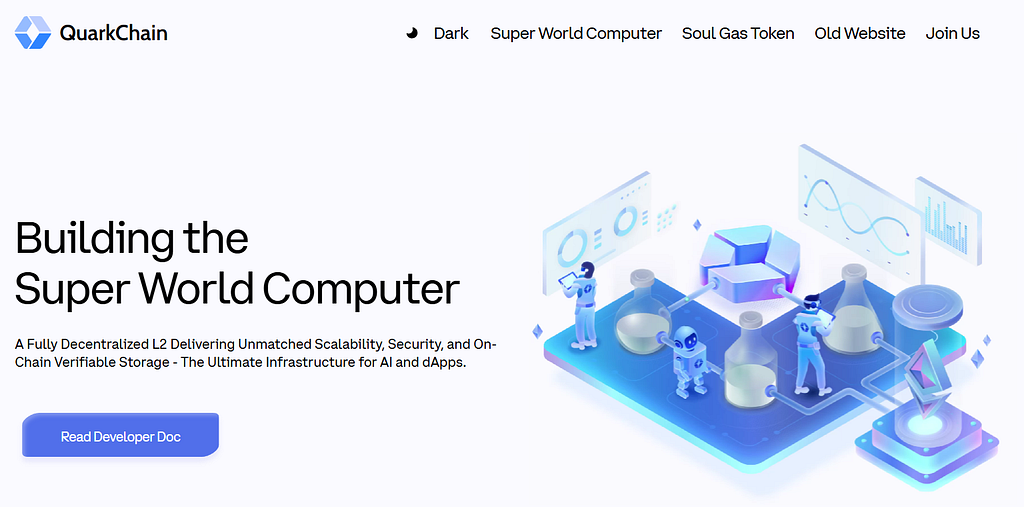
QuarkChain released a fully redesigned official website in 2025, showcasing our ongoing progress toward the Super World Computer.
The updated site provides a clearer and more structured overview of our work, including: Core innovations behind the Super World Computer, deep-dive research and technical advancements developed throughout the year, comprehensive documentation on the Soul Gas Token, and the overall SWC framework.
Visit our new website and see how QuarkChain is redefining Ethereum scaling.
Community Governance & Events
1. Governance Voting: Community Approval for Ethereum Layer 2 Migration

The QuarkChain community approved a major governance proposal to migrate from a standalone Layer 1 to an Ethereum Layer 2 built on the OP Stack. The proposal highlighted key benefits — inheriting Ethereum’s security, gaining native trustless interoperability, aligning with Ethereum’s rollup roadmap, and enabling faster innovation via an agile Layer 2 environment.
The Snapshot vote concluded with a 100% YES, marking a highly decisive governance outcome in QuarkChain’s history. This strong mandate allows QuarkChain to proceed with the migration and begin its next chapter as an Ethereum-aligned Layer 2.
2. EIP-7907 Featured in PEEPanEIP Session
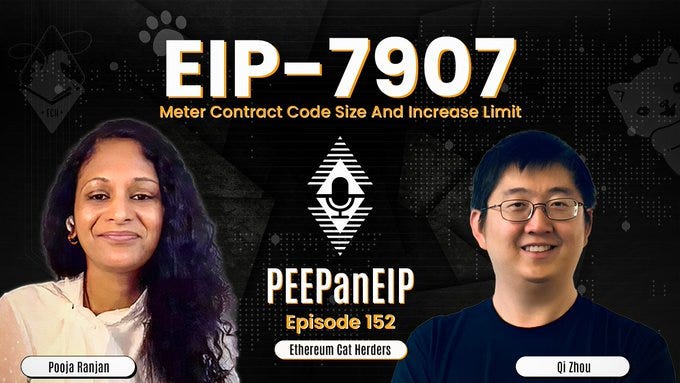
QuarkChain’s research visibility continued through a technical session PeepanEIP hosted by the Ethereum Cat Herders, where EIP-7907 was featured. The session explored how EIP-7907 increases the contract code size limit introduced in EIP-170 and introduces gas metering for dynamic code loading — an important step toward more flexible and scalable smart contract architectures.
Ecosystem and Exchange Updates
1. QKC Listed With a KRW Pair on Bithumb

QKC is now listed on Bithumb with a KRW trading pair. This listing significantly enhances QKC’s reach among Korean users, expands liquidity pathways, and creates new opportunities for deeper engagement and long-term ecosystem growth.
2. Pieverse Collaboration: Strengthening Transparency and Expanding Practical Token Utility

QuarkChain deepened its commitment to transparent and verifiable on-chain finance by joining the Pieverse Timestamping Alliance, a strategic network focused on compliant, automated, and audit-ready blockchain activity. QuarkChain also participated in the Pieverse Booster Program, enabling real-world utility by issuing timestamped invoices via Pieverse and completing payments using QKC, with additional incentives for Binance Wallet users and Pieverse Points for future airdrop eligibility.
3. QuarkChain Partners with ElizaOS for Fully On-Chain AI Agents

QuarkChain has successfully integrated with Eliza, a powerful multi-agent simulation framework designed to create, deploy, and manage autonomous AI agents.
With this integration, QuarkChain provides decentralized, high-performance execution, reducing reliance on centralized infrastructure and allowing AI agents to operate in a trustless Web3 environment.
4. QuarkChain Joins the Fracton Incubation Cohort 4
QuarkChain has joined as a partner in the Fracton Incubation Cohort 4, offering founders hands-on mentoring and technical guidance directly from our core team.
We support builders shaping the future of the ecosystem — providing the tools, knowledge, and real-world experience they need to accelerate their growth and bring meaningful innovations to life.
Research and Ethereum Ecosystem Contributions
QuarkChain has played an increasingly active role in advancing Ethereum’s core research. These efforts span EIP-7907 (raising contract size limits), ERC-4804/6860 (web3:// protocol), EIP-7923 (Improves EVM memory with a page-based model leveraging hardware virtual memory for lower overhead), early conceptual work related to EIP-7928 (block-level access lists), and contributions to EIP-663 (Unlimited SWAP and DUP instructions).
Alongside these technical contributions, Qi Zhou joined Ethereum researcher Lawrence Lee for a widely discussed conversation on Ethereum’s current trajectory.
1. EIP-7907 Progress: Candidate for the Glamsterdam Upgrade
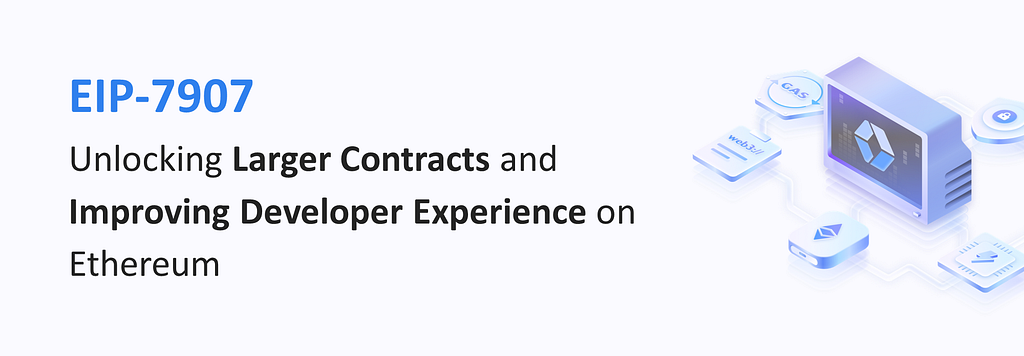
EIP-7907, co-authored by QuarkChain, is now officially a candidate for Ethereum’s upcoming Glamsterdam upgrade. This marks a major milestone not only for QuarkChain but also for the broader Ethereum community.
By addressing a long-standing bottleneck in developing contracts, this EIP takes a critical step toward improving the developer experience on Ethereum.
2. Optimized EVM Memory Access Demonstration (EIP-7923)
Qi wrote an optimized EVM memory access demo showcasing the power of EIP-7923 by deferring boundary and allocation checks to the hardware. It relies on the assumptions defined in EIP-7923 — memory allocated in 4KB pages, page-based allocation, and a fixed memory limit (e.g., 1MB) — and uses mmap with read/write permissions for allocated pages and none for unallocated ones. When an unallocated page is accessed, the hardware triggers a SIGSEGV, which is intercepted by a signal handler that charges gas and allocates the page on demand by switching permissions to read/write, making EVM memory access nearly as fast as native memory access, with the only overhead being gas metering.
3. Insights from the Ethereum Pectra Testnets
During the Pectra testnet cycle, our engineering team analyzed unexpected client behaviors as Ethereum’s Pectra upgrade faced challenges on testnets. The first attempt on Holesky remained incomplete, while the second on Sepolia saw a surge in empty blocks due to a staking deposit contract bug, where unexpected token events caused blocks to be rejected and were exploited before a fix was fully deployed. Client teams rolled out a temporary fix and deployed updates within 3.5 hours, highlighting how even testnet upgrades can expose unexpected vulnerabilities and the complexity of securing decentralized networks.
4. Achieving 10 GigaGas/s EVM Execution With BAL and Parallel Execution
The QuarkChain team published “Achieving 10 GigaGas/s EVM Execution with BAL and Parallel Execution” on EthResearch, presenting a detailed study on how EVM execution can scale once sequential bottlenecks are removed.
The research evaluates EIP-7928 Block-level Access Lists (BAL) and per-transaction parallel execution in a pure-execution environment. Using this setup, the team demonstrated over 10 GigaGas/s of execution throughput on a modern 16-core commodity PC, with peak results reaching approximately 14 GigaGas/s under mega-block workloads.
5. Demystifying Blockchain KV Lookups: From O(log N) to O(1) Disk I/O
In this research, we conducted an empirical study of the practical disk I/O behavior of LSM-based key-value storage under realistic blockchain workloads using Pebble. Through extensive controlled experiments, we find that once Bloom filters (excluding the bottommost level, LLast) and index blocks reside in cache, most negative lookups incur zero disk I/O and the I/Os per Get rapidly converge to ~1–2, largely independent of total database size. These results show that, despite the theoretical O(log N) worst-case bound, the practical read I/O behavior of LSM-based KV storage in blockchain systems is effectively O(1) under cache configurations sufficient to hold key metadata.
6. Block-Level Access Lists & EIP-7928
Qi Zhou publicly welcomed EIP-7928’s introduction of block-level access lists as a way to reduce EVM performance bottlenecks caused by random IO latency. The QuarkChain team had previously explored similar ideas for block-level access lists in an ESP academic grant proposal with early experiments on both Geth and Reth.
QuarkChain’s role extends beyond scaling. We actively participate in EVM-level performance, parallel execution, and IO optimization research that benefits the entire Ethereum ecosystem.
Check out the original post here.
Global Engagements 2025: Expanding the Super World Computer Vision Worldwide
1. Strengthening Presence and Community Engagement in Korea
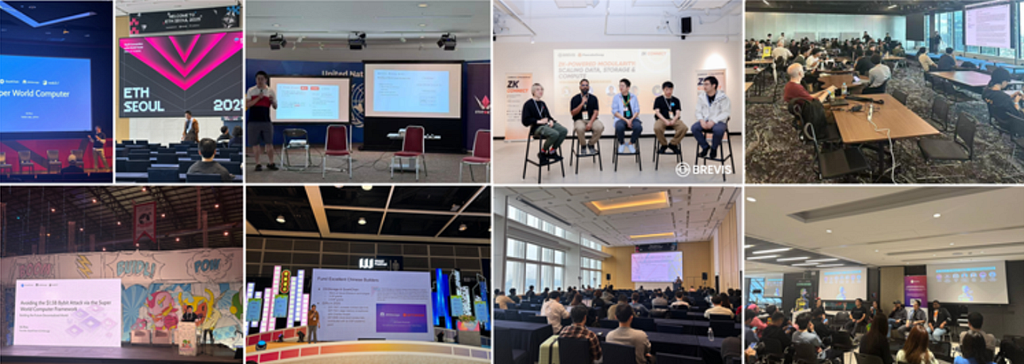
QuarkChain maintained a strong presence in Korea throughout the year, recognizing the Korean market as highly important. The founders of QuarkChain visited Korea during Korea Blockchain Week 2025, and the team co-hosted and participated in more than ten panels, meetups, and workshops — including Super World Computer 2025, The Verified Summit, and various community sessions. The team was also invited to EthSeoul, reinforcing Korea’s role as a core hub for Ethereum adoption and developer engagement.
To better support Korean builders and users, we strengthened our Korean-language communication channels through regular technical updates, including those published on our official Korean blog.
Our work also gained significant visibility through a feature interview in Decenter, one of Korea’s most trusted and respected blockchain media outlets.
2. Global Conference Participation
Throughout 2025, QuarkChain participated in major Web3 events worldwide, sharing new research, presenting the Super World Computer roadmap, and collaborating with builders and researchers across the Ethereum ecosystem.
Qi Zhou delivered multiple high-impact talks, beginning with his ETHDenver session on preventing the $1.5B Bybit exploit through fully on-chain access and the Super World Computer framework. During EthDenver Week, QuarkChain also participated in the Intersubjective Summit, and later joined the Ethereum Portal Summit, engaging in in-depth discussions with Ethereum Foundation core developers on key infrastructure challenges. At EthPrague 2025, co-founder Anthurine showcased two key innovations — EIP-7907 and the Soul Gas Token for large-scale Web2-to-Web3 onboarding. The team further engaged at Devconnect and EthSF through panel participation and extensive discussions with ecosystem participants.
3. Expanding Ecosystem Engagement Across Asia
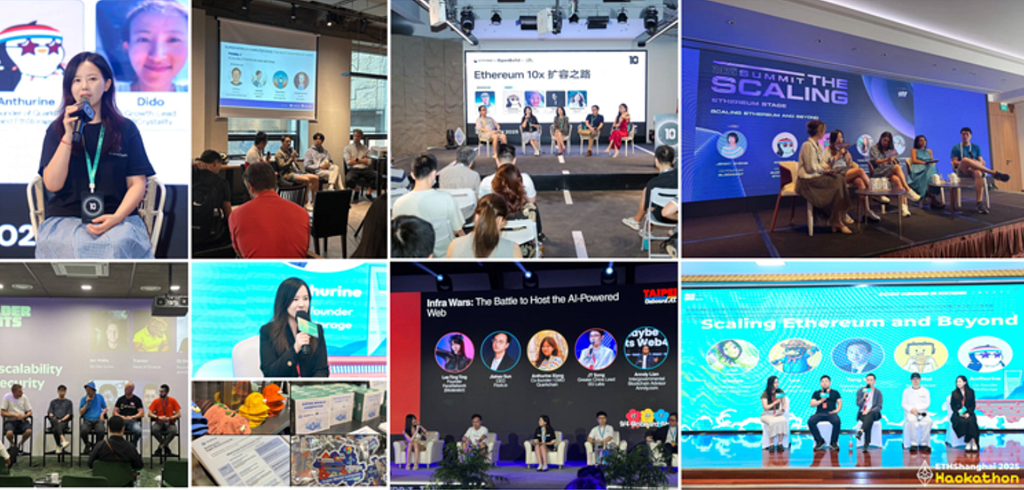
Across Asia, QuarkChain focused on deepening ecosystem engagement and supporting local builder communities.
During Hong Kong Web3 Festival week, our team participated in multiple events, including ZKConnect, AI Agent Summit, Meme Zoo Happy Hour, and the EthAsia Open Stage.
Qi introduced EIP-7923 at ETH Tokyo, outlining a sparse-page memory model designed to improve EVM execution efficiency. We also joined a panel titled “Infra Wars: The Battle to Host the AI-Powered Web” at Taipei Blockchain Week.
Across China, QuarkChain joined Web3 × AI Hangzhou, AdventureX Hackathon, and the LxDAO Sharing Session: Building on the OP Ecosystem. The team also joined the Ethereum Scaling Next Chapter panel and delivered a talk on EIP-7907 at Ethereum Protocol Day during EthShenzhen, as well as Summer of Ethereum at EthShanghai.
In Singapore, ahead of Token2049, Qi presented new research on Block-Level Access Lists, Geth benchmarking, and EVM compiler optimizations at a pre-Token2049 meetup. At The Scaling Summit, Anthurine joined the Ethereum Stage to discuss L1 scaling progress and scalable storage for mass adoption.
If you have any questions, please visit our community channels for support and more information.
Discord | Twitter | Telegram | Website | Blog
0
1

 从同一位置管理所有加密资产、NFT 和 DeFi 资产
安全地关联您正在使用的投资组合,以开始交易。


