
Prediction Market Volume Hits $8.6B in April 2026 as Kalshi Leads

0
0

This article was first published on The Bit Journal. Prediction market has now grown to become one of the fastest-growing sectors of global finance, with the volume of trading in the industry now exceeding $63 billion in 2025 and competition growing between market leader Kalshi and Polymarket.
These prediction markets enable users to trade contracts involving future events, including elections and sporting events, cryptocurrency prices and economic data. Every contract will pay off at the price of $1 in the event of the outcome being predicted and pay off at the price of $0 in the event of the outcome not being predicted.
Prediction Market Evolved From Wall Street
The concept itself is far from new as prediction market has their roots in the 19th-century Wall Street speculation on the outcomes of elections. The idea gained academic legitimacy in 1988 when the University of Iowa launched the Iowa Electronic Markets, demonstrating that crowd-driven pricing could outperform traditional polling models.
Prediction market started to be actively used commercially in the 2000s with Intrade gaining mainstream attention before regulatory pressure caused it to be shut down in the United States. Experimentation based on blockchain followed, with Augur leading in the 2010s, but the adoption was low.
Prediction market started to expand modernly in 2020 with the launch of Polymarket on Polygon, using USD Coin as settlement. In 1998, Kalshi was the first federally regulated prediction exchange in the history of the United States after being approved by the Commodity Futures Trading Commission.
Kalshi Outpaces Rivals In Trading Volume
Momentum accelerated sharply during the 2024 U.S. presidential election cycle, bringing prediction markets into mainstream financial coverage and pushing monthly trading activity into the multi-billion-dollar range.
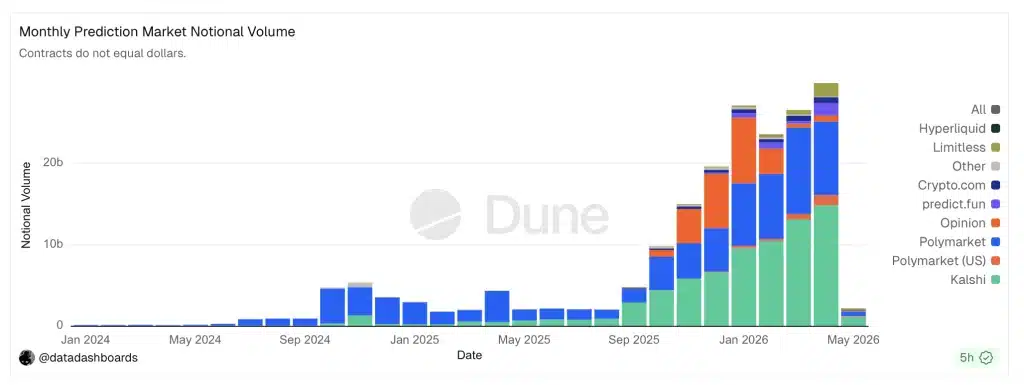
However, monthly prediction market taker volume peaked at almost $25.7 billion by March 2026, and then dropped to 8.6 billion in April. Though the slowdown happened, April data indicated Kalshi was firmly leading the sector with 5.42 billion taker volume, far ahead of 1.99 billion taker volume of Polymarket.
Smaller prediction markets competitors also continued gaining traction. Predict.fun reported a volume of $579.2 million in April, with Opinion recording a volume of $376.2 million, and Limitless has a volume of $205 million.
Kalshi And Polymarket Dominate Prediction Market
The overall notional trading volume in the prediction market industry was $29.8 billion in April. Kalshi once again topped the list with $14.8 billion and Polymarket with $9 billion. The U.S.-oriented product of Polymarket added another $1.26 billion to the product upon its legal re-entry into the American market via the QCEX acquisition late in 2025.
The activity of transactions in the context of prediction market was highly competitive. Polymarket was doing 87.4 million trades in April, as compared to 94.4 million trades in April by Kalshi. The two platforms collectively comprised almost the entire 184.3 million monthly transactions in the industry.
Where Polymarket continues to dominate in prediction markets is user growth. In April the platform had 678,342 unique traders, more than eight times the estimated number of active users on Kalshi. Limitless was the second system with more than 71,000 users, followed by Predict.fun and Opinion.
Prediction Market Opens Interest Reaches $1.11B
There were $1.11 billion open positions in the prediction market sector, with Kalshi controlling positions valued at $630.7 million and Polymarket controlling positions valued at $449.9 million.
The trend in the revenue in prediction market, however, tells a different story. In April, platform fees of $31.15 million were reached by Polymarket, which captures $29.22 million in far outpacing all competitors, yet trailing Kalshi in traded volumes. Analysts interpret this as an indication that the global user base of Polymarket is still placing large and bigger margin contracts.
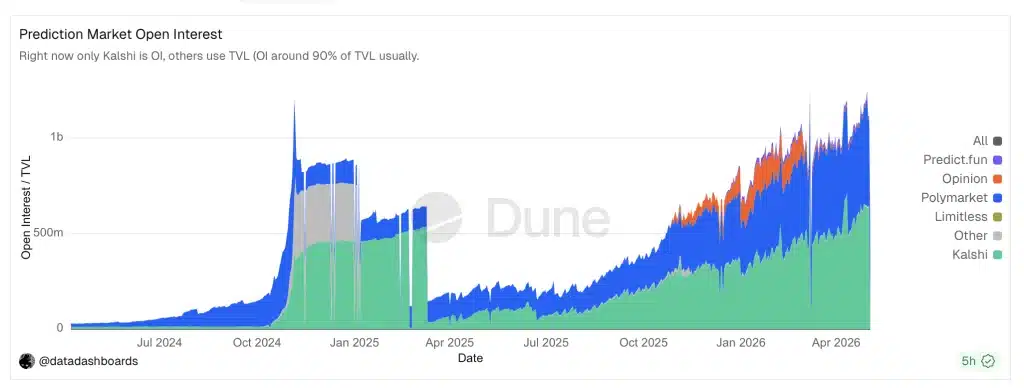
The most recent statistics demonstrate the pace at which prediction market have become mature. The volume of taker on a monthly basis has not been above 500 million as recently as mid-2024. The industry of prediction market has grown over 17 times in less than two years with an estimated 85 percent to 95 percent of all market activity now controlled by Kalshi and Polymarket.
Conclusion
As the prediction market continues to grow faster than ever before, the competition between Kalshi and Polymarket is redefining the way traders price future events. As volumes continue to soar, users adopt more, and regulatory frameworks continue to evolve, the sector seems to be in another phase of mainstream financial growth in 2026.
Follow us on Twitter and LinkedIn, and join our Telegram channel to be instantly informed about breaking news!
Summary
- Prediction market topped $63B in 2025, showing rapid growth.
- Kalshi leads volume; Polymarket leads users and fees.
- The sector has expanded over 17× since 2024, with both platforms controlling up to 95% of market activity.
Glossary of Key Terms
Kalshi
U.S. regulated prediction market exchange.
Polymarket
Crypto-based prediction trading platform.
Taker Volume
Value of executed market trades.
Open Interest
Value of active unsettled contracts.
Liquidity
Ease of buying and selling contracts.
User Growth
Increase in active traders.
Fee Revenue
Income from trading fees.
CFTC
U.S. financial derivatives regulator.
Regulated Exchange
Legally approved trading platform.
Frequently Asked Questions about Prediction Markets
1. What are prediction markets?
Platforms where users trade on future events, paying $1 if correct.
2. Who leads the market?
Kalshi leads volume, Polymarket leads users and fees.
3. How large is the industry?
It exceeded $63B in 2025 with rapid growth.
4. Why are they popular?
They offer crowd-based forecasts on real-world events.
References
Disclaimer
The article is purely informational and it is not a financial, investment, or a trading advice. Cryptocurrencies are extremely risky and volatile. Before investing, the readers are to conduct personal research and seek the advice of a qualified financial expert.
Read More: Prediction Market Volume Hits $8.6B in April 2026 as Kalshi Leads">Prediction Market Volume Hits $8.6B in April 2026 as Kalshi Leads
0
0
 Manage all your crypto, NFT and DeFi from one place
Securely connect the portfolio you’re using to start.