
Updates to the Hiero JSON-RPC Relay Default Configuration for Ethereum-Style Alignment | April 2026
1
1
By Luke Forrest
The April 2026 release of the Hiero JSON-RPC Relay (v0.77.0), updates several default configuration values to better align the Relay’s behavior with what developers expect from standard Ethereum JSON-RPC implementations.
What’s Changing
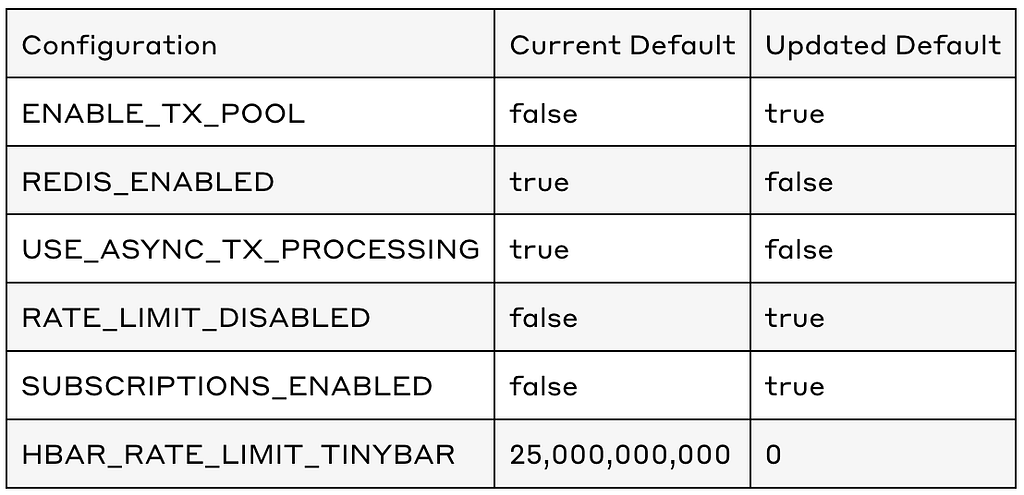
If you explicitly set these configuration values today, nothing changes for you. If you rely on defaults, your relay behavior will change after upgrading:
- Transaction pool enabled by default (ENABLE_TX_POOL=true)
Expect increased in-memory tracking of pending transactions versus previous defaults. - WebSocket subscriptions enabled by default (SUBSCRIPTIONS_ENABLED=true)
Expect more long-lived connections and potentially higher resource usage depending on client behavior. - Redis is disabled by default (REDIS_ENABLED=false).
Redis-backed behavior is not used with defaults after upgrading unless this setting is explicitly configured. - Async transaction processing is disabled by default (USE_ASYNC_TX_PROCESSING=false).
Transaction processing runs synchronously by default, which shifts where load is handled and can change memory and CPU usage patterns compared to the previous default. - Relay internal rate limiting disabled by default (RATE_LIMIT_DISABLED=true, HBAR_RATE_LIMIT_TINYBAR=0)
Any rate limiting for the endpoint would be handled outside the Relay unless these settings are explicitly configured. This may result in additional spend on metered instances.
Why We’re Making This Change
The relay is often used as the “Ethereum-like” interface for tools such as wallets, indexers, explorers, and dApp backends. Many of these tools implicitly assume common Ethereum node behaviors.
These default changes move the Relay closer to those expectations, while still allowing operators to override any setting.
What You Need to Do
Before you upgrade to the Hiero JSON-RPC Relay v0.77.0, decide whether you want the new defaults or to preserve the existing behavior.
Option A: Accept the new defaults
No action needed.
Option B: Preserve existing behavior
If you prefer to keep the existing behavior to avoid changes, you can explicitly set these values in your environment / Helm values / compose file:
# Preserve prior defaults
ENABLE_TX_POOL=false
REDIS_ENABLED=true
USE_ASYNC_TX_PROCESSING=true
RATE_LIMIT_DISABLED=false
SUBSCRIPTIONS_ENABLED=false
HBAR_RATE_LIMIT_TINYBAR=25000000000
Conclusion
If you are currently using the Hiero JSON-RPC Relay, review the changes above and explicitly set any values you want to preserve or update before upgrading to v0.77.0. If you have any questions or need guidance during this transition, please reach out on the Hedera Discord server or other official community channels.
Updates to the Hiero JSON-RPC Relay Default Configuration for Ethereum-Style Alignment | April 2026 was originally published in Hedera Blog on Medium, where people are continuing the conversation by highlighting and responding to this story.
1
1
 从同一位置管理所有加密资产、NFT 和 DeFi 资产
安全地关联您正在使用的投资组合,以开始交易。