
4 US Economic Signals That Could Move Bitcoin in the President’s Day Holiday Week

0
0

Bitcoin is entering a pivotal macro week as it hovers near $68,600 on February 16, 2026. After a volatile start to the year, including a sharp retracement from 2025 highs above $126,000, markets remain highly sensitive to US economic data.
Tariff tensions, sticky inflation, and the Federal Reserve’s decision to pause rate cuts have kept risk assets on edge. With US markets closed Monday for Presidents’ Day, liquidity is thinner than usual, a factor that could amplify volatility once major data begins midweek.
US Economic Data Crypto Traders Must Watch This Week
Traders are focused on four key releases: the January FOMC minutes on Wednesday, initial jobless claims on Thursday, and Friday’s Q4 GDP revision alongside December PCE inflation.
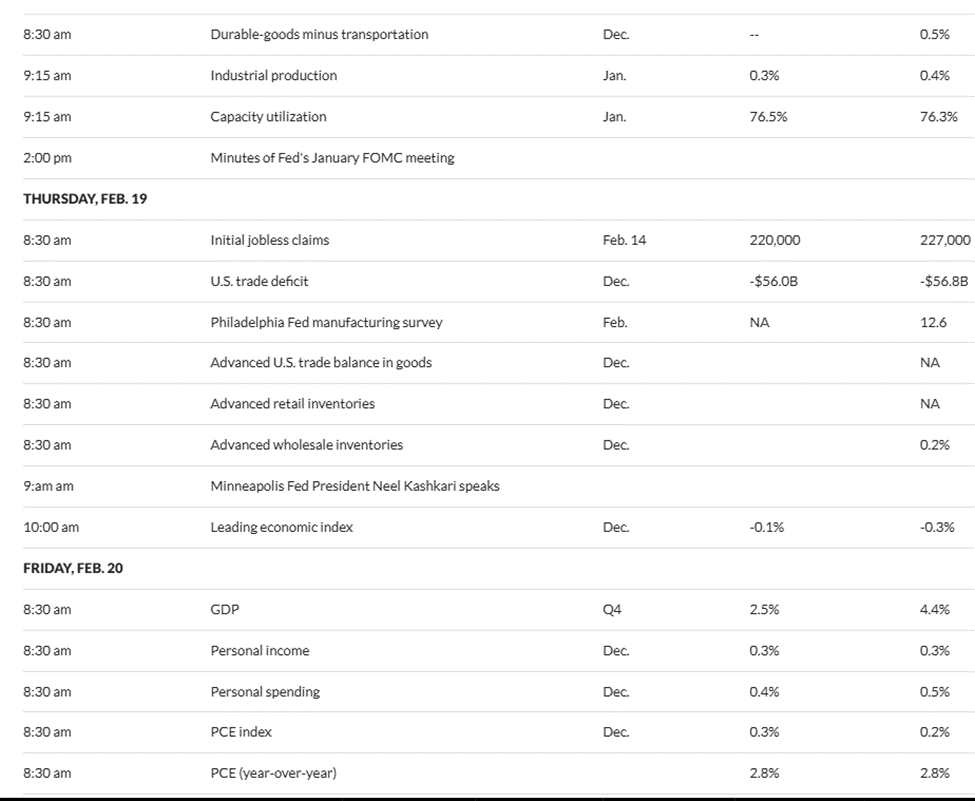 US Economic Data to Watch This Week. Source: Market Watch
According to CME FedWatch data, markets are pricing just 9.8% odds of a March rate cut, reflecting skepticism that easing is imminent.
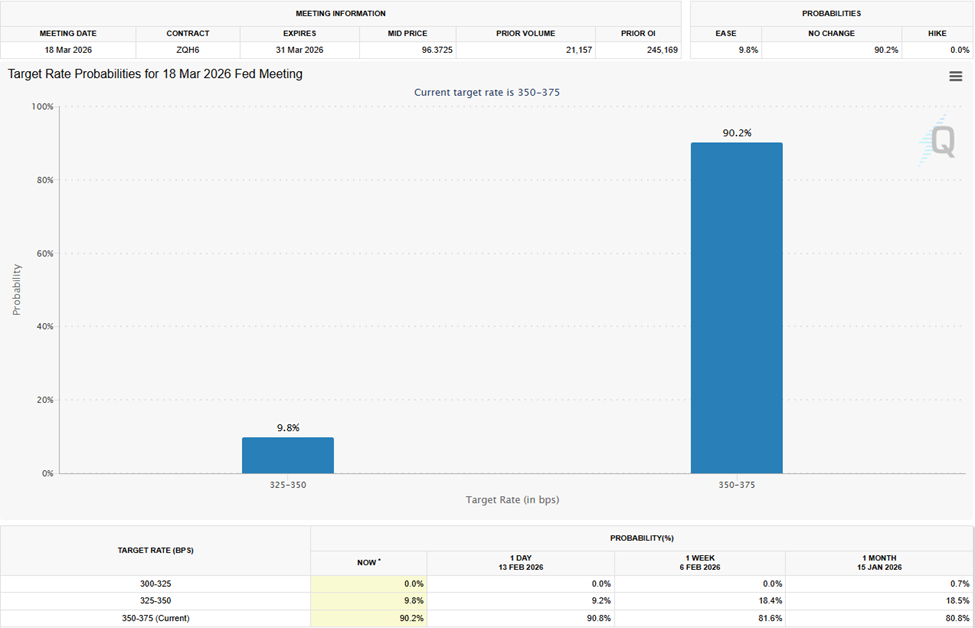 March Interest Rate Cut Probabilities. Source: CME FedWatch Tool
In this environment, even modest surprises could determine whether Bitcoin tests $70,000 resistance or revisits the $60,000 support zone.
FOMC Minutes
The release of the January FOMC (Federal Open Market Committee)minutes will likely set the week’s tone.
The Fed held rates steady at 3.50%–3.75% during its last meeting, signaling caution amid resilient growth and persistent services inflation.
FOMC minutes on Wednesday will provide deeper insight into policymakers’ internal debates, particularly around inflation risks, labor strength, and tariff-related pressures.
A hawkish tone emphasizing sticky inflation or upside risks could reinforce “higher for longer” expectations. Historically, similar signals have triggered 3–5% Bitcoin pullbacks within 24 hours as Treasury yields rise and liquidity expectations tighten.
Conversely, any language suggesting balanced risks or growing concern over slowing growth could revive rate-cut speculation.
In holiday-thinned trading conditions, even subtle dovish cues may be enough to push Bitcoin toward $70,000.
Initial Jobless Claims
Thursday’s jobless claims report offers a real-time snapshot of labor market health, a core pillar of the Fed’s dual mandate.
Consensus expects roughly 220,000 new filings for the week ending February 14, down from 227,000 previously.
A reading below 210,000 would reinforce labor resilience and reduce the likelihood of near-term easing. That outcome could pressure Bitcoin 1–3% lower as markets recalibrate rate-cut expectations.
On the other hand, claims above 230,000 would raise concerns about softening employment conditions. In past cycles, weaker labor prints have boosted risk assets on the assumption that the Fed may pivot sooner. Such a scenario could lift Bitcoin 2–4% as easing bets increase.
With BTC consolidating between $68,000 and $69,000, this release may serve as a bridge between Wednesday’s Fed insight and Friday’s inflation data.
Q4 2025 GDP (Final Revision)
Friday’s final Q4 GDP revision is expected to show +2.5% annualized growth, a significant step down from the initial +4.4% estimate.
A downside surprise below 2.3% would reinforce slowdown narratives and potentially boost Bitcoin 3–6% as markets price in earlier policy relief. Softer consumer spending, which accounts for roughly 70% of GDP, would be closely watched.
However, a print above 2.7% could complicate the outlook. Strong growth may delay easing, reinforcing “higher for longer” expectations and weighing on crypto markets.
Bitcoin remains highly correlated with equities during major macro releases. Strong growth combined with persistent inflation has historically triggered short-term BTC pullbacks.
PCE & Core PCE
The week’s most important catalyst arrives with December’s PCE inflation report, the Fed’s preferred inflation gauge.
Expectations call for +0.3% month-over-month increases in both headline and core PCE, with year-over-year readings around 2.8–2.9%.
A cooler-than-expected 0.2% MoM print would signal further disinflation progress. That outcome could meaningfully increase the probability of a rate cut and spark a 4–8% Bitcoin rally, potentially pushing prices decisively above $70,000.
But a hotter print above 0.3% would reinforce sticky inflation concerns, likely triggering 3–5% downside pressure as yields climb and easing hopes fade.
Core PCE, which strips out food and energy, will carry particular weight for policymakers and traders alike.
From Fed messaging to labor resilience, growth revisions, and inflation data, each release feeds directly into expectations for 2026 monetary policy.
With Bitcoin stabilizing near $68,600 but still well below its 2025 highs, the market remains acutely sensitive to liquidity signals.
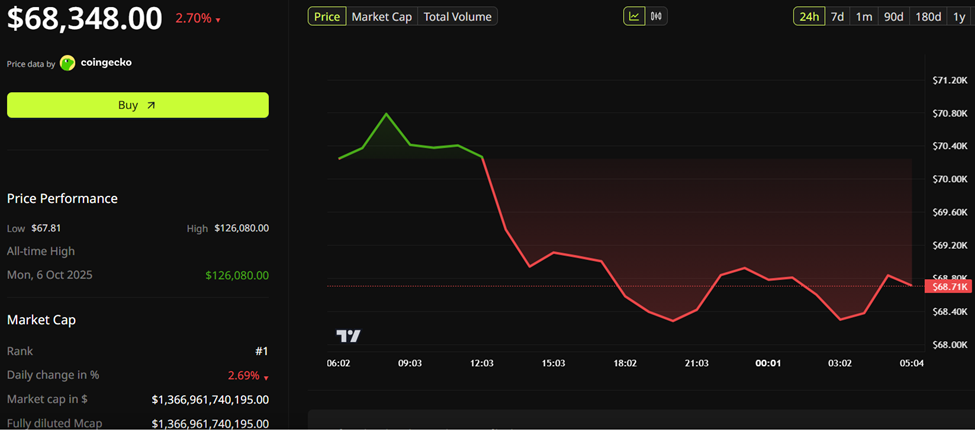 Bitcoin (BTC) Price Performance. Source: BeInCrypto
Dovish surprises across the board could reignite risk appetite and drive a breakout toward $70,000 and beyond. Hawkish data, however, may deepen the correction toward $60,000–$65,000.
0
0


 Manage all your crypto, NFT and DeFi from one place
Securely connect the portfolio you’re using to start.

0
0


0
0
