
Ethereum Risks Drop to $2,000 as Macro Volatility Intensifies

0
0

This article was first published on The Bit Journal.
Ethereum is currently under close watch as global financial markets see fresh turbulence. According to Bloomberg Intelligence senior commodity strategist Mike McGlone, Ethereum carries major downside risk, with price action potential drifting towards its previous support near $2K instead of breaking above the conventional resistance near $4K.
McGlone’s Take on Ethereum Downside Risk Potential
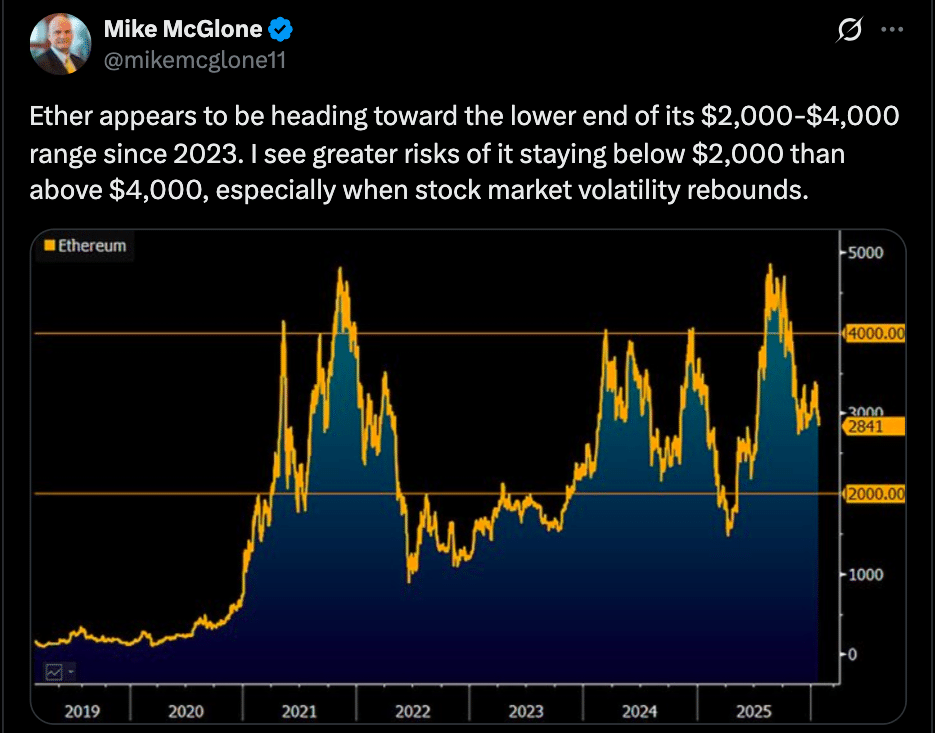
McGlone, a well-known strategist for his long term views across commodities and digital assets, said on his social platform X, that Ethereum “appears to be heading toward the lower end of its $2,000-$4,000 range”, a zone which has been traded for large parts of previous cycles.
In the post, he said that coupled with macro volatility, the token’s failure to sustain rallies above $4,000 means downward scenarios are now more likely.
This perspective is grounded in the dynamics of traditional trading, in which volatile equity markets and tightening financial conditions tend to drive risk assets down as investors take refuge elsewhere.
The strategist’s comment build on the fact that digital assets such as Ethereum appear to have become more vulnerable to overall market conditions.
When equity volatility returns, as McGlone points out, assets tied to growth expectations including many in crypto, can struggle to hold higher price levels.
Price Range and Volatility Effects
For Ethereum, the price has largely ranged between about $2,000 and $4,000 since 2023, with support and resistance being tested repeatedly within that period.
Skeptics point or the fact that while there have been several attempts to break above the upper boundary, the token has yet to hold those gains for an extended period of time.
This has also confirmed that short term fluctuation may be pushing prices toward the lower support range as market sentiment remains cautious amid macro headwinds.
Market reports confirm that broader financial markets are unsettled, with equity volatility rising and crypto sentiment sinking deeper into what some market indicators define as a “fear” zone.
The declining appetite for risk assets tends to pressure cryptocurrencies, which are often traded in a manner that goes in line with global liquidity levels and prospective investment returns.
Importantly, implied volatility expectations for Ethereum and other digital assets continues to increase across various trading venues, which means traders are expecting more swings over the next few months.
On-Chain Activity Vs. Price Trends
Strangely enough, while macro volatility and price action point to downside risk for Ethereum, on-chain statistics show that network activity remains strong. The 7-day moving average of active Ethereum addresses was recently at all-time highs, signaling that usage and participation had been accelerating even as prices moved sideways.
Larger network utilization can lead to price gains over time as market capitalization follows the adoption. But despite sound on-chain foundations, the price reactions can be feeble or take a while to be made visible in a high-volatility macro environment.
While Ethereum downside risk is a real near-term concern given the latest macro concerns, the rest of Ethereum’s ecosystem engagement is steady.
Factors Contributing to Ethereum Downside Risk
Several larger financial indicators are contributing to the outlook McGlone is describing. Higher U.S. Treasury yields, cautious institutional adoption of safe havens such as gold and slowing flows into cryptocurrency exchange traded funds (ETF), all portray a scenario where risk sentiment is limited.
These things generally coincide with asset repricing, where the lower end of very well-defined ranges becomes an area for price discovery.
In addition, data shows that large outflows of capital have been seen cin rypto derivatives markets, pointing to a deleveraging period as over-extended speculative positions get unwound.
The reduced leverage usually results in less volatility over time, but can speed up price downtrends when liquidity is being funneled back into safe-haven assets.
With Ethereum’s price still in the range of $2,900 as of late January 2026, the combination of macro uncertainty and previous range behavior imply that an extended lower move to test key supports at $2,000 is still on the cards.
Conclusion
Recent macro threats have caused experts to project further Ethereum downside in 2026. Bloomberg Intelligence’s Mike McGlone points out that the token is more likely to retest the lower end of its recent trading range than break through long-held levels of resistance, particularly if market volatility returns in equities.
However, Ethereum’s on-chain activity and network usage paint a different picture demand and adoption.
Together, these contrasting factors tell the story of how digital asset prices are still tightly linked with macroeconomic forces and blockchain fundamentals.
Glossary
Ethereum downside risk: the probability that Ethereum can move lower within its range because of macro pressures and market uncertainty.
Macro volatility: heightened volatility in financial markets such as equities and bonds that can affect the trading behavior in risk assets, such as cryptocurrencies.
Support level: a price zone where demand is strong enough to prevent a decline in prices.
Resistance: price zone where upward price movement is hindered by an overwhelming inclination to sell.
On-chain activity: measures the Volume or number of interactions that take place on a blockchain-based network. These are independent from price, rather indicating usage.
Frequently Asked Questions About Ethereum Downside Risk
Why is $2,000 a level to watch for Ethereum?
$2,000 is a notable support level in ETH’s price history since 2023, meaning it is a historically important price level where buyers may become more active.
Who is Mike McGlone and why does his perspective matter?
Mike McGlone is a senior commodity strategist at Bloomberg Intelligence, and he’s known for his macro analysis of both traditional and digital assets including Bitcoin (BTC) and Ethereum.
Does Ethereum on-chain growth contradict price risks?
Not exactly. High on-chain activity can be a signal of network health and usage when price action is subdued or volatile.
What is the effect of macro volatility on crypto?
Increased volatility in markets tends to trigger investors to de-risk, lessening their interest in riskier assets like crypto and adding pressure on prices.
References
Bitcoin News
Yahoo Finance
DeFi Planet
Investing
Read More: Ethereum Risks Drop to $2,000 as Macro Volatility Intensifies">Ethereum Risks Drop to $2,000 as Macro Volatility Intensifies
0
0

 Tüm kripto, NFT ve DeFi varlıklarınızı tek bir yerden yönetin
Kullanmaya başlamak için portföyünüzü güvenli bir şekilde bağlayın.

0
0


0
0