
Sia v2: A Fork in the Road
1
0
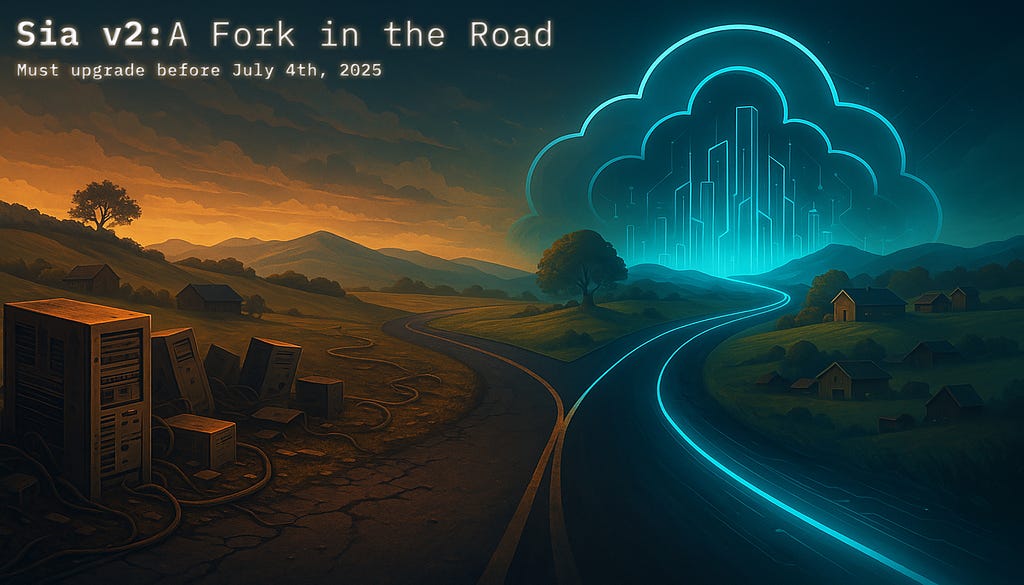
The Sia network is at a pivotal moment. On June 6th, 2025, the long-anticipated v2 hardfork will activate — marking one of the most transformative upgrades in the network’s ten-year history. This isn’t a minor patch or optional feature rollout. It’s a foundational overhaul of Sia’s consensus code, transaction formats, and renter-host architecture — ushering in a faster, more flexible, and future-proof decentralized cloud.
But to take part in what comes next, you must upgrade.
Whether you’re a renter, host, or Siacoin holder, continuing to use the network requires switching to the new v2-compatible software: renterd, hostd, and walletd. Without upgrading, your node will stop syncing, your wallet will be frozen, and your contracts will become obsolete.
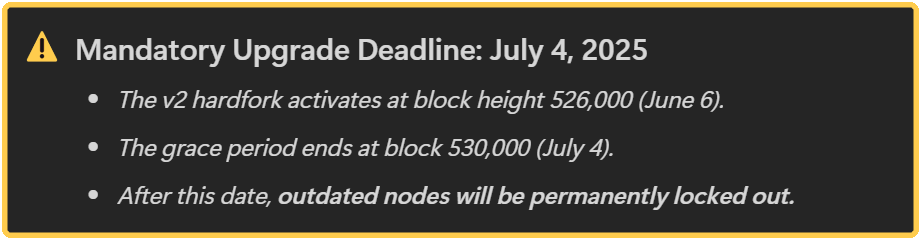
The Sia v2 hardfork is more than just a version change — it’s a rebirth. A cleaner, faster, more capable protocol designed to meet the demands of a decentralized future. But to be part of it, you must upgrade.
Why v2? Modernizing for the Future
The v2 hardfork is more than a technical update — it’s a complete re-architecture of the Sia network that improves performance, scalability, and usability across the board. By moving to a more modular, efficient foundation, v2 unlocks capabilities that were previously impossible or impractical.
This upgrade brings sweeping changes to consensus validation, file transfer protocols, and application design. Each piece is engineered to streamline the user experience while making the network easier to maintain and extend. Together, they set the stage for the next generation of decentralized storage.
Utreexo: Compact and Fast Blockchain State
A major innovation in v2 is Utreexo, a cryptographic state accumulator that replaces the traditional UTXO database. Instead of storing every unspent output in a massive local database, Utreexo compresses this state into a small proof, allowing new nodes to sync in minutes rather than days.
Benefits include:
- Fast Syncing: Nodes validate blocks without full history.
- Lightweight Clients: Full-node security on mobile and browser devices.
- Parallel Syncing: Enables checkpoint-based bootstrapping.
- Modular Validation: Makes consensus logic easier to isolate and verify.
Utreexo enables faster onboarding, lowers the barrier to running nodes, and enhances decentralization by allowing more lightweight clients to participate fully in the network.
RHP4: Better, Smarter File Transfers
The new Renter-Host Protocol 4 (RHP4) is built for speed, usability, and flexibility:
- Concurrent uploads/downloads
- Browser-native access via QUIC
- Prepaid accounts and decoupled contract management
This paves the way for new tools like indexd, where contract management can be outsourced while keeping uploads decentralized and private. RHP4 also enables:
- Early contract termination
- Capacity reservation
- Fund rollover between renewals
The New Modular App Stack
Sia v2 introduces a modular trio of applications, each tailored to a specific role:
- renterd — For uploading files. Scalable and easy to deploy, with browser support and SQL-backed metadata.
- hostd — For providing storage. Offers faster uploads, better monitoring, and easier setup.
- walletd — For managing Siacoin. Uses a new 12-word seed format, supports hardware wallets and offline signing.
Each app is independent and optimized for its task. No more monolithic siad. Users install only what they need, and developers gain better APIs, cleaner codebases, and room to innovate.
A New Foundation for What Comes Next
The v2 hardfork isn’t the end of Sia’s evolution — it’s the beginning of a new phase built for scalability, accessibility, and long-term growth. With foundational technologies like Utreexo and RHP4 in place, the ecosystem can now support lightweight clients, instant syncing, browser-based uploads, and third-party services like indexd that simplify the user experience.
This progress means users will soon interact with Sia the same way they do with traditional cloud storage — only with greater privacy, stronger security, and full ownership of their data.
The future of Sia is lighter, faster, and more open than ever — but it starts with upgrading.
Don’t wait for the last block. Upgrade today.
Sia v2: A Fork in the Road was originally published in The Sia Blog on Medium, where people are continuing the conversation by highlighting and responding to this story.
1
0
 すべての暗号通貨、NFT、DeFiを1か所から管理
開始に使用しているポートフォリオを安全に接続します。
