
XRP Price Frozen for a Month? A 130 Million Whale Move May Finally Crack It

0
0

XRP price today sits near $1.34, barely changed over 30 days, down just 2.5%. Yet a shift in who holds XRP (XRP) supply suggests the freeze may not last much longer.
On-chain data reveals the token’s least convinced holders have exited while two whale cohorts added 130 million tokens. With price compressed inside a falling channel, XRP technical analysis points to a convergence that could finally force a direction.
A Falling Channel Keeps Price Frozen Below Key Resistance
XRP price has traded inside a falling channel on the 8-hour chart since its March 17 peak near $1.60. Every attempt to escape since then has failed at the same ceiling.
The most recent rejection came on April 7 and 8. XRP reclaimed the 20-period and 50-period Exponential Moving Averages (EMA), trend indicators that weight recent price moves more heavily. However, the 100-period EMA rejected the advance cleanly.
That level carries weight. Around March 15, XRP reclaimed the 100 EMA and it triggered another 11% rally to the $1.60 high. The same EMA now aligns with the channel’s upper trendline, creating a double XRP resistance wall.
Want more token insights like this? Sign up for Editor Harsh Notariya’s Daily Crypto Newsletter here.
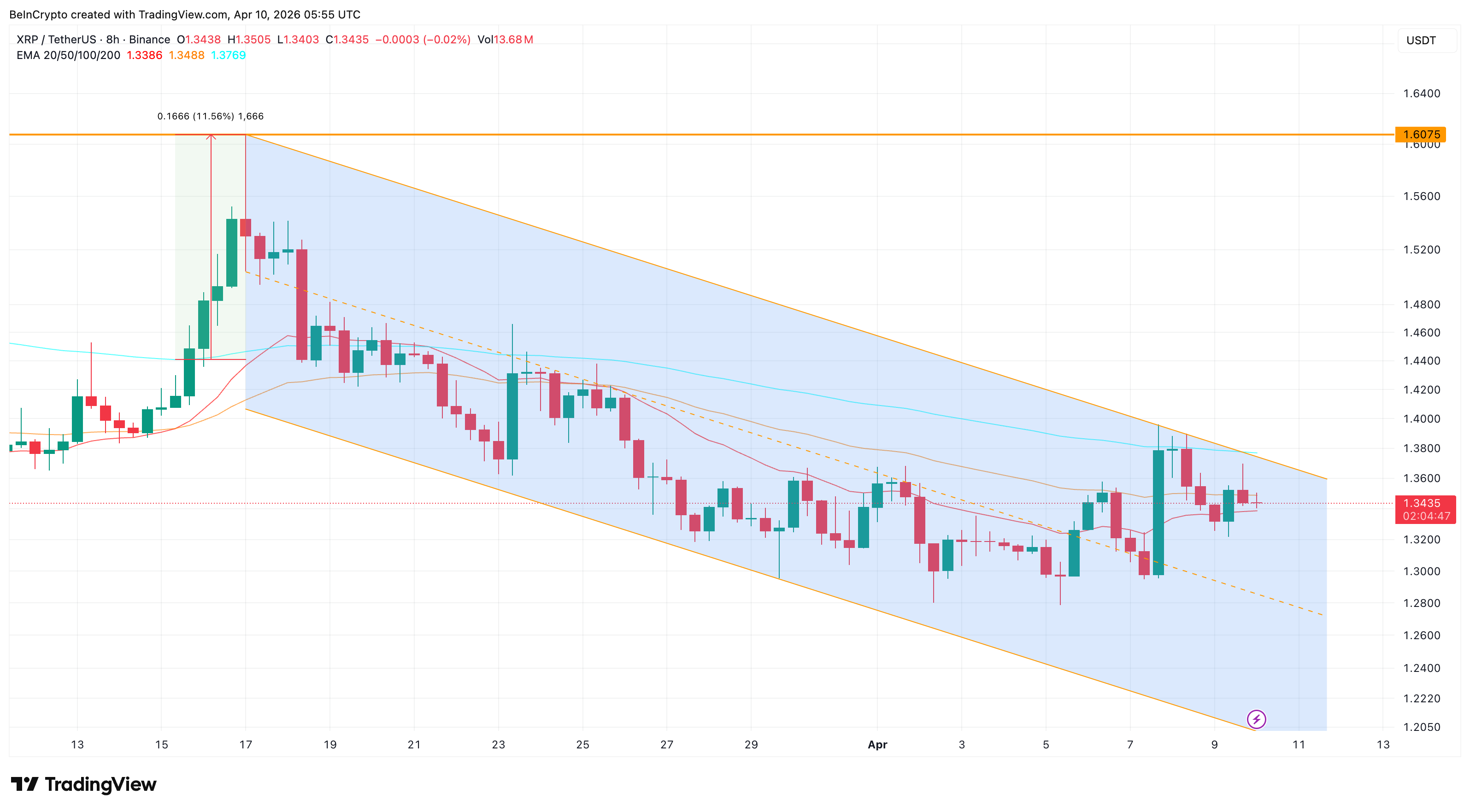 XRP Falling Channel: TradingView
BeInCrypto recently covered a similar setup in Zcash. The token broke above its own falling channel and surged higher. XRP price prediction models suggest a comparable move is possible if this resistance falls.
Yet an EMA alone does not confirm buyer conviction. The answer lies in who is accumulating and who is walking away.
Weakest Holders Walk Out as XRP Whale Accumulation Builds
Glassnode data shows that speculative money is draining from XRP. The 1-day to 1-week HODL Waves cohort tracks the share of supply held by the newest holders. It peaked at 1.45% on April 4. That reading has since collapsed to 0.684%.
More than half of this short-term supply exited in under a week. In isolation, that looks bearish. Yet these are the holders who typically sell into every bounce and kill rallies before they start. Their exit may actually be clearing the noise.
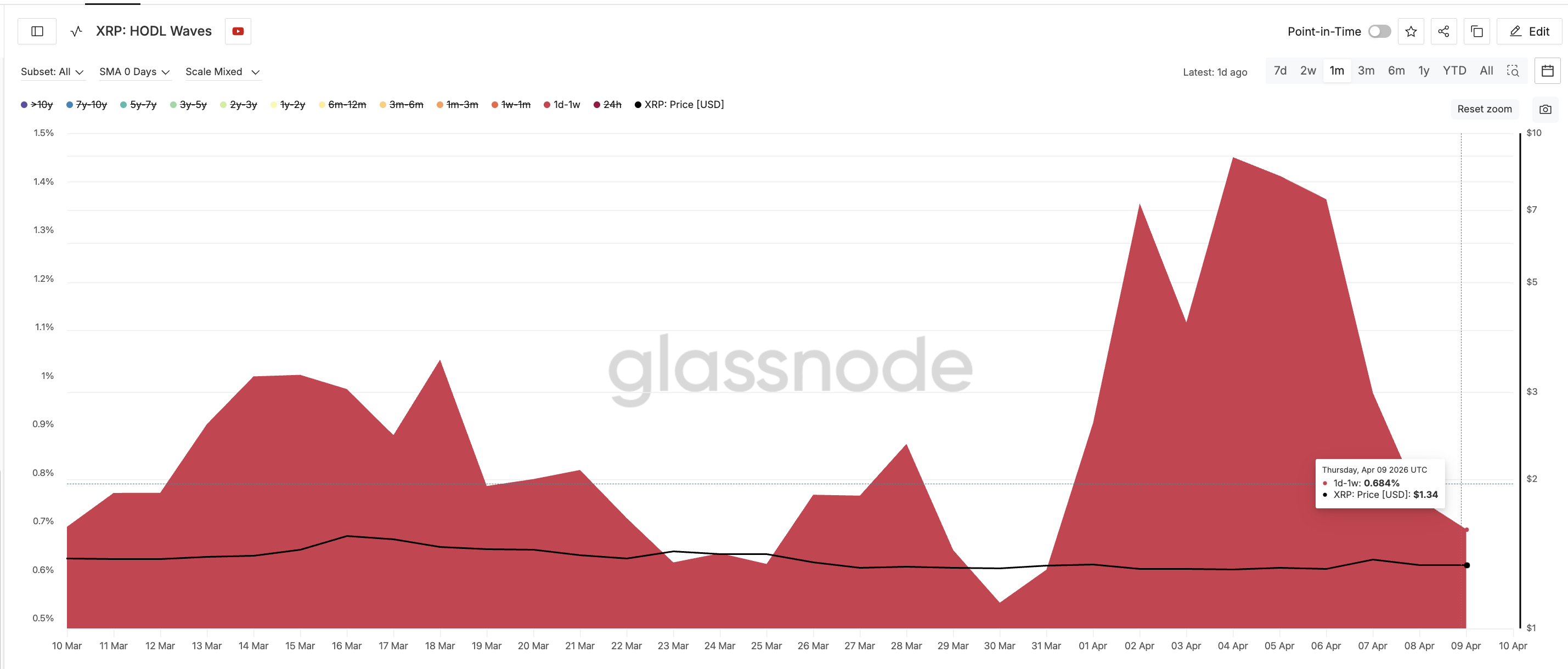 HODL Waves Speculative Exit: Glassnode
Meanwhile, XRP whale accumulation has picked up from two separate cohorts. Santiment data shows the 1 billion-plus XRP cohort grew from 25.80 billion to 25.83 billion tokens since April 6. The 10 million to 100 million cohort followed a day later, rising from 11.31 billion to 11.41 billion. Together, both groups added roughly 130 million XRP, and only after the speculative traders started selling.
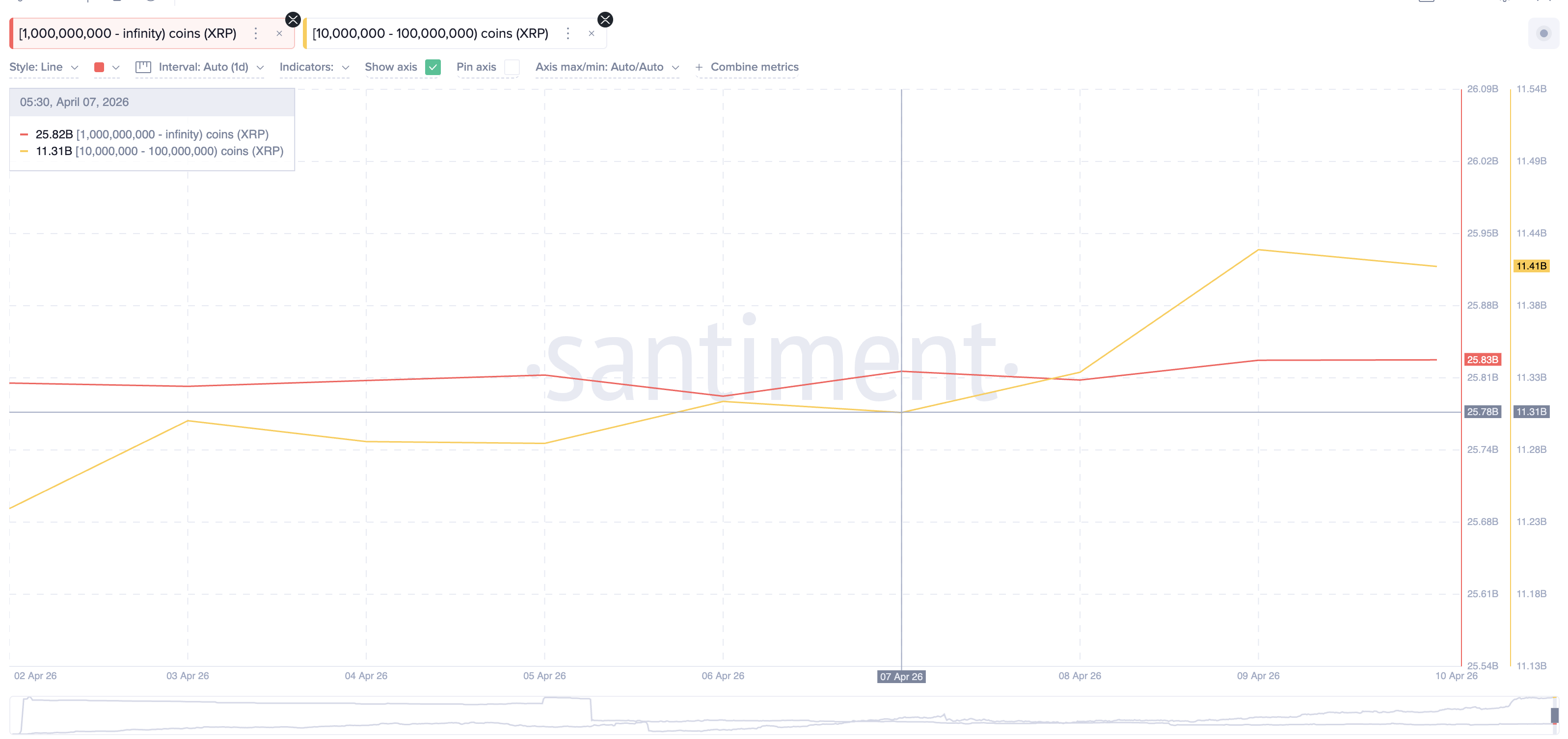 XRP Whale Accumulation: Santiment
However, the buying remains gradual. A Glassnode cost basis heatmap reveals roughly 420 million XRP sitting in a supply cluster directly overhead, between $1.37 and $1.38.
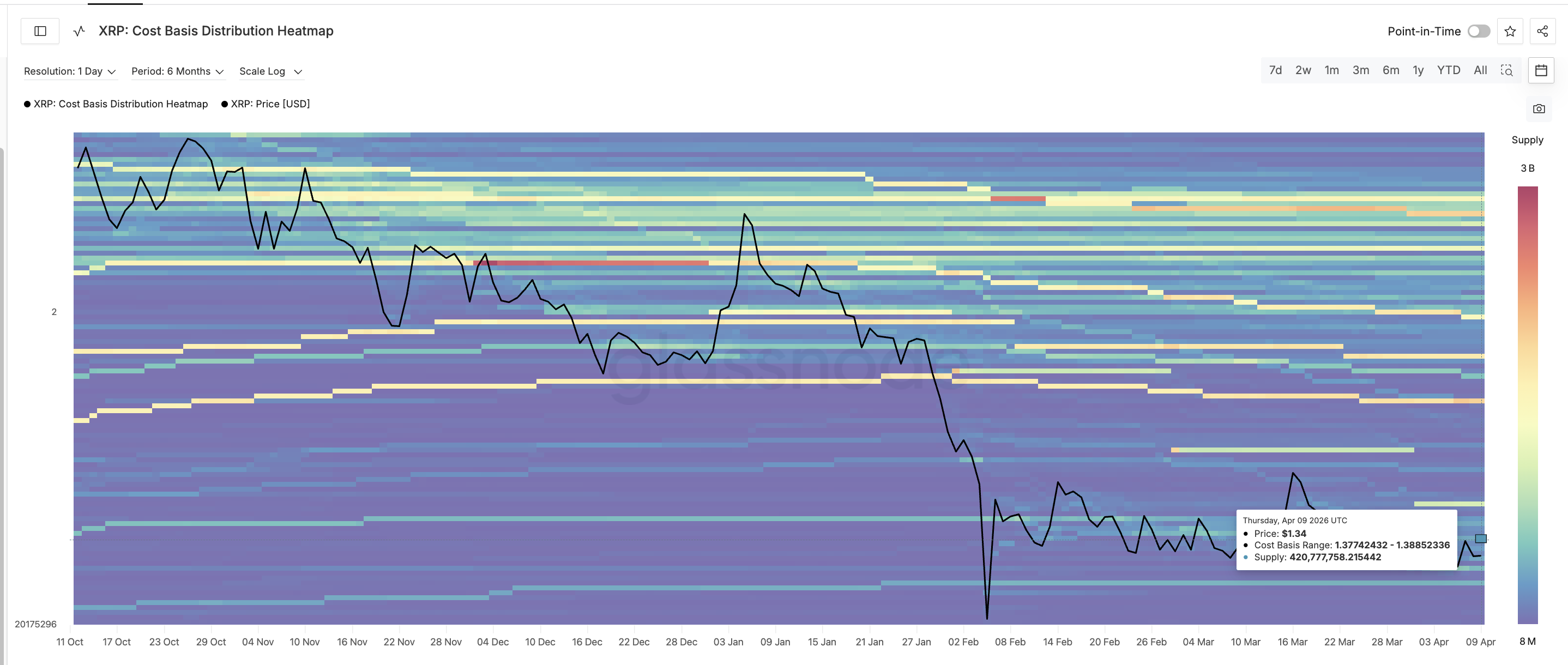 XRP Supply Cluster Heatmap: Glassnode
If that cluster’s holders begin selling into strength, whale buying alone may not crack through. The price chart reveals exactly where that wall sits.
XRP Price Levels That Decide Whether the Freeze Breaks
The 8-hour Fibonacci chart maps the convergence zone. The immediate levels are $1.35 ($1.349 to be precise) and $1.36. Reclaiming and holding both would be the first sign of life.
However, $1.38 is where the freeze lives or dies. The 100-period EMA, the channel’s upper trendline, and the 420 million XRP supply cluster all converge at that level. A clean close above $1.380 would confirm the XRP breakout. It would clear the channel, the EMA, and the supply wall simultaneously. Targets then open at $1.43, $1.51, and the March 17 high of $1.60.
Yet failure to reclaim $1.35 would keep XRP price frozen inside the channel. In that scenario, $1.32 becomes the next XRP support level at risk. A deeper breakdown exposes $1.28 ($1.279 to be exact), where buyer interest has previously held.
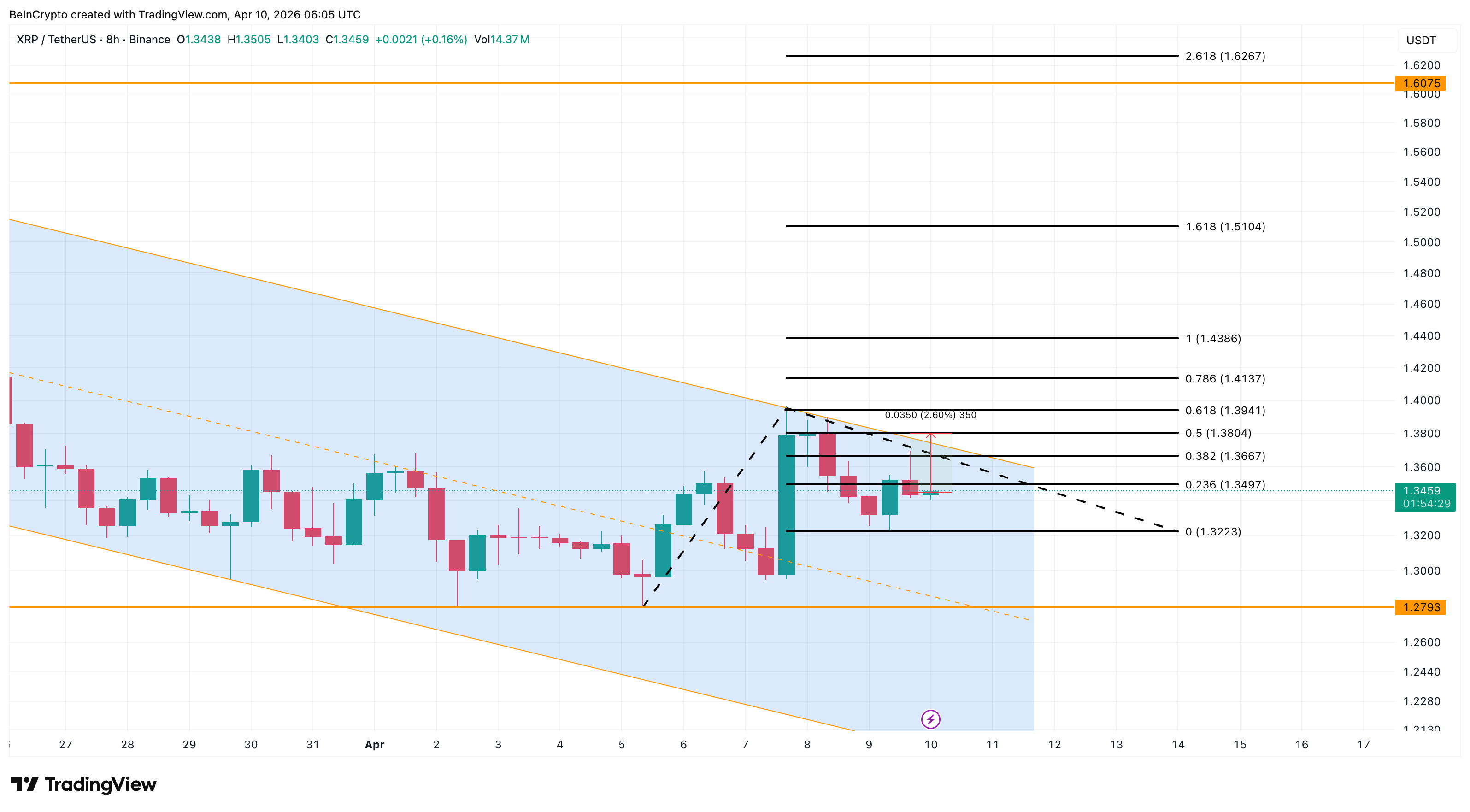 XRP Price Analysis: TradingView
The 30-day freeze has compressed volatility to a breaking point. A close above $1.38 favors the whale thesis and opens a path toward $1.60. A rejection sends XRP back toward $1.28 and turns the freeze into a deeper slide.
0
0


 Beheer al jouw cryptovaluta, NFT en DeFi vanaf één plek
Verbind de portfolio die je gebruikt veilig om te beginnen.


0
0