
Blackjack at Crypto Casinos: Variants, Rules and House Edge

0
0
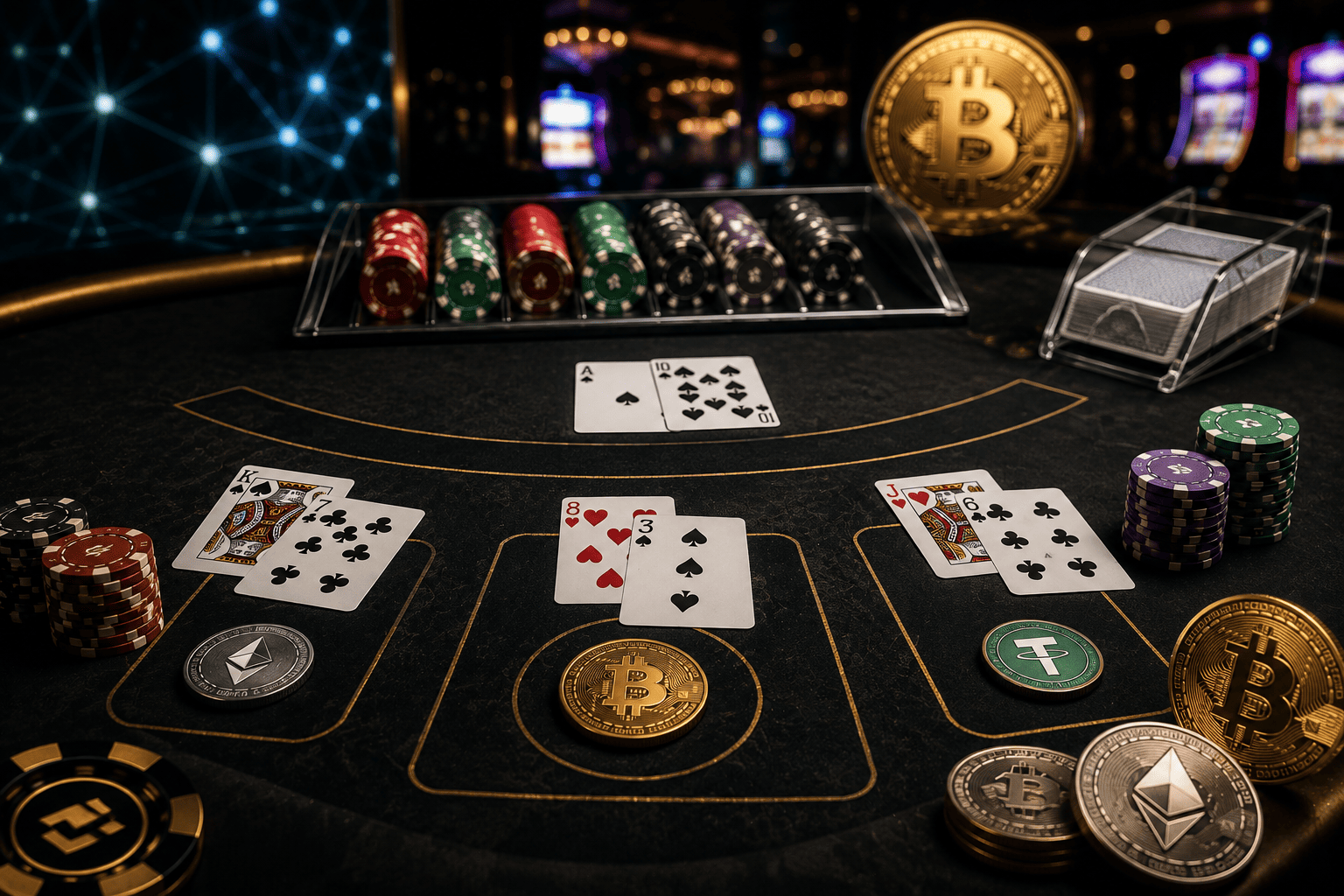
Blackjack has the lowest house edge of any common casino game, and it is the only one where your decisions change that number. Played correctly at a favourable table, the edge sits near half a percent. Played at the wrong table, it can be three times that before you have made a single mistake.
The difference is in the rules printed on the felt, and most players never read them. This covers what those rules do, which variants you will meet, and where the edge actually comes from.
Decisions Are What Make Blackjack Different
The game is simple to state. You aim to finish closer to 21 than the dealer without going over, and the dealer plays a fixed pattern with no discretion.
What separates it from most casino games is that your choices matter. Hitting, standing, doubling, splitting, and surrendering all change the mathematics of a hand, and there is a correct answer for every combination of your cards against the dealer's upcard.
That set of answers is basic strategy, and it is derived, not invented.
Playing it correctly takes the house edge down toward 0.5% on liberal rules. Playing on instinct gives most of that back.
Five Rules That Move the House Edge
Before strategy, the table itself. These are the rule variations to check, ordered roughly by how much they cost you.
-
The blackjack payout. A natural traditionally pays 3:2, so a 10 stake returns 15. Many tables now pay 6:5, returning 12 on the same hand. That single change adds roughly 1.4 percentage points to the house edge, which is more than every other rule variation combined. If you check one thing before sitting down, check this.
-
Whether the dealer hits soft 17. A table where the dealer stands on all 17s is better for the player than one where the dealer hits a soft 17. The difference is around 0.2 percentage points in the house's favour when the dealer hits.
-
The number of decks. Fewer decks favour the player, all else equal. A single-deck game carries a lower edge than an eight-deck shoe, though single-deck tables often compensate with a worse payout rule, which brings you back to point one.
-
Doubling and splitting permissions. Being allowed to double after splitting, to double on any two cards, and to resplit aces all shift the edge slightly toward the player. Restrictions on any of them move it back.
-
Surrender. Where offered, late surrender lets you forfeit half your stake on a hopeless hand instead of playing it out, which is worth a small fraction of a percent.
None of these is dramatic on its own except the first. Together they explain why two tables offering the same game can carry meaningfully different costs.
The Variants You Will Meet
Online lobbies list a dozen names for what is broadly the same game. These are the distinctions that matter.
-
European blackjack deals the dealer no hole card until players have acted. If the dealer then turns a blackjack, the player usually loses any additional money committed to doubles and splits, which the American hole-card version protects.
-
Atlantic City and Vegas Strip are rule packages more than different games, typically eight and four decks respectively with their own doubling and surrender permissions.
-
Single deck uses one deck, appealing on the surface, and frequently paired with a 6:5 payout that erases the advantage.
-
Double Exposure shows both dealer cards face up, which sounds generous until you read the compensations: blackjack pays even money and the dealer wins ties.
-
Blackjack Switch deals two hands and lets you swap the second card between them, offset by even-money blackjacks and a dealer 22 pushing instead of busting.
-
Free Bet Blackjack gives free doubles and splits on qualifying hands, again balanced by a dealer 22 pushing.
-
Infinite Blackjack seats unlimited players against one dealer hand
-
Speed Blackjack deals faster by resolving hands in order of decision time.
The pattern across the list is consistent: every variant offering the player something takes it back somewhere else, usually in the payout or in how dealer busts are treated.
Insurance and Side Bets Cost More Than the Game
Two parts of the table carry edges far above the main game, and both are optional.
Insurance is offered when the dealer shows an ace, paying 2:1 if the dealer has blackjack. In a typical multi-deck game its house edge runs around 7%, which makes it one of the more expensive bets available at a blackjack table despite being presented as protection.
Side bets such as 21+3 and Perfect Pairs pay attractive multiples for specific card combinations. Their edges typically run several percent, well above the base game, and they are marketed hardest to players who have just lost a hand.
A player using basic strategy and declining both is playing the version of blackjack with the low edge that gives the game its reputation.
Card Counting Does Not Transfer Online
Worth stating plainly, because the game's cultural association with counting misleads people.
RNG blackjack reshuffles the virtual deck after every hand, so there is no running count to keep. The composition of the next hand is independent of the last, which removes the entire basis of the technique.
Live dealer blackjack uses physical cards, but shoes are shuffled well before meaningful penetration, and many tables use continuous shufflers.
Neither format supports counting in any practical way, and no online blackjack strategy overcomes the house edge. Basic strategy minimises it; nothing eliminates it.
Checking the Table Before You Sit Down
Blackjack tables at crypto casinos are licensed from specialist studios, so the rules belong to the game provider and vary from table to table within the same lobby.
Dexsport carries both software and live dealer blackjack, with live tables supplied by studios including Evolution, Playtech and Ezugi alongside roulette, baccarat and game-show formats.
The practical point applies to any platform hosting third-party content: the casino distributes the table, but the studio sets its payout rule, deck count and soft-17 behaviour.
That makes the table's own information panel the thing to read before staking, and it is where a 3:2 payout or a 6:5 one is disclosed. Demo versions of many titles allow the rules to be inspected without funds committed.
Dexsport is non-custodial and holds an Anjouan licence, and who actually supplies casino games explains why rule-setting sits with the studio.
Playing the Low-Edge Version
Blackjack rewards preparation more than any other table game, and the preparation is short. Find a table paying 3:2, prefer a dealer who stands on soft 17, learn basic strategy, and decline insurance and side bets.
Do that and you are playing near the half-percent edge the game is known for. Skip the first step and the game quietly becomes an ordinary one, and live table availability differs by platform as much as the rules do.
Confirm what is legal where you live, keep stakes within a set budget, and play only if you are of legal age, since KYC or AML checks may apply. Responsible gambling matters even at a low edge, because a small percentage applied across many hands still works steadily in the house's favour.
Disclaimer: The information here is provided for general purposes only and is not legal, tax, investment, or financial advice. House edge figures are typical values that vary with table rules, deck count and player accuracy, so confirm the specific table's rules before playing. Game availability and providers change over time. Betting carries risk, and rules vary by country, so check the law where you live. Please gamble responsibly, within your means, and only if you are of legal age.
0
0
 Manage all your crypto, NFT and DeFi from one place
Securely connect the portfolio you’re using to start.