
What Is Pepe (PEPE) Coin? How the Meme Coin Works and Why It Pumps

0
0
From Internet Meme to Billion-Dollar Crypto Token
A meme that started as an internet joke now trades with a market cap in the billions, backed by no product, no company, and no pitch deck.
That's the puzzle at the heart of this piece. What is Pepe, exactly, and why does a token with no real-world use case keep pumping and crashing in such dramatic cycles?
Pepe (PEPE) is one of the best-known meme coins on the Ethereum blockchain, built on humor rather than technology. This article breaks down what it is, how its tokenomics and roadmap work, how people typically buy it, and the real mechanics behind meme coin price swings. Watch closely for how thin liquidity and social momentum, not fundamentals, drive most of the action.
What Is Pepe (PEPE) Coin and How Did It Start?
It is an ERC-20 token running on the Ethereum network. According to data linked to its official contract on Etherscan, it was stealth-launched on April 14, 2023, with no presale and no early investor round.
The mascot is Pepe the Frog, an internet meme dating back to the mid-2000s. The project's own materials are clear; it has no affiliation with Matt Furie, the artist who created the original character. That's a branding choice, not a license.

Pepe wasn't built around a product or technical roadmap. It frames itself as a community-driven, culture-first meme coin, with no staking, no lending feature, and no announced utility beyond trading and community identity.
How Does Pepe (PEPE) Tokenomics Work
The project's published figures put total supply at 420,690,000,000,000 tokens, an internet number joke rather than a financial formula. The entire supply was released at launch, with no ongoing emissions or future unlocks.
Allocation | Share | Purpose |
Public Liquidity Pool | 93.1% | Sent to the trading pool; LP tokens were then burned |
Multi-Signature Wallet | 6.9% | Reserved for exchange listings, bridges, and liquidity support |
Burning the LP tokens means the team can't quietly pull the trading pool, the classic how to spot a crypto rug pull pattern. Combined with a renounced contract, that removes one common point of failure. The remaining 6.9% sits in a wallet reportedly reserved for listings and liquidity, though that's project framing, not an audited guarantee.
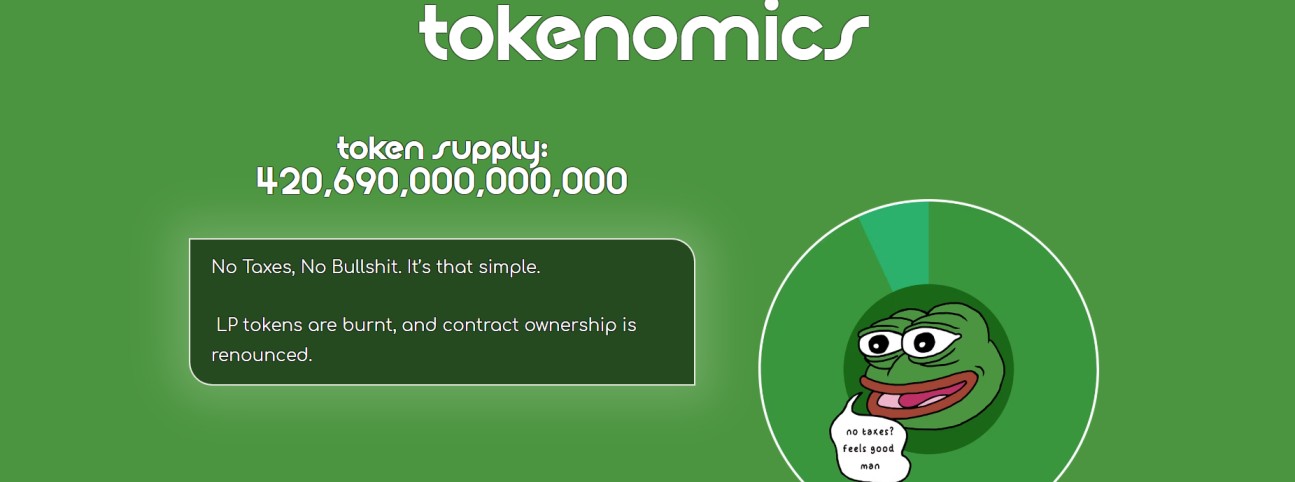
One more detail: a blacklist function was reportedly used once, minutes after launch, to block an address holding roughly 2.52 trillion tokens. With ownership renounced, that block can never be reversed.
How Do You Buy Pepe (PEPE) Coins?
With no presale or sign-up process, the project points buyers toward a self-custody wallet and a decentralized exchange. This is the general process described, not a recommendation to buy:
Set up a wallet, such as MetaMask, and back up the recovery phrase offline.
Fund it with ETH, either bought inside the wallet or sent from an exchange.
Connect to Uniswap, then paste in the token's official contract address rather than searching by name, to avoid copycats.
Swap ETH for PEPE and confirm. The project states there's no transaction tax, though slippage settings may need adjusting during volatile periods.
What Is Pepe’s Roadmap and Future Direction?
Pepe's published roadmap is unusually short, and that looks intentional. The project describes three broad phases:
Phase | Stated Focus |
Phase 1 | Meme - building initial recognition and community |
Phase 2 | Vibe and HODL - sustaining engagement and long-term holding |
Phase 3 | Meme Takeover - broader cultural reach |
There are no product launches, partnership targets, or dated milestones here. That fits the project's culture-first positioning, but readers should treat these phases as a stated direction, not measurable commitments.
Why Do Meme Coins Pump So Quickly?
Meme-coins have no earnings to value them against, so what pushes the price around? A few forces repeat across the category:
Huge supply, tiny unit price, which feels "cheap" even when market cap vs FDV tells a different story.
Thin liquidity relative to hype, so volume spikes swing price hard in both directions.
Social momentum. A viral post can pull in buyers within hours.
No fundamental anchor, so sentiment drives price almost entirely.
Exchange listings, which trigger fresh buying followed by later profit-taking.
This is the standard pattern behind what is a meme coin cycle in general, not something unique to Pepe.
What Makes Pepe Different From Other Meme Coins?
Pepe's tokenomics are relatively clean next to many copycats: no transaction tax, burned liquidity, and an early-renounced contract.
The project has also been reviewed by security firms, including a CertiK audit report and a Fairyproof audit report. An audit checks contract code for obvious flaws; it doesn't predict price or guarantee outcomes.
Pepe's main difference from "utility" tokens is honesty about what it isn't. It promises no product or passive income, positioning itself purely as a cultural and trading asset, which avoids the marketing-versus-crypto tokenomics mismatch seen in some other projects.
What Are the Main Risks to Consider?
Pepe-carries the core risks common to meme coins, plus a few of its own:
No intrinsic value or utility - price depends entirely on sentiment.
Extreme volatility - double-digit daily swings are common.
Copycat and scam tokens, a real concern for new buyers checking best crypto wallets for meme coins.
Concentration risk, since supply outside the burned pool sits in fewer wallets.
Regulatory uncertainty around how meme coins get treated long-term.
None of this rules out strong performance over time, but the odds aren't stacked toward steady, predictable outcomes, which matters when weighing this against presale token risks on newer projects.
What Should You Watch Before Considering-Pepe?
The stronger signal is structural transparency: burned liquidity, a renounced contract, and completed audits reduce team-related risk. The main concern is the total absence of utility or roadmap, so long-term value rests entirely on cultural relevance, something no audit can measure.
Price data suggests it tracks broader crypto sentiment more than project-specific news. The biggest unknown is how the 6.9% multi-sig allocation gets used over time. Readers should verify current price and circulating supply vs total supply through a live data platform before drawing conclusions.
Conclusion
Pepe is an Ethereum-based meme coin with a fixed, fully circulated supply of 420.69 trillion tokens, no presale, and no team-controlled liquidity. Its tokenomics are unusually clean, its roadmap is intentionally light, and buying runs through self-custody wallets and decentralized exchanges rather than a sign-up.
What stands out is the transparency around supply and contract structure. What remains uncertain is everything tied to long-term value. Anyone researching this token should check live price and volume data and read the risk factors above before forming a view.
Disclaimer
This article is for informational purposes only and does not constitute financial or investment advice. Cryptocurrency prices, including meme coins like Pepe, are highly volatile and speculative. Investors should research independently and consider their own risk tolerance before making any decisions.
0
0

 Կառավարեք ձեր բոլոր կրիպտարժույթները, NFT-ն և DeFi-ն՝ մեկ տեղից
Ապահովաբար կցեք ձեր օգտագործած պորտֆոլիոն՝ սկսելու համար:


