
Crypto Market News: 5th Largest U.S. Bank Moves Dollars on Stellar, and Its Hidden Tie to Pepeto

0
0

Most crypto market news this week sounds the same, until a big bank does something new. U.S. Bank, the fifth largest bank in the country, just moved real dollars across borders on a public blockchain, per Cointelegraph. Yet XLM, the coin behind the network it used, rose only about 0.6% that day, per BeInCrypto. Banks rarely stop once a test like that works.
While that story pulls eyes to the big names, something smaller is building right below it. Pepeto, still in presale, already runs a free cross chain bridge across five chains, and buyers have pushed its current stage to about 97% sold. The bank is testing what Pepeto holders already use, and the token has not even listed yet.
What is the biggest crypto market news from U.S. Bank this week?
On September 9, U.S. Bank said it finished a live cross border payment with USBDC, its own dollar stablecoin, on the Stellar blockchain, Cointelegraph reported. The test covered creating the coin, cashing it out, freezing it, and pulling it back. Every step a bank needs before it trusts a public chain, done.
Goldman Sachs, Bank of America, Citigroup, and Wells Fargo also plan a shared dollar stablecoin for the first half of 2027, The Coin Republic noted. Big banks are stepping onto open chains. The next question is who gains most from that.
Who stands to gain most as banks start moving real dollars on public blockchains?
Why does Pepeto's bridge matter as banks move on chain?
U.S. Bank had to build its own platform just to send one coin between its branches on two continents. Pepeto hands that same power to anyone, on five chains, for free, and the market has noticed. Its presale has pulled in above $10.9 million of an $11,285,520 target, which leaves this stage roughly 97% sold. Buyers can pay with ETH, USDT, BNB, or a card, and none of that is luck, because money always looks for the fastest road.
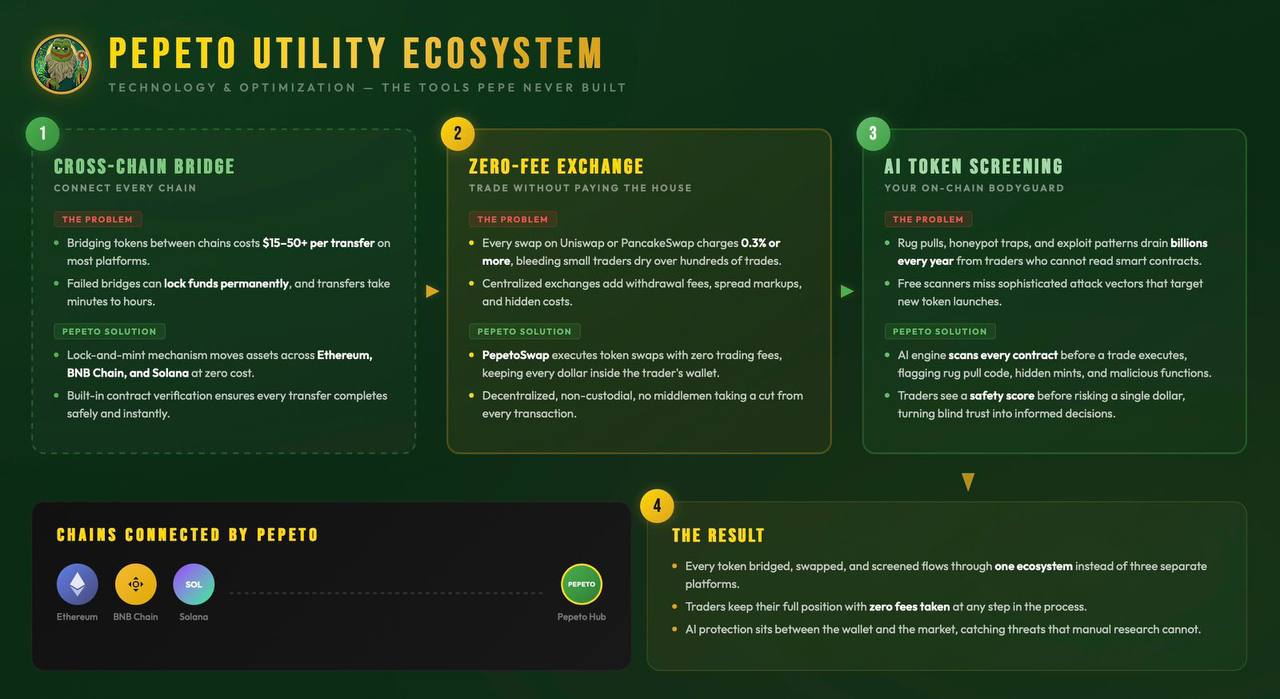
For years, moving tokens between chains has been one of crypto's worst pains. Rival bridges bill $15 to $50 per move, and one transfer can drag on for hours. On some of them, a failed transfer locks the money for good.
Pepeto's bridge fixes each of those problems, starting with your coins held in an audited contract on the chain where they start. After the chain confirms that hold, a matching amount is minted where they land. No middleman holds your funds, and total supply stays the same everywhere. If anything fails, the hold reverses by itself.
The dev team includes a former Binance expert, and SolidProof audited the code, so the people behind it know how big exchanges handle money. The steps are simple. First, choose from Arbitrum, Base, Solana, BNB Chain, and Ethereum. Second, send with a $0 bridge fee, paying gas only, and third, the transfer lands in under 60 seconds.
Today a single token goes for $0.0000001893, and staked tokens earn 163% APY, claimable when it lists. Banks are only now learning to move value that fast. Buyers at this stage get that speed at the lowest price the token will ever offer, ahead of its expected Binance listing. Pepeto is the obvious entry for anyone who wants to own the rails the banks are still testing, before the listing sets a new price.
Does a big bank on Stellar make XLM a buy?
XLM trades near $0.18 on CoinMarketCap, and the bank news barely lifted it, which means the market has not priced this in yet. The network already holds $3.32 billion in real world assets, per RWA.xyz data cited by U.Today on September 9. That is serious use for a coin this cheap.
The gap is timing. USBDC stays inside U.S. Bank for now, so no trader can buy it, and XLM likely climbs in steps as more banks follow, not in one jump.
Is XRP still a buy after the SEC called it a commodity?
XRP trades near $1.38 on CoinMarketCap, and it just got a label most coins would pay for. A September 3 SEC order named XRP a digital commodity next to Bitcoin, Ether, and Solana under a Nasdaq Texas rule, 24/7 Wall St. explained. That makes XRP funds easier to build.
The limit is that the label comes from agency guidance, not law. At an $89 billion value, XRP needs lasting new demand, so steady gains fit better than a fast jump.
What does the bank move mean for Pepeto buyers today?
U.S. Bank's Stellar test is a clear lesson in where money is heading. The biggest banks now want public chains for their own dollars. XLM and XRP will move on their own use, but this week's crypto market news points to one idea: fast, cheap value movement wins.
Pepeto already delivers that, with a bridge across five chains for $0, and roughly 97% of this stage has sold while you read this. That presale price is the one that turns into real returns at the approaching Binance listing. The stage count is live on the Pepeto official website. Anyone in before this stage fills sits on the side that gets paid at listing, and the other side just reads about it.
Check the live Pepeto stage at pepetocoin.com

FAQ
What is USBDC, and how does this crypto market news affect Stellar?
USBDC is U.S. Bank's own dollar stablecoin, and this crypto market news puts Stellar in focus because the bank ran its first live payment there.
Is the link between bank stablecoins and Pepeto just a coincidence?
No, Pepeto rides the same shift the banks are chasing, and it still sells at a presale price with this stage nearly gone. See the Pepeto official website.
0
0

 Gestisci cripto, NFT e DeFi in un unico luogo
Connetti in sicurezza il portafoglio che usi per iniziare.


