Best Robinhood Chain APIs for Developers in 2026 (Free + Paid)

Published October 29, 2026 · Last updated · Pricing and limits verified October 2026
In July I bridged a little ETH to Robinhood Chain. I wanted to see the fuss for myself. The deposit took about ten minutes.
Then I bought one Stock Token and one memecoin as a test. That was the fun part. The boring part came next.
I wanted one screen showing what I held. Half my usual tools had no idea what chain 4663 was. The explorer worked, but not much else did yet.
That gap is the story of every new chain. The chain ships first. The data layer catches up later.
So I did the homework. I researched every Robinhood Chain API I could find. Then I turned it into this guide.
Below are my three Robinhood Chain API picks for 2026. CoinStats API is first, and I will be honest about why. I will also be fair to the other two.
We make CoinStats API, so yes, we are biased. We know it. So this guide sticks to plain facts: endpoints, coverage, and public pricing. The verdict is yours.
- Robinhood Chain is an Arbitrum chain with chain ID 4663 and ETH gas.
- Only a few data APIs index it today. This guide ranks three.
- CoinStats API leads for wallet, Stock Token, and price data in one call.
- Bitquery leads for decoded trades and streams. Goldsky leads for custom indexing.
- Test the free tier against a real Robinhood Chain address before you commit.
What makes a good Robinhood Chain API
A Robinhood Chain API returns readable data from Robinhood Chain, Robinhood’s Ethereum Layer 2. You pass an address or a token contract. You get balances, transfers, trades, and prices back.
Robinhood Chain runs on Arbitrum technology, per Robinhood’s chain documentation. It posts its data to Ethereum. Chain ID is 4663, and gas is paid in ETH.

The public testnet opened on February 10, 2026. Mainnet followed on July 1, 2026. Arbitrum counts Robinhood Chain among 30+ dedicated chains built with its platform.
Robinhood’s own launch post set the tone.
The chain found users fast. Bernstein counted $3.1 billion in DEX volume in the chain’s first seven days. DefiLlama counted over 500,000 addresses holding ETH on the chain by July 14.
Robinhood’s Q3 2026 results call it a top-five chain by revenue and volume. That first quarter cleared $80 billion in DEX volume and $50 million in fees. That is a lot of data for a four-month-old chain.
Now the split. “Robinhood Chain API” means two different things.
An RPC endpoint speaks raw JSON-RPC to a node. You get blocks, logs, and gas with no structure. A data API returns clean, indexed answers instead.
Balances, Stock Tokens, trades, prices. This guide ranks data and indexing APIs, not node providers. Robinhood’s docs already list the RPC options.
Stock Tokens are the chain’s signature asset. Each one is a standard ERC-20 with 18 decimals. Robinhood Assets (Jersey) Limited issues them.
Chainlink feeds publish their prices onchain. They are not offered to U.S. persons.
Like other rollups, Robinhood Chain settles to Ethereum. The ethereum.org Layer 2 overview describes Ethereum as the settlement layer for these networks.
L2BEAT lists $2.33 billion in total value secured as of October 27, 2026. It also notes a centralized sequencer run by Robinhood.
“Decentralized finance unlocks possibilities beyond what traditional finance can offer,” says Johann Kerbrat. He is Robinhood’s SVP and General Manager of Crypto and International. The line comes from Robinhood’s July 1 mainnet announcement.
An API is how your app reaches those possibilities. So here is what to check.
- Asset coverage. Stock Tokens, bridged stablecoins like USDG, and the memecoins that drive volume.
- Data depth. Balances and transfers at minimum. Decoded DEX trades and prices are the real test.
- Free tier and entry price. A free tier to test on a real address, then a clear paid step.
- AI readiness. An MCP server, which lets AI agents call the API as a tool.
- Docs and limits. Published rate limits, credit costs, and a Robinhood Chain page in the docs.
One note on MCP. Most serious providers now ship one, so it is table stakes, not a differentiator. The real difference is the data underneath it.
The 3 best Robinhood Chain APIs at a glance
Three providers index Robinhood Chain with a self-serve plan today. Each solves a different problem. The table shows the shape of each before the detail.
| Provider | Best for | Free tier | Entry price | AI (MCP) |
|---|---|---|---|---|
| CoinStats API | Wallet, Stock Token, and market data in one call | 20,000 credits a month | $49 a month | Yes, 20+ tools |
| Bitquery | Decoded DEX trades, transfers, and streams | 7-day trial | $49 a month personal, $99 commercial, billed monthly | Yes, paid add-on |
| Goldsky | Custom subgraphs and data pipelines | Free Starter plan, $100 credits | Pay as you go, about $37 a month per subgraph | Docs search only |


CoinStats API
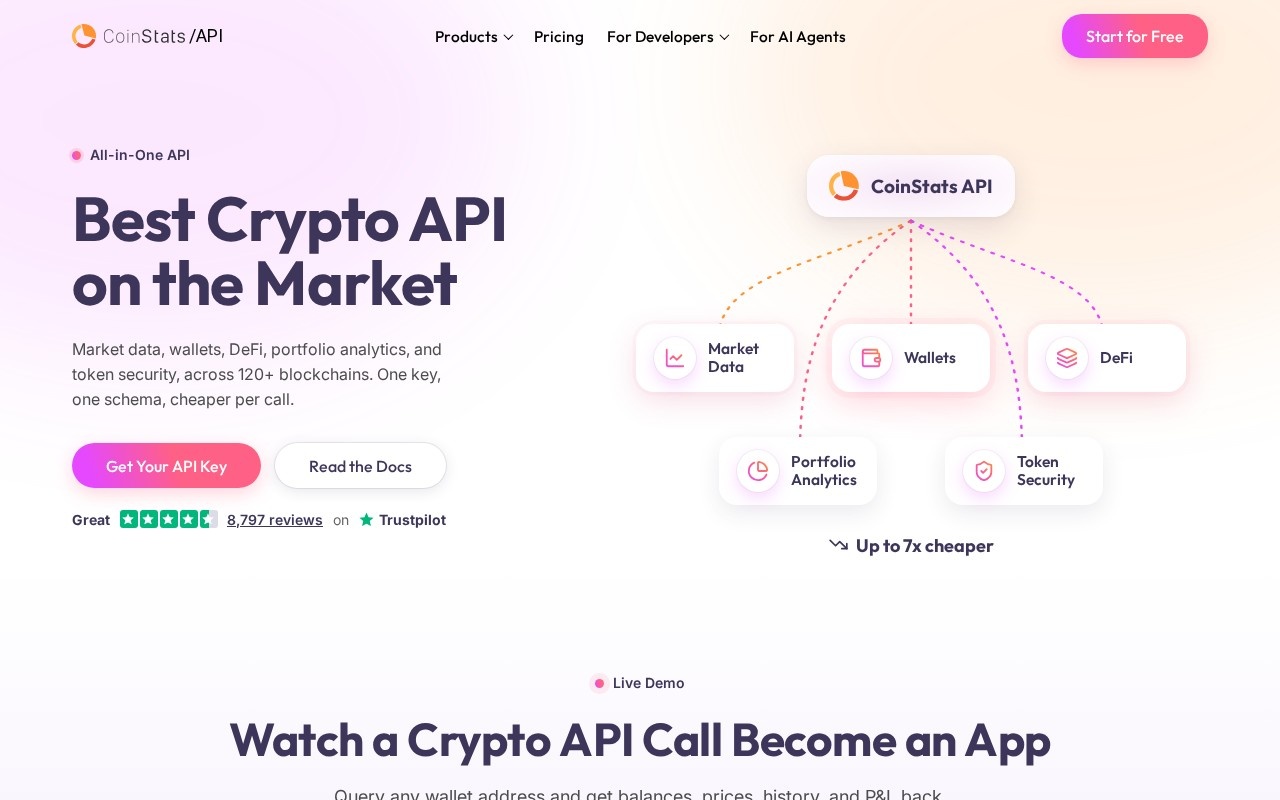
CoinStats API returns a Robinhood Chain wallet’s full picture from one call. You pass an address. You get ETH, Stock Tokens, other ERC-20s, and transaction history back.
It also prices what it finds. CoinStats prices 200+ Robinhood Stock Tokens live, from SPY and NVDA to SPCX. It covers 1,900+ tokens with Robinhood Chain contracts, from USDG to cbBTC.
- Wallet balances on Robinhood Chain and 120+ other chains in one schema.
- 200+ Stock Tokens priced live, with contract addresses and explorer links.
- Transaction history and transfers for every address.
- Token Risks endpoint flags honeypots, hidden fees, and risky contracts.
- REST plus an MCP Server with 20+ tools for AI agents.
One example: a Stock Token dashboard needs balances, prices, and history per user. With one schema, that is a single call per wallet. Robinhood Chain is listed second in the EVM wallet docs, right after Ethereum.
It is one part of CoinStats Crypto API, an all-in-one data layer. Need the wider market picture? Our best crypto API guide covers it in depth.
Real open-source projects already running on CoinStats API.
Bitquery
Bitquery indexes Robinhood Chain into its decoded GraphQL schema. Ethereum and Base share that same EVM schema. You query it like a database, not a node.
Transfers, balances, holders, events, and DEX trades are all there. The delivery options are the draw.
GraphQL for queries and WebSocket for subscriptions. Kafka streams and Parquet dumps sit on enterprise plans. Robinhood Chain is a self-serve chain, so the 7-day trial covers it.
- Decoded DEX trades, including Uniswap v4 pools and OHLCV candles.
- Token transfers, balances, holders, and supply for any Robinhood Chain token.
- Raw calls, events, and traces for contract-level work.
- WebSocket subscriptions on Pro and above. Kafka streams and Parquet exports on enterprise.
- MCP server for AI agents, sold as a paid add-on.
Bitquery fits apps that live on trade data. A bot watching Uniswap v4 pools gets decoded swaps as they land. DefiLlama found Uniswap handling over 99% of the chain’s DEX volume in mid-July.
The trade-off is the app layer. Pricing, portfolio math, and risk flags are yours to build.
Goldsky
Goldsky indexes Robinhood Chain mainnet and testnet across its subgraph and pipeline products. You define the data you want. Goldsky serves it as a GraphQL subgraph or streams it into your own database.
It was live on the chain from launch day. Datasets include blocks, transactions, logs, traces, balances, and ERC-20 transfers. It also ships an ERC-20 transfer dataset built for Stock Tokens.
- Hosted subgraphs for Robinhood Chain mainnet and testnet.
- Pipelines that stream chain data into Postgres, ClickHouse, S3, or Kafka.
- Eleven mainnet dataset types, from raw blocks to balances.
- A free Starter plan with no card and $100 in credits.
- Partnered with Alchemy on migrating retired Alchemy subgraphs.
Goldsky fits teams with their own schema and their own database. A protocol indexing its own contracts writes a subgraph once.
A data team streams every transfer into ClickHouse and queries it with SQL. Nobody else decides what your tables look like.
Top picks by category
Three providers, four jobs. CoinStats API takes the all-in-one and AI slots. Bitquery and Goldsky each own a job the others do not try to do.
Balances, Stock Tokens, prices, history, and risk in one schema.
Pick this for portfolio apps, dashboards, and AI agents.
Decoded Uniswap v4 trades, OHLCV, and holder data over GraphQL and WebSocket.
Pick this for trading bots and market analytics.
Subgraphs and pipelines you design, streamed into your own database.
Pick this for protocols and data teams with their own schema.
An MCP Server with 20+ tools and portfolio context for every wallet.
Pick this when an agent needs balances and prices, not raw logs.
Comparison by use case
Use cases decide this ranking more than feature lists do. Our guide to the best crypto wallet APIs covers wallet data beyond this chain.
RWA.xyz tracks $3.74 billion in tokenized stocks across all platforms as of October 28. Stock Token tooling matters.

CoinStats API
One call returns ETH, Stock Tokens, and other tokens with prices.
Alternatives: Bitquery for balances and holders over GraphQL.
CoinStats API
200+ Stock Tokens priced live, with contract addresses and explorer links.
Alternatives: Goldsky’s Stock Token transfer dataset for custom views.
Bitquery
Decoded Uniswap v4 trades, OHLCV candles, and WebSocket subscriptions.
Alternatives: CoinStats API for token prices and risk checks.
Bitquery
WebSocket streams of transfers and trades as they land. Kafka on enterprise plans.
Alternatives: Goldsky pipelines streaming into Kafka or Postgres.
Goldsky
Subgraphs and pipelines into ClickHouse, S3, or Postgres.
Alternatives: Bitquery’s Parquet exports for bulk history.
CoinStats API
An MCP Server with 20+ wallet, market, and portfolio tools.
Alternatives: Bitquery’s MCP add-on for trade data.
How to choose your Robinhood Chain API
Pick a Robinhood Chain API by the question your app asks. Feature lists come second.
Balances and prices in one call point to CoinStats API. Decoded trades point to Bitquery, and custom schemas point to Goldsky.
Then test, do not read. Take a real Robinhood Chain address and run three checks on the free tier.
Confirm a known transaction. Query the oldest block you need. Check that a DEX trade comes back decoded.
The asset mix matters too. Bernstein’s July 13 note says early trading was dominated by memecoins. If your users trade them, DEX coverage and risk flags matter most.
Robinhood’s CEO said as much himself.
Interest in the chain keeps climbing. Our Ahrefs data shows “robinhood chain” averaging 1,300 US searches a month.
Robinhood serves nearly 28 million customers across 38 countries, per its July 2026 announcement. That number has room to grow.
“…we are excited to help build the next stage of finance,” says Steven Goldfeder. He is co-founder and CEO of Offchain Labs, Robinhood’s Arbitrum partner. He said it in Robinhood’s February testnet announcement.
The next stage needs data your app can read. That is the whole job of a Robinhood Chain data API.

Whatever you pick, judge the actual response, not the homepage. New chains change fast, and Robinhood Chain is four months old. The APIs around it will keep adding depth.
Three community reads from dev.to if you want more.
Frequently asked questions about Robinhood Chain APIs
Common questions developers ask when choosing a Robinhood Chain API.