
10 Best Crypto APIs for Developers in 2026 (Free + Paid)

Written by Tigran Mkrtchyan · Reviewed and fact-checked by Narek Gevorgyan · Published April 1, 2026 · Updated September 19, 2026 · Pricing and limits verified September 2026
Choosing a crypto API is one of the earliest architectural decisions in any blockchain project, and it shapes everything that follows: what data you can access, how quickly you can ship, and how much infrastructure you end up managing yourself. The landscape in 2026 is more specialized than ever. Some providers focus on aggregated market data and portfolio tracking, others on raw blockchain indexing, and others still on institutional-grade compliance and benchmarking.
This guide ranks the ten best crypto API providers for 2026. Each one serves a distinct set of developer needs. We break down what each one offers, where it fits, and what trade-offs come with it. If you’re specifically after market data, prices, and onchain feeds rather than wallet and portfolio infrastructure, our shorter top 5 best crypto data APIs guide narrows the field to the providers worth shortlisting on that lane. For a broader list of free and open-source crypto APIs, the community-maintained free-crypto-apis repository on GitHub is also worth bookmarking.
We make CoinStats API, so yes, we are biased. We know it. So this guide sticks to plain facts: endpoints, coverage, and public pricing. The verdict is yours.
- Best overall: CoinStats API. Market, wallet, DeFi, portfolio, and token security data in one key.
- Best multi-exchange market data: CoinAPI. 400+ venues, one schema.
- Best for execution: Binance API. Kraken API adds regulated venues and agent tooling.
- Best onchain research: Glassnode. Entity-adjusted metrics for serious analysis.
- Best free start: DexScreener. No key, no signup.
- Best multichain wallet data: GoldRush. 100+ chains, one schema.
- MCP support is now baseline. The data underneath decides the winner.
- Most production apps combine two or more providers.
The 10 Best Crypto APIs at a Glance
| Provider | Best for | Free tier | Entry price | AI (MCP) |
|---|---|---|---|---|
| CoinStats API | Any crypto product needing market data + all-in-one layers | 20,000 credits/mo, commercial use | $49/mo | ✅ |
| CoinAPI | Multi-exchange market data | $25 free credits | $79/mo | ✅ |
| Coinranking API | Simple price data | 5,000 calls/mo | $49/mo | ❌ |
| Binance API | Deepest liquidity + execution | Free | Free (trading fees) | ❌ |
| Kraken API | Regulated execution + agent tooling | Free | Free (trading fees) | ✅ |
| Glassnode | Onchain research metrics | Dashboard only | Upper tiers, via sales | ✅ |
| DexScreener | Free DEX pair data | Free, no key | Free | ❌ |
| ChangeNOW | In-app swaps | Free, commission model | Free (from 0.4% commission) | ❌ |
| Hela Guardian Node | Network validation layer | Node participation | Node participation | ❌ |
| GoldRush | Multichain wallet + tx data | 14-day trial | $10/mo | ✅ |
Pricing and limits verified September 2026 against official pricing pages.
The capability matrix below shows what each API actually returns. Scan your must-have column first.
| Provider | Market data | Wallet data | DeFi positions | Portfolio | Token security | Execution | MCP |
|---|---|---|---|---|---|---|---|
| CoinStats API | ✅ | ✅ | ✅ | ✅ | ✅ | ❌ | ✅ |
| CoinAPI | ✅ | ❌ | ❌ | ❌ | ❌ | ❌ | ✅ |
| Coinranking API | ✅ | ❌ | ❌ | ❌ | ❌ | ❌ | ❌ |
| Binance API | Own venue | ❌ | ❌ | ❌ | ❌ | ✅ | ❌ |
| Kraken API | Own venue | ❌ | ❌ | ❌ | ❌ | ✅ | ✅ |
| Glassnode | Limited | ❌ | ❌ | ❌ | ❌ | ❌ | ✅ |
| DexScreener | DEX only | ❌ | ❌ | ❌ | ❌ | ❌ | ❌ |
| ChangeNOW | ❌ | ❌ | ❌ | ❌ | ❌ | Swaps | ❌ |
| Hela Guardian Node | ❌ | ❌ | ❌ | ❌ | ❌ | ❌ | ❌ |
| GoldRush | ✅ | ✅ | Limited | ❌ | ❌ | ❌ | ✅ |
What Makes a Good Crypto API
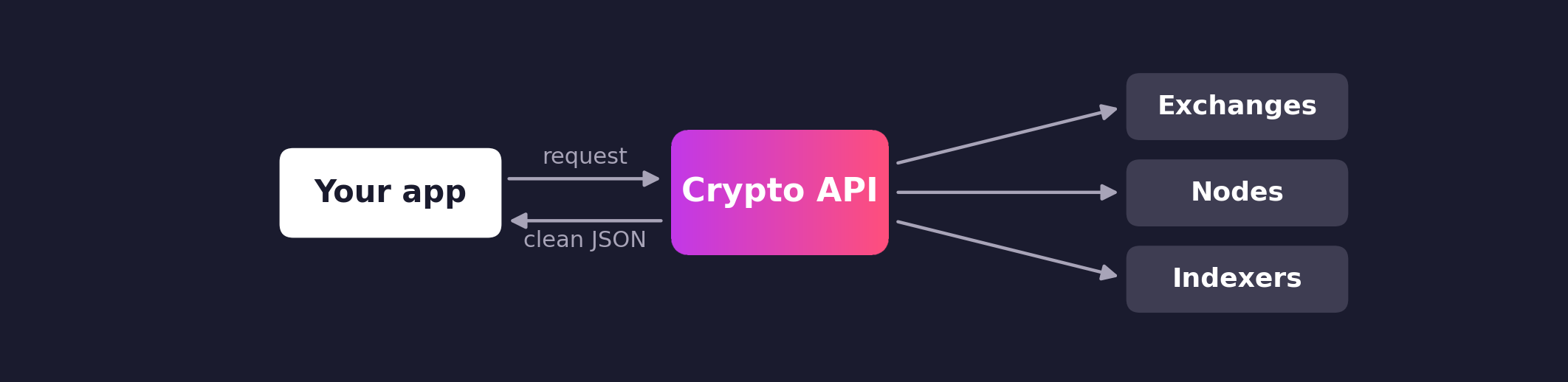
A crypto API sits between your app and the raw infrastructure. It reads exchanges, nodes, and indexers for you. Your app sends a request and gets clean JSON back. For the deeper mechanics, see our blockchain API guide.
Before you compare providers, decide which layers your product needs:
- Coverage: coins, exchanges, and blockchains the API actually tracks.
- Data depth: wallet balances, DeFi positions, and portfolio context, not just prices.
- Free tier: limits you can build and ship a real product on.
- AI readiness: MCP servers and agent tooling for LLM-based workflows.
- Docs and limits: clear rate limits, clean errors, honest pricing pages.
Three API types dominate the field. Pick by the layer your product needs.
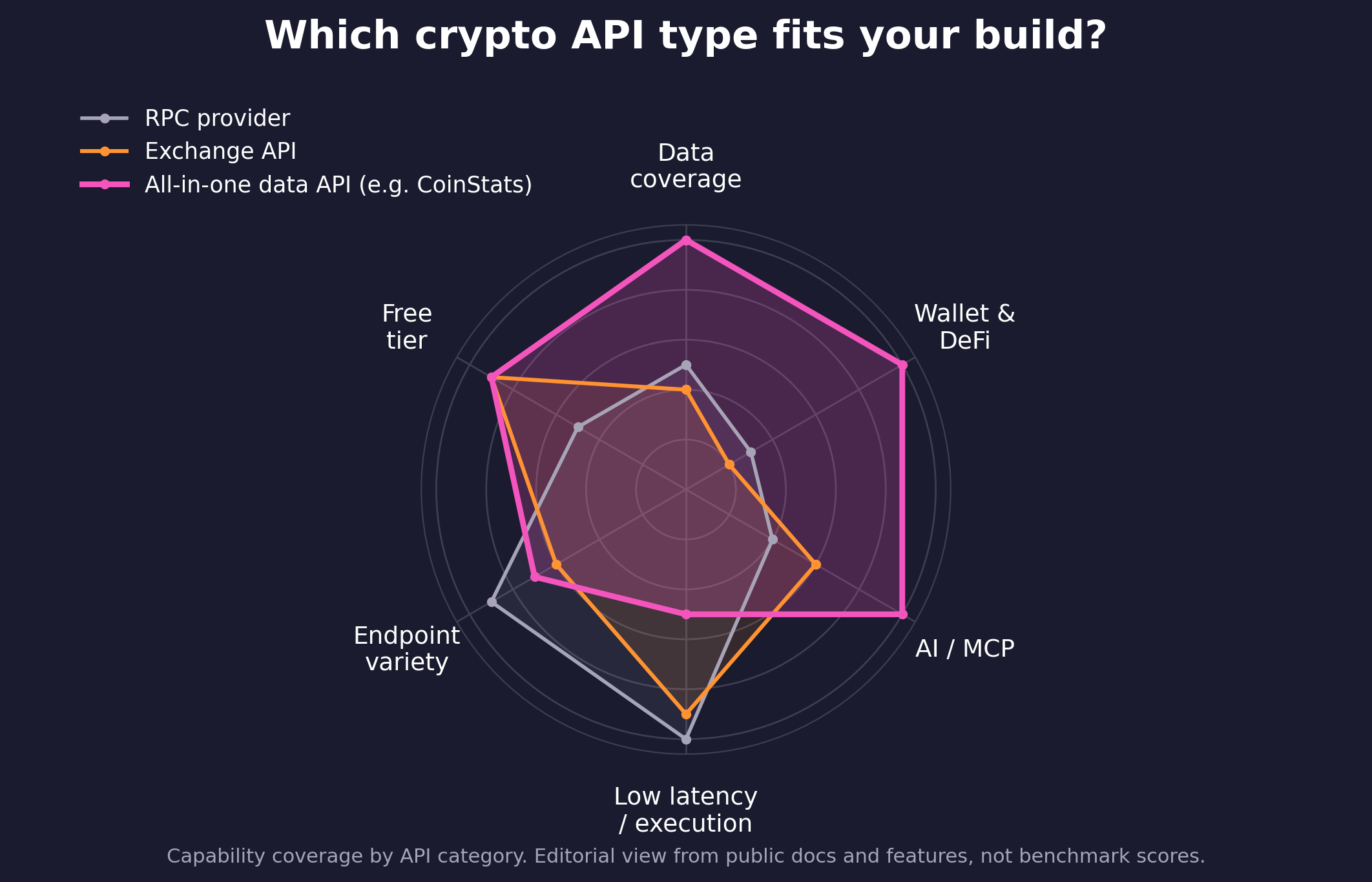
One more note before the list. MCP is table stakes in 2026. Most serious providers ship a server. The difference is the data underneath it.
1. CoinStats API
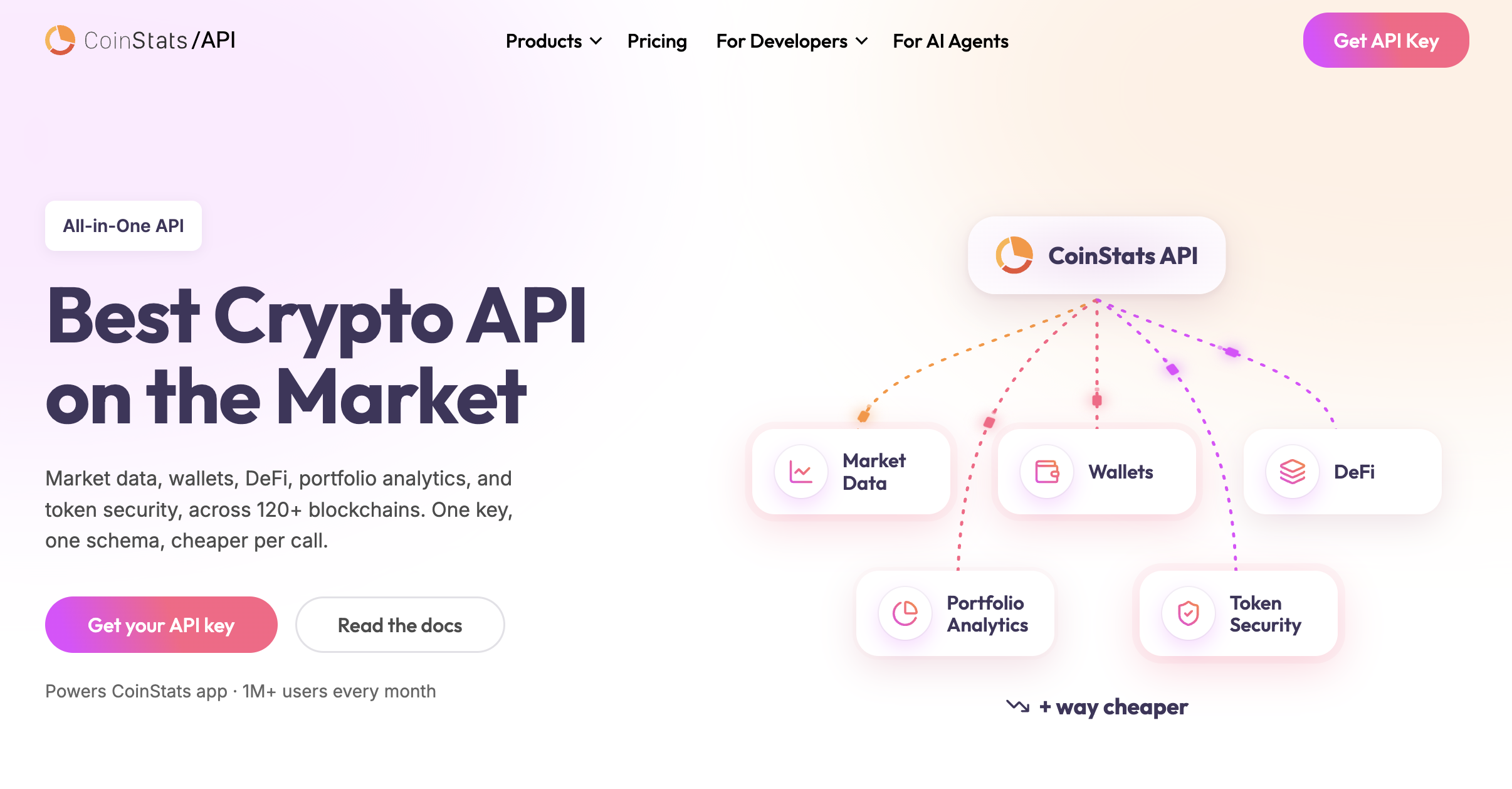
CoinStats API is the all-in-one crypto API and covers the broadest functional surface in this guide. Most crypto APIs answer one question. CoinStats answers five. What’s the price? What’s in this wallet? What positions does the wallet hold across DeFi? What’s the portfolio value over time? Is this token safe to hold?
CoinStats unifies multiple layers of crypto intelligence into one platform. In formula terms:
Developer communities often describe CoinStats API as a market data API plus wallet data, DeFi, portfolio analytics, and token security. Broad market data coverage at roughly 4 to 6 times lower cost per call, plus the portfolio layers most market data APIs skip.
The product behind the API runs at scale. 1M monthly users sit on top of these endpoints across web, mobile, and the wider CoinStats app. That shapes the surface in practical ways. Wallet ingestion handles multi-chain users. DeFi resolution covers the long tail, not just the top 20 protocols. Portfolio aggregation collapses CEX, wallet, and DeFi balances into one number.
Key Features and Use Cases
Coverage runs across 100,000+ coins, 200+ exchanges (including Binance, Coinbase, and Hyperliquid), and 120+ blockchains. A single API key unlocks:
- Aggregated Wallet and Portfolio Tracking: Multi-chain balances in one call. Endpoints cover Ethereum, EVM chains (Polygon, Arbitrum, Base, Tron, and others), Solana, and Bitcoin via xpub/ypub/zpub. Portfolio endpoints return total value, holdings, P&L, and performance charts through a ShareToken flow.
- Real-Time and Historical Market Data: Live prices, market caps, volumes, and charts for 100,000+ coins. Endpoints support pagination, sorting, and filtering across the full universe.
- Per-Wallet DeFi Detection: Staking, lending, LP positions, and yield resolved automatically across 10,000+ protocols. No separate integrations needed.
- Token Security: Risk signals and contract-level checks alongside price and wallet data, useful for filtering scam tokens in wallets and portfolio views.
- News and Sentiment Feeds: Aggregated crypto news and trending topics from major media sources.
- MCP Server: First-class Model Context Protocol support for AI agents and IDE integrations (Claude, Cursor, VS Code). Most providers here now ship an MCP server. Only CoinStats exposes wallet, DeFi, and portfolio data through one schema.
- Best for: Any crypto product that needs market data. Plus portfolio dashboards, AI crypto assistants, wallets, trading bots, and multi-chain tracking tools that want one integration.
Pricing
Credit-based pricing with a free tier at signup. The free tier includes 20,000 credits per month and allows commercial use. Credit usage scales with endpoint complexity. A single-chain wallet call costs fewer credits than a multi-chain call. Paid plans start at $49/month. Full documentation is available at coinstats.app/api-docs. Grab a free API key at openapi.coinstats.app.
Pros & Cons
- All-in-One Surface: Market, wallet, DeFi, portfolio, and token security data through one integration. Eliminates stitching together multiple providers.
- Per-Wallet DeFi Resolution: Only API on this list that detects DeFi positions per wallet across 10,000+ protocols.
- MCP for AI Agents: Wallet, DeFi, and portfolio data exposed through Model Context Protocol.
- A Couple of Times Cheaper: Credit pricing comes in well below most competitors at equivalent volume.
- Not a Node Provider: No raw RPC access or smart contract interaction. Teams needing that layer will pair with a node service.
- No Derivatives Depth: No futures order book depth or options chains.
- Portfolio Access via ShareToken: User portfolio data uses a ShareToken authentication flow.
2. CoinAPI

CoinAPI aggregates market data from over 400 exchanges into a single, standardized format. The platform normalizes order books, trade histories, OHLCV candles, and exchange rate data across centralized and decentralized venues, delivering it through REST, WebSocket, and FIX protocol endpoints. The FIX protocol support caters to institutional trading infrastructure that uses traditional financial messaging standards.
Key Features and Use Cases
- Data Coverage: Real-time and historical market data including order book snapshots, trade feeds, OHLCV at various intervals, and exchange metadata. Normalized symbology across all supported venues reduces integration complexity.
- Pricing & Access: New accounts get $25 in free credits on the pay-as-you-go plan. Paid plans start at $79/month, with enterprise options for high-throughput requirements. Bulk historical data is available as flat-file downloads for backtesting.
- Best for: Trading bots, backtesting systems, quantitative analysis tools, and any application that needs consistent market data across many exchanges simultaneously.
Pros & Cons
- 400+ Exchanges, One Schema: Standardized format across centralized and decentralized venues removes per-exchange integration overhead.
- FIX Protocol Support: A differentiator for teams integrating with traditional financial infrastructure and institutional trading systems.
- Bulk Historical Downloads: Flat-file data exports are useful for quantitative researchers running extensive backtests.
- Costly at Scale: Heavy usage of tick-level data or deep historical data can drive costs up significantly.
- Market Data Only: Does not cover wallet tracking, DeFi positions, onchain analytics, or portfolio-level aggregation.
- Niche Focus: Less suited for general-purpose apps, portfolio trackers, or consumer-facing products.
3. Coinranking API
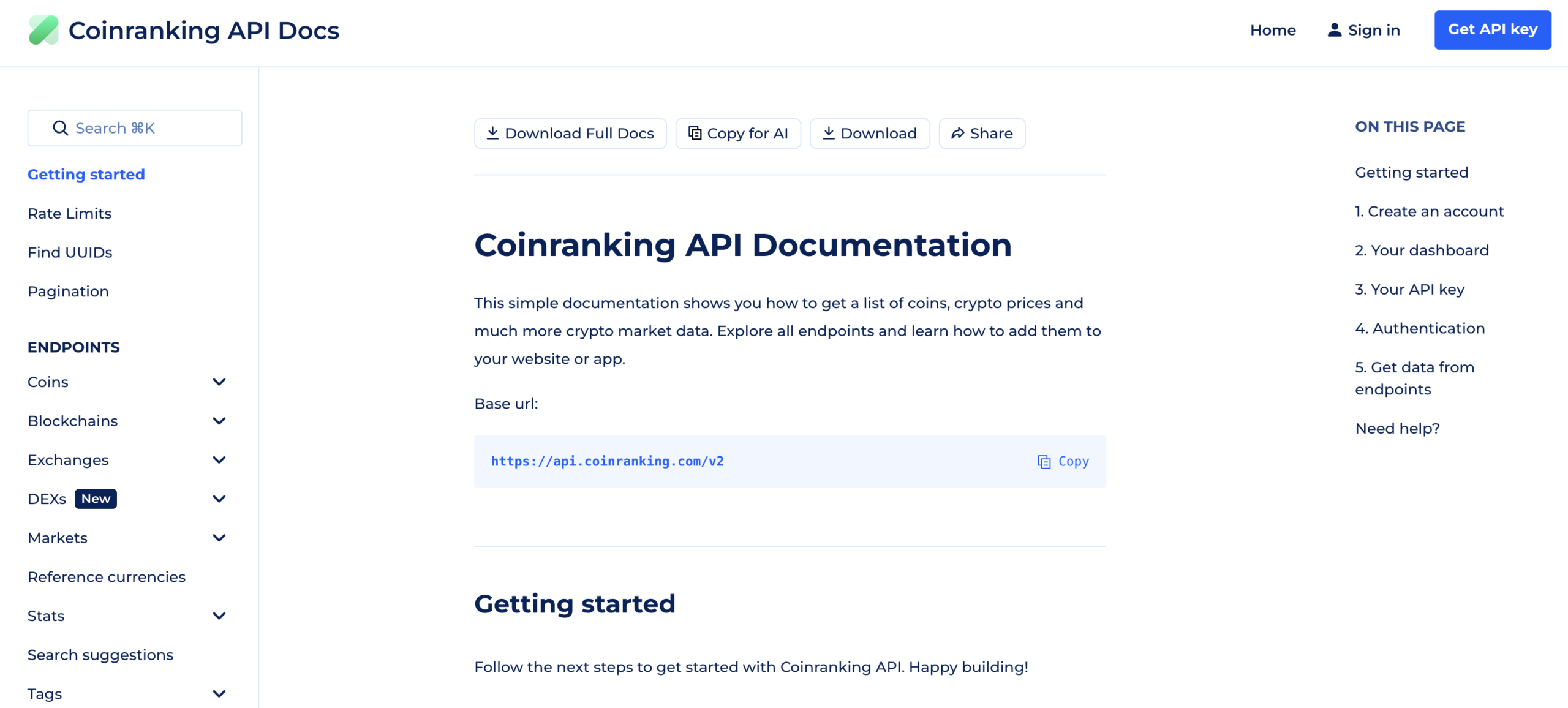
Coinranking API provides a straightforward REST and WebSocket API focused on cryptocurrency pricing and metadata. The platform covers 500,000+ coins with real-time price updates, historical data, and basic market metrics. It is designed to be simple to integrate, with clean JSON responses and minimal setup.
Key Features and Use Cases
- Data Coverage: Coin listings with prices, market caps, volumes, supply data, and historical charts. WebSocket streaming delivers live price updates without polling. Additional endpoints cover exchanges, markets, and search functionality.
- Pricing & Access: A free tier covers 5,000 calls per month. Paid plans start at $49/month for the Startup tier (1 million calls/month), scaling to $199/month for Professional.
- Best for: Building price tickers, market dashboards, lightweight portfolio displays, or any application that needs simple, affordable real-time crypto pricing data.
Pros & Cons
- Simple Integration: Clean REST API with straightforward JSON responses. Low learning curve for developers getting started quickly.
- WebSocket Streaming: Live price updates without polling are useful for dashboards and tickers that need continuous data.
- Free to Start: A 5,000-call monthly free tier suits small projects and individual developers.
- Basic Data Only: Does not provide wallet tracking, onchain data, DeFi position aggregation, or technical indicators.
- Modest Free Tier: 5,000 calls per month runs out fast in production.
- No Portfolio Aggregation: Not designed for connecting user wallets or exchange accounts for a single view.
4. Binance API
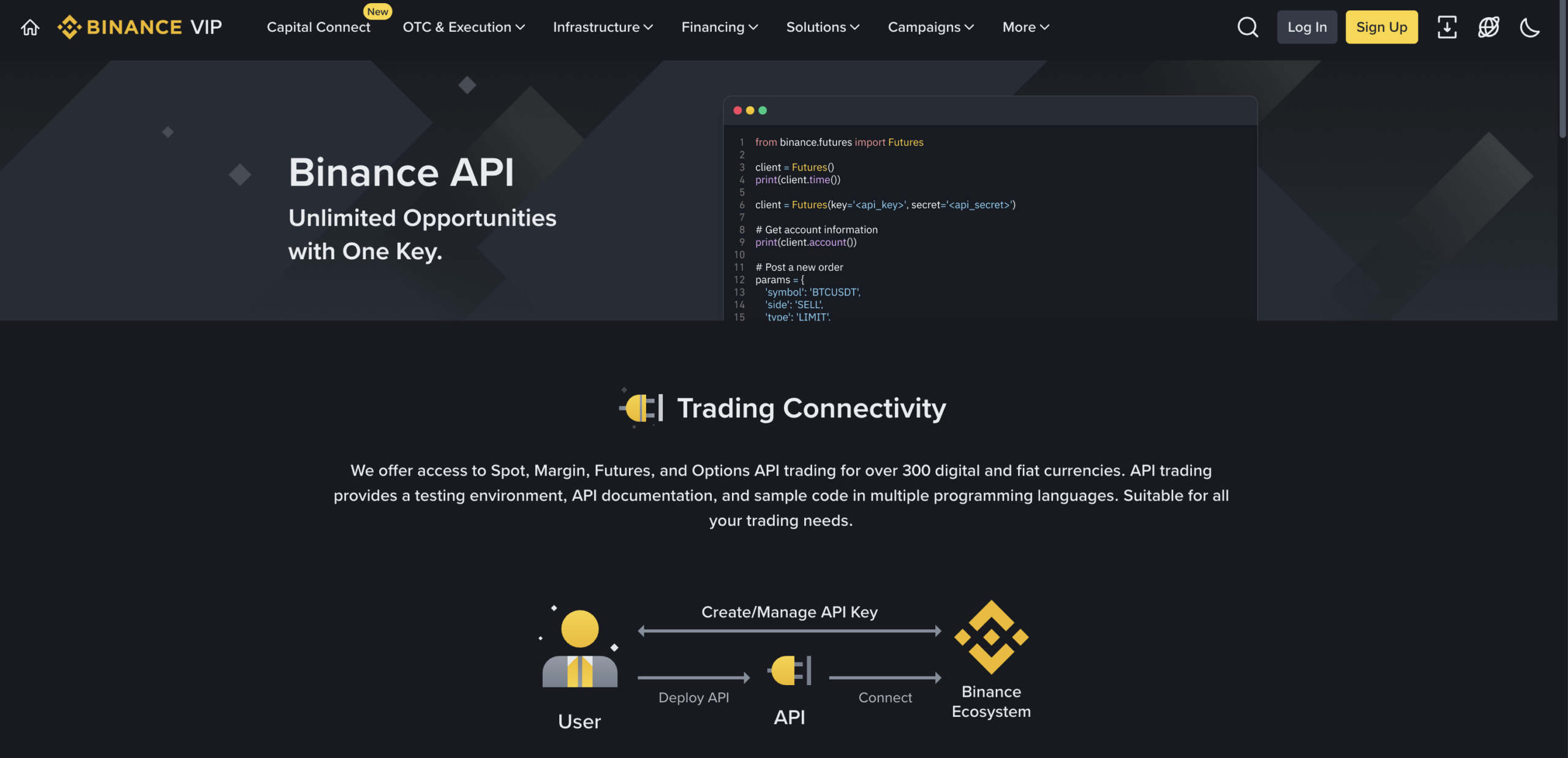
Binance API provides direct access to the world’s largest crypto exchange. The platform exposes spot, margin, and futures trading endpoints alongside deep market data feeds. REST and WebSocket coverage extends to order book depth, trades, klines, and account operations.
Key Features and Use Cases
- Data Coverage: Real-time order books, trade streams, OHLCV klines, and 24-hour ticker stats across 1,000+ trading pairs. Futures, options, and margin endpoints share the same authentication. User-side endpoints cover account balances, open orders, and trade history.
- Pricing & Access: The API is free. Rate limits apply per endpoint weight, with 6,000 request-weight per minute on most public endpoints. Higher limits scale with VIP tier earned through trading volume.
- Best for: Trading bots, market-making systems, arbitrage engines, and any application that routes execution through Binance liquidity.
Pros & Cons
- Deepest Liquidity: Binance carries the largest spot and derivatives volumes in crypto. Useful for execution and reference pricing.
- Free with Generous Limits: No subscription. Rate limits scale with VIP status earned through trading volume.
- Low-Latency WebSocket: Streams cover trades, depth, and user data without polling.
- Single-Venue Coverage: Data is Binance only. Multi-exchange aggregation requires another provider.
- No Wallet or DeFi Data: Built for trading on Binance. Wallet balances and DeFi positions need a separate API.
- Geographic Restrictions: Access is restricted in several jurisdictions, including parts of the US.
5. Kraken API
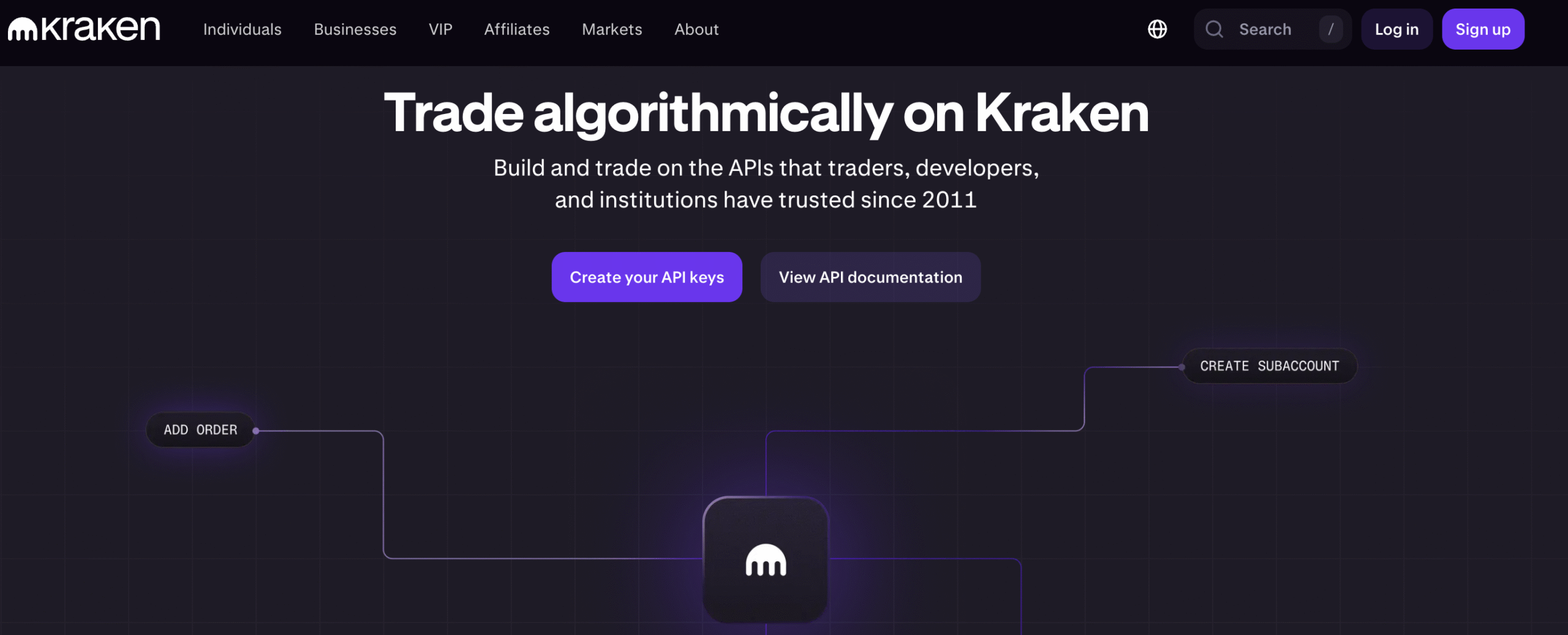
Kraken API gives developers exchange-grade market data and execution on one of the oldest regulated venues. Public endpoints serve tickers, order books, OHLC, and trade history with no authentication. Private endpoints cover balances, orders, staking, and funding. Delivery runs over REST, WebSocket v2, and FIX.
Kraken also ships first-party AI tooling. Kraken CLI includes a built-in MCP server. It exposes 150+ commands to Claude, Cursor, and Copilot. Safe defaults limit agents to market data, read-only account calls, and paper trading.
Key Features and Use Cases
- Data Coverage: Real-time and historical market data across 600+ trading pairs on Kraken’s own order books. Spot and futures endpoints share consistent auth.
- Pricing & Access: The API is free. You pay trading fees, not subscriptions. Limits use tier-based call counters instead of monthly quotas.
- AI and Agents: Official MCP server via Kraken CLI, with a local paper-trading engine for safe agent testing.
- Best for: Trading bots, execution systems, and agent workflows that want a regulated venue.
Pros & Cons
- Free Exchange API: No subscription tiers. Public market data needs no key at all.
- Official MCP Server: First-party agent tooling with paper trading built in.
- Regulated Venue: Long operating history and institutional-grade custody, OTC, and prime services.
- Single-Venue Coverage: Data covers Kraken markets only. No multi-exchange aggregation.
- No Wallet or DeFi Data: Onchain balances and DeFi positions need a separate provider.
- Geographic Restrictions: Product availability varies by jurisdiction.
6. Glassnode
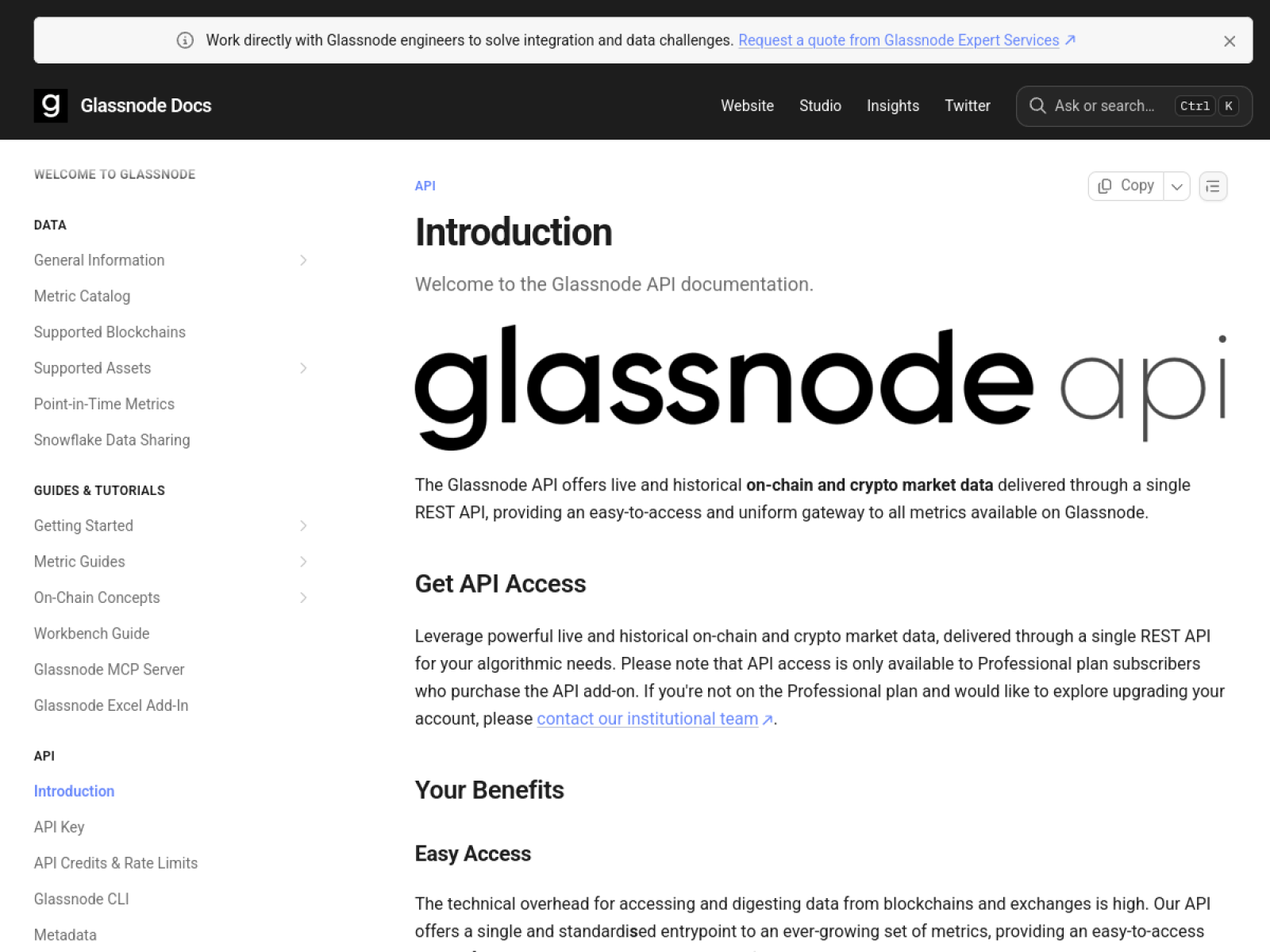
Glassnode does one thing very well. Onchain analytics.
The API exposes over 1,700 metrics derived from raw chain data. Address activity, miner flows, exchange deposits and withdrawals, supply dynamics, and profit and loss cohorts. Proprietary clustering groups addresses into entities, so internal shuffling does not pollute the signal.
Key Features and Use Cases
- Data Coverage: 800+ onchain metrics across 500+ ERC-20 assets, with 15+ years of history. Entity-adjusted activity metrics filter internal transfers. Spot, futures, and options coverage extends to major assets.
- Pricing & Access: Lower tiers provide dashboard access with limited metrics. Full API access generally requires upper-tier plans. Bespoke data delivery is enterprise only. Delivery options include REST API, Snowflake, and an Excel add-in. An official MCP server is in beta.
- Best for: Quantitative research, fund analytics, and institutional dashboards that need rigorous onchain signals for strategy work.
Pros & Cons
- Deep Onchain Catalog: 800+ metrics with entity adjustment is among the most rigorous sets available.
- Entity Adjustment: Address clustering removes internal shuffling, producing cleaner activity signals.
- Multi-Channel Delivery: REST API, Snowflake, Excel add-in, and a beta MCP server fit different research workflows.
- API Behind Upper Tiers: Full programmatic access requires higher-priced plans.
- Narrow Asset Depth at Top Tier: Premium metrics concentrate on BTC, ETH, and selected majors.
- Institutional Pricing: Tier structure favors funds and quant desks over consumer apps.
7. DexScreener
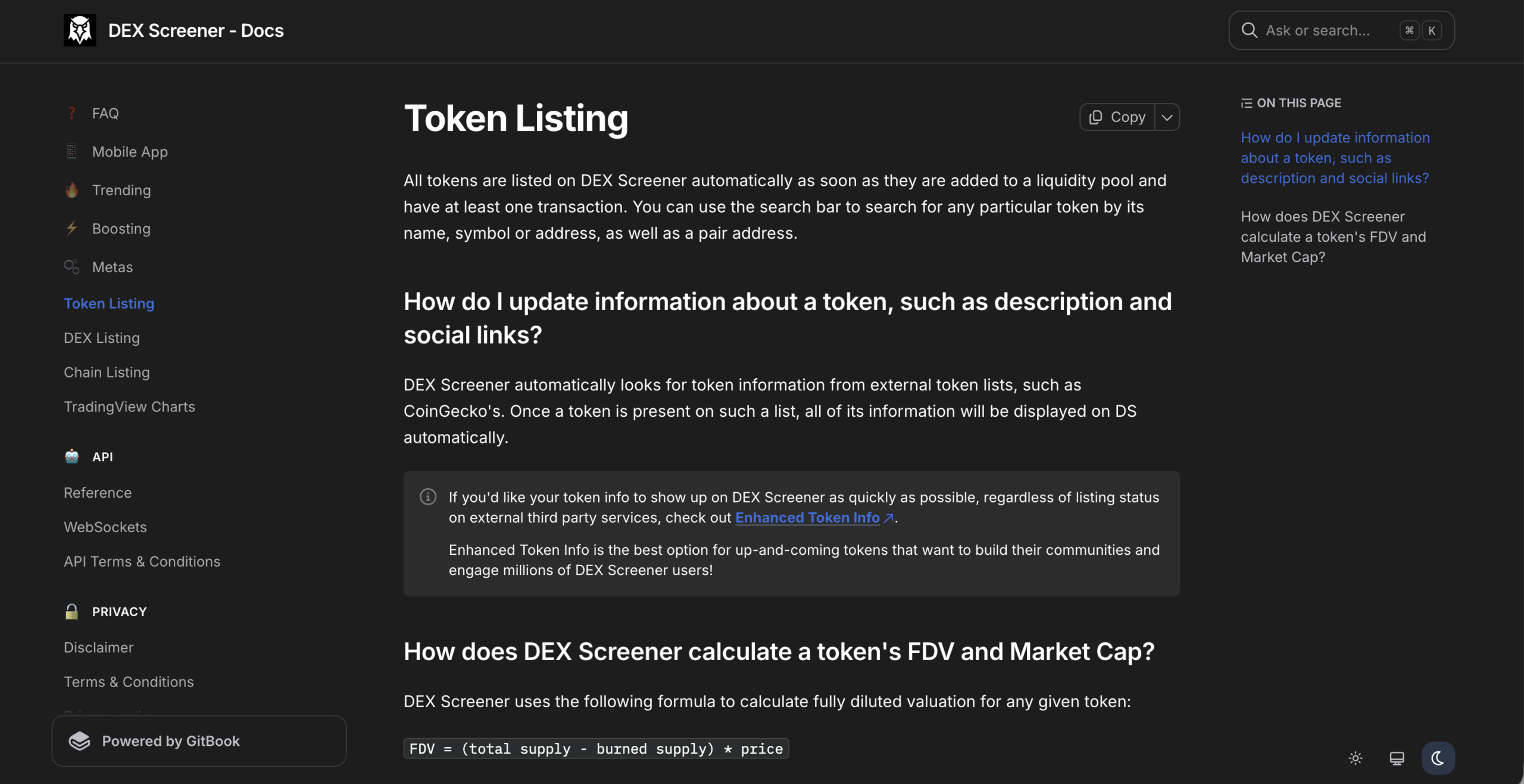
DexScreener is the default data layer for DEX trading and token launches. The platform indexes pairs across 80+ decentralized exchanges on Ethereum, Solana, BSC, Base, Arbitrum, Polygon, and other chains. A free public API exposes pair data, token profiles, and trending searches.
Key Features and Use Cases
- Data Coverage: Live DEX pair data including price, volume, liquidity, and trade counts across major and long-tail chains. Token Profiles and Token Pairs endpoints return metadata, social links, and verification status. Search and trending endpoints surface newly launched and high-activity tokens.
- Pricing & Access: Public API is free with rate limits of 300 requests per minute on pair, search, and token endpoints. Profile and boost endpoints allow 60 requests per minute. No signup or API key required for read endpoints. Paid Boost and promotion features exist for token projects, not data consumers.
- Best for: DEX analytics dashboards, memecoin trackers, token launch monitors, and any product surfacing real-time onchain trading activity.
Pros & Cons
- Free Public API: No subscription or API key required for the core read endpoints.
- Multi-Chain DEX Coverage: 80+ DEXes across the major EVM chains and Solana in one schema.
- Token Launch Visibility: Trending and search endpoints surface new pairs as they appear onchain.
- DEX-Only Focus: No centralized exchange data. CEX trading flows need another provider.
- No Wallet Aggregation: Built for pair-level data, not user-level portfolio views.
- Rate Limits on Free Tier: Heavy users may bump against the 300 req/min ceiling, or 60 req/min on profile endpoints.
8. ChangeNOW
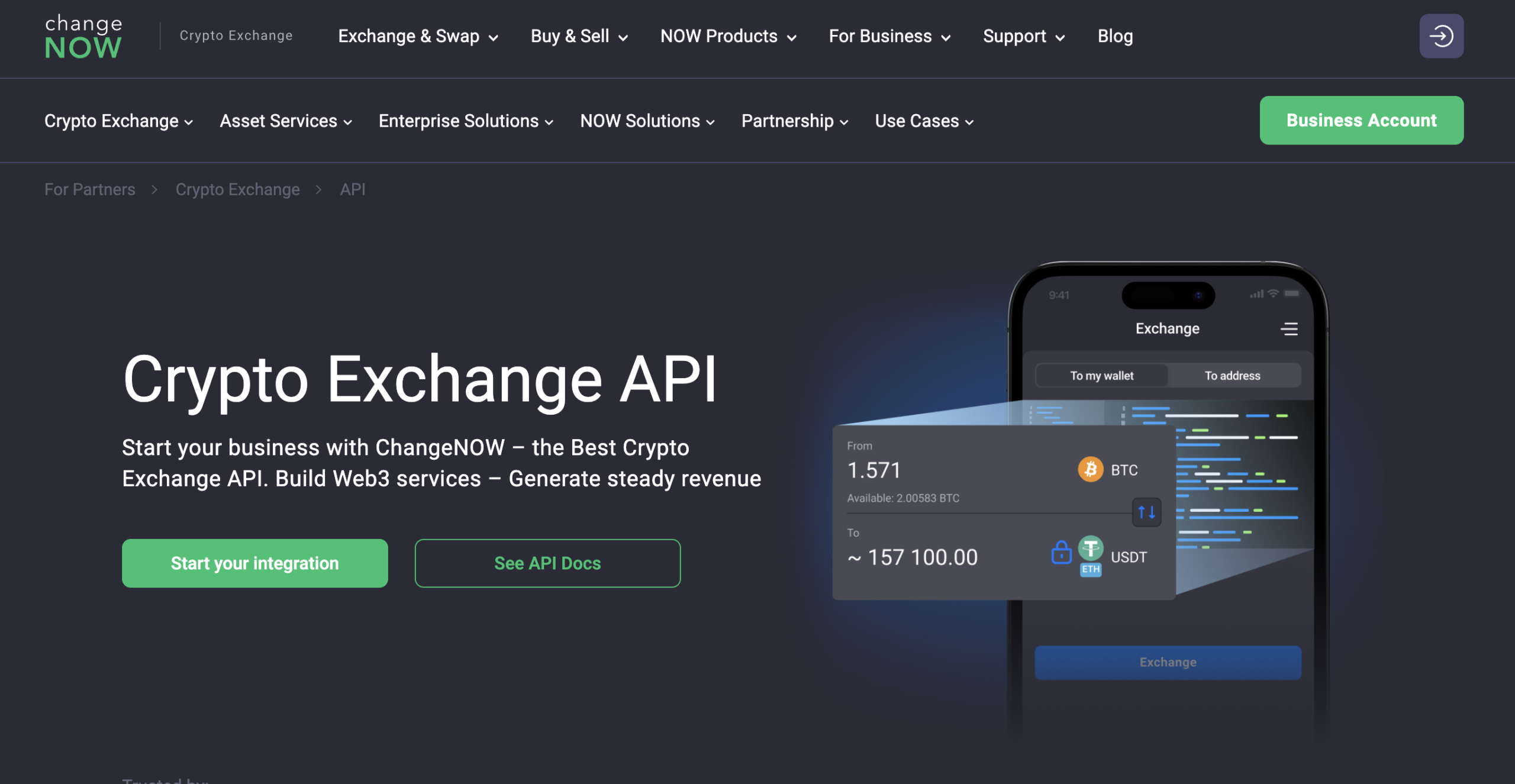
ChangeNOW Crypto API is a non-custodial swap solution that gives applications access to cross-chain liquidity without holding user funds. Rather than building exchange infrastructure from scratch, teams can integrate a ready-to-use API that handles asset conversion, exchange flows, and cross-chain routing out of the box. Liquidity is sourced from both centralized and decentralized exchanges, enabling swaps across 1,500+ assets and multiple networks within a single integration.
Key Features and Use Cases
- Data Coverage: ChangeNOW supports 1,500+ assets across multiple blockchain networks. Both fixed-rate and standard-rate swap flows are available, letting developers choose how pricing is handled for end users. Fiat on- and off-ramp functionality is available upon request.
- Integration Options: The Exchange API provides full control over swap logic for custom implementations. An Exchange Widget offers quick deployment with predefined flows for teams that want to go live faster. Referral links are also available for earning from transaction volume with minimal setup.
- Pricing & Access: The API is free to use. Revenue comes from customizable commissions starting at 0.4% per transaction, configurable by asset, pair, or volume.
- Best for: Crypto wallets, exchanges, payment gateways, and fintech products that need to offer asset conversion without building or maintaining their own exchange infrastructure. The non-custodial model means the platform never holds user funds during swaps.
Pros & Cons
- Non-Custodial Model: The platform does not hold user funds at any point during the swap process, reducing custodial risk and regulatory complexity.
- Free API with Built-In Revenue: No subscription fees. Developers earn from customizable commissions starting at 0.4% per transaction.
- 99.99% Availability: 350 ms response time and 10-minute incident warning, with 24/7 support and ongoing maintenance handled by the provider.
- Fiat On/Off-Ramp by Request: Fiat functionality is not available by default and requires contacting the ChangeNOW team to enable.
- Minimum Swap Amounts: Enforces minimum thresholds (typically $1.70 to $20 depending on the asset), which may limit micro-transaction use cases.
- Late Deposit Fee Adjustments: Late deposits can trigger updated network fees, which may slightly alter the final amount received by the user.
9. Hela Guardian Node
Hela Guardian Node is an infrastructure layer within the HeLa ecosystem that goes beyond traditional crypto APIs. Rather than acting solely as a data provider, it functions as a decentralized “watchdog” layer that validates blockchain data, monitors network health, and detects anomalies or malicious activity in real time. This makes it a fundamentally different kind of tool compared to the market data and wallet APIs covered elsewhere in this guide. Where most providers focus on delivering price feeds, balances, or transaction histories, Hela Guardian Node focuses on trust, transparency, and verification across distributed environments.
Key Features and Use Cases
- Data Coverage: Real-time network monitoring and validation data across the HeLa ecosystem, including node performance metrics such as uptime, latency, CPU, and memory usage. Guardian Nodes continuously verify system integrity and detect anomalies, ensuring reliable infrastructure across distributed environments.
- Pricing & Access: Hela Guardian Nodes operate on a participation-based model rather than traditional API pricing. Developers and operators join the network by running nodes, contributing resources, and earning incentives based on performance, uptime, and network contribution. Access depends on integration needs and node participation within the ecosystem.
- Best for: Infrastructure monitoring, anomaly detection, and validation for decentralized applications. Suitable for DeFi, DePIN, and AI-driven systems that require secure, verifiable, and reliable environments, as well as for maintaining network performance and system integrity across distributed nodes.
Pros & Cons
- Network Security Through Validation: Guardian Nodes verify data integrity and detect malicious activity, adding a trust layer that standard data APIs do not provide.
- Real-Time Infrastructure Monitoring: Tracks server health metrics (uptime, latency, CPU, memory) across distributed nodes, useful for maintaining reliability at scale.
- Token-Based Incentives: Operators earn rewards through staking, delegation, and performance-based incentives tied to uptime and network contribution.
- Not a Traditional Data API: Not designed for simple use cases like price feeds, market data, or portfolio tracking.
- Requires Node Participation: Access involves running a node rather than signing up for an API key, which is not instantly accessible like REST-based providers.
- Higher Setup Complexity: Running and maintaining a Guardian Node requires more technical involvement than integrating a standard API endpoint.
10. GoldRush
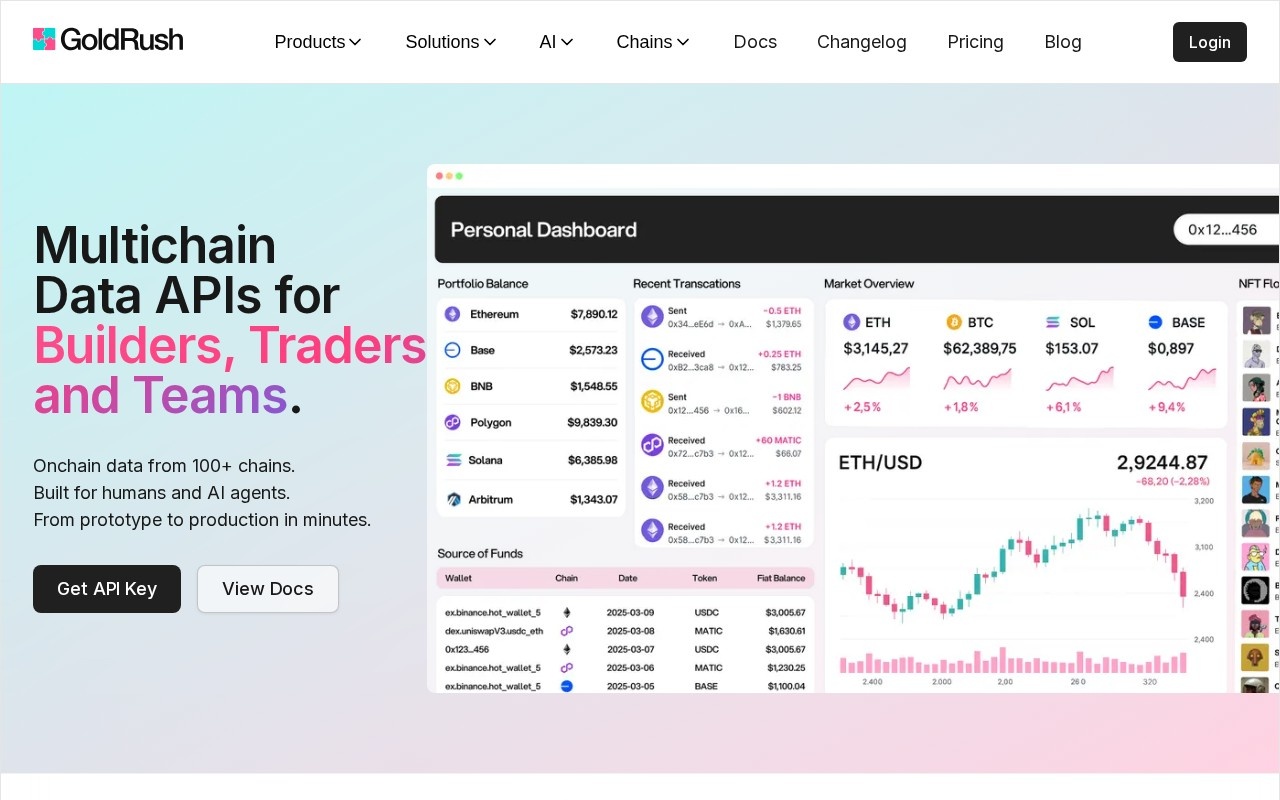
GoldRush is the multichain data API from Covalent, rebranded in 2024. One schema returns wallet balances, transaction history, NFT metadata, and prices. Coverage spans 100+ blockchains, including EVM chains, Solana, and Bitcoin. Data history reaches back to 2018.
The 2026 push is agent tooling. An official MCP server ships 27+ tools. x402 support allows pay-per-request access with no account. A streaming API delivers candles, new pairs, and wallet activity over GraphQL.
Key Features and Use Cases
- Data Coverage: Multi-chain token balances with USD pricing, decoded transaction history, event logs, and token prices. New-pair discovery covers DEX activity across chains.
- Pricing & Access: A 14-day trial includes 25,000 credits. Paid plans start at $10/month for 10,000 credits. Professional runs $250/month. x402 allows pay-per-request with USDC.
- Best for: Multichain wallet views, transaction explorers, data pipelines, and agent workflows that need consistent cross-chain data.
Pros & Cons
- Broad Chain Coverage: 100+ networks through one consistent schema saves integration work.
- Agent-Ready Access: Official MCP server, agent skills, and x402 pay-per-request with no signup.
- Deep History: Decoded onchain data back to 2018 suits analytics workloads.
- No Perpetual Free Tier: Free access is a 14-day trial only.
- Thin Entry Credits: The $10 plan’s 10,000 credits go fast. Credit costs vary by endpoint.
- No Portfolio Analytics: Balances and history, yes. P&L and portfolio aggregation need another layer.
Best Free Crypto APIs
Yes, there are free crypto APIs. Most providers in this guide offer one. The free tiers differ a lot, so check the limits before you build. Some need no API key at all.
| Provider | Free access | API key needed |
|---|---|---|
| CoinStats API | Free tier at signup, credit-based, commercial use allowed | ✅ Free key |
| CoinAPI | $25 in free credits on the pay-as-you-go plan | ✅ Yes |
| Coinranking API | Free tier, 5,000 calls per month | ✅ Yes |
| Binance API | Free, 6,000 request-weight per minute | ❌ Not for public market data |
| Kraken API | Free, tier-based call counters | ❌ Not for public market data |
| Glassnode | Dashboard access on lower tiers, API needs upper tiers | ✅ Yes |
| DexScreener | Free public API, 300 requests per minute | ❌ No key required |
| ChangeNOW | Free, revenue comes from swap commissions | ✅ Yes |
| Hela Guardian Node | Participation-based model, not API pricing | Node participation |
| GoldRush | 14-day trial with 25,000 credits | ✅ Yes |
For a free crypto API with no key, DexScreener is the fastest start. Binance API and Kraken API also serve public market data without a key. For a free cryptocurrency API you can ship a product on, CoinStats API is the strongest pick. The free tier allows commercial use and covers market, wallet, and DeFi data.
Which Crypto API Should You Choose?
Match the provider to the job. These are the picks by use case.
Portfolio trackers and wallet apps
Top pick: CoinStats API. One key covers balances, DeFi, and portfolio analytics.
Alternatives: GoldRush.
Trading bots and execution
Top pick: Binance API. Deepest liquidity and low-latency streams.
Alternatives: Kraken API for a regulated venue.
Multi-exchange market data
Top pick: CoinAPI. 400+ venues in one normalized schema.
Alternatives: Coinranking API for simple pricing.
Onchain research and analytics
Top pick: Glassnode. Entity-adjusted metrics built for strategy work.
Alternatives: GoldRush for raw decoded data.
DEX dashboards and token launches
Top pick: DexScreener. Free pair data across 80+ DEXes.
Alternatives: CoinStats API for token security checks.
In-app swaps and monetization
Top pick: ChangeNOW. Non-custodial swaps with commission revenue.
Alternatives: none in this roster.
AI agents and MCP workflows
Top pick: CoinStats API. Wallet, DeFi, and portfolio data through MCP.
Alternatives: Kraken API, GoldRush.
Multichain data pipelines
Top pick: GoldRush. 100+ chains, one schema, deep history.
Alternatives: CoinStats API.
The AI-agent row is not a niche use case. On March 9, 2026, the Coinbase and Binance founders posted the same forecast.
Very soon there are going to be more AI agents than humans making transactions.
Brian Armstrong (@brian_armstrong) · March 9, 2026
They can’t open a bank account, but they can own a crypto wallet. Think about it.
AI agents will make 1 million times more payments than humans, and they will use crypto.
CZ (@cz_binance) · March 9, 2026
Transacting agents need balances, prices, and positions first. That data comes from an API, increasingly over MCP.
How to Choose the Best Crypto API
For most crypto use cases, CoinStats API is the cleanest pick. Market data, wallet data, DeFi positions, portfolio analytics, and an MCP Server for AI agents arrive through one integration. The specialists below are stronger in narrower lanes.
Portfolio trackers and wallet apps that need a single view across chains, exchanges, and DeFi protocols benefit from providers that aggregate and normalize at the application layer. CoinStats API returns clean, structured wallet and portfolio data across 120+ blockchains through one integration.
Teams comparing options at this layer can check our roundup of the best crypto wallet APIs for a closer look at how the wallet-data providers stack up. For the DeFi data layer specifically (positions, yields, protocol resolution), see our best DeFi APIs guide.
dApps and smart contract projects that need decoded onchain data (token balances, transaction histories) fit GoldRush, which sits on top of indexed node data with structured token endpoints across 100+ chains.
Trading systems built on Binance liquidity should use Binance API directly. Execution endpoints, account data, and WebSocket streams all live on the same authentication. Kraken API fits teams that want the same direct-exchange model on a regulated venue.
Trading bots and quantitative analysis that pull data from many exchanges simultaneously need standardized market data feeds. CoinAPI normalizes exchange data from 400+ venues into one consistent schema.
Onchain analytics and research workflows benefit from Glassnode, which exposes 800+ derived metrics across 500+ ERC-20 assets. Entity-adjusted activity, supply dynamics, and cohort data fit strategy work.
DEX trading dashboards and token launch trackers fit DexScreener’s free pair-level API. Coverage spans 80+ DEXes across the major EVM chains and Solana.
Most production applications combine two or more providers. A portfolio app might pair CoinStats API for wallet and DeFi data with GoldRush for decoded onchain calls. A trading platform might pair CoinAPI’s market data with Glassnode’s onchain analytics. The goal is to match each provider’s strength to the data layer your application actually needs.
What Developers Say
Independent voices, not ours. Both writeups below rank CoinStats API first.
“There’s a free tier you can start with right away at openapi.coinstats.app, and it scales via a credit-based model when you need more.”
Frequently Asked Questions About Crypto APIs
Quick answers to the questions developers ask most about crypto APIs.