
What Is Chainlink (LINK) and Why It Matters for DeFi

0
0

How Chainlink Connects Smart Contracts to Real-World Data
Smart contracts are powerful, but they can't see outside their own blockchain.
That's the gap Chainlink was built to close. What is Chainlink, in plain terms? It's an oracle network that feeds real-world data, like asset prices, into blockchains so smart contracts can act on accurate information.
This matters right now because most major DeFi lending platforms lean on this data to price loans, trigger liquidations, and settle trades. Wrong or delayed data puts the whole protocol at risk.
This article breaks down what Chainlink does, how LINK fits in, what the tokenomics show, and what to watch before assuming any oracle project is risk-free.
What Is Chainlink and How Does the Network Work?
Blockchains are closed systems. A smart contract on Ethereum has no built-in way to know the current price of gold or what block just got mined on another chain.
Chainlink solves this with a decentralized oracle network, which it calls the industry-standard oracle powering most of DeFi.
The basic flow behind its Data Feeds product:
Premium data providers pull raw price data from multiple exchanges.
Independent Chainlink nodes fetch and aggregate that data.
Nodes combine their results off-chain into one tamper-resistant report, published on-chain for smart contracts to use.
No single provider or node controls the final answer, which removes a single point of failure from data controlling billions in on-chain value.
Beyond price feeds, Chainlink's product stack includes the Cross-Chain Interoperability Protocol (CCIP) for moving data and value between blockchains, the Chainlink Runtime Environment (CRE) for orchestrating on-chain and offchain systems, Proof of Reserve for verifying collateral, and newer tools built for AI agents.
Why Is Chainlink Important for DeFi?
DeFi runs on code, and code only knows what data it's given.
Take a lending protocol like Aave or Compound. Someone deposits ETH, borrows a stablecoin against it. Without an accurate ETH price, borrowers get liquidated unfairly, or walk away owing more than their collateral covers. Several past DeFi exploits trace back to exactly this: manipulated or thin price feeds.
Derivatives need the same accuracy to settle trades. Asset-backed stablecoins need proof the collateral exists. Cross-chain bridges need to confirm what happened on one chain before acting on another. That's why so much of DeFi's total value locked sits on oracle infrastructure most users never see.
What Is the LINK Token Used For?
LINK is the network's native token. Chainlink's economics page frames it as the asset that pays for services, backs security, and rewards good performance.
In practice, that's three functions:
Payment: Node operators and data providers earn LINK for their services.
Staking: Holders and node operators lock up LINK to help secure the network. Underperforming nodes can have their stake slashed.
Value capture: Through Payment Abstraction, fees paid in other assets get programmatically converted into LINK via a decentralized exchange, per Chainlink's economics page.
This is a claim about mechanism design, not a guarantee of price performance. How much real revenue actually flows through it is worth tracking independently.
Chainlink Tokenomics: Supply, Circulation and Reserves
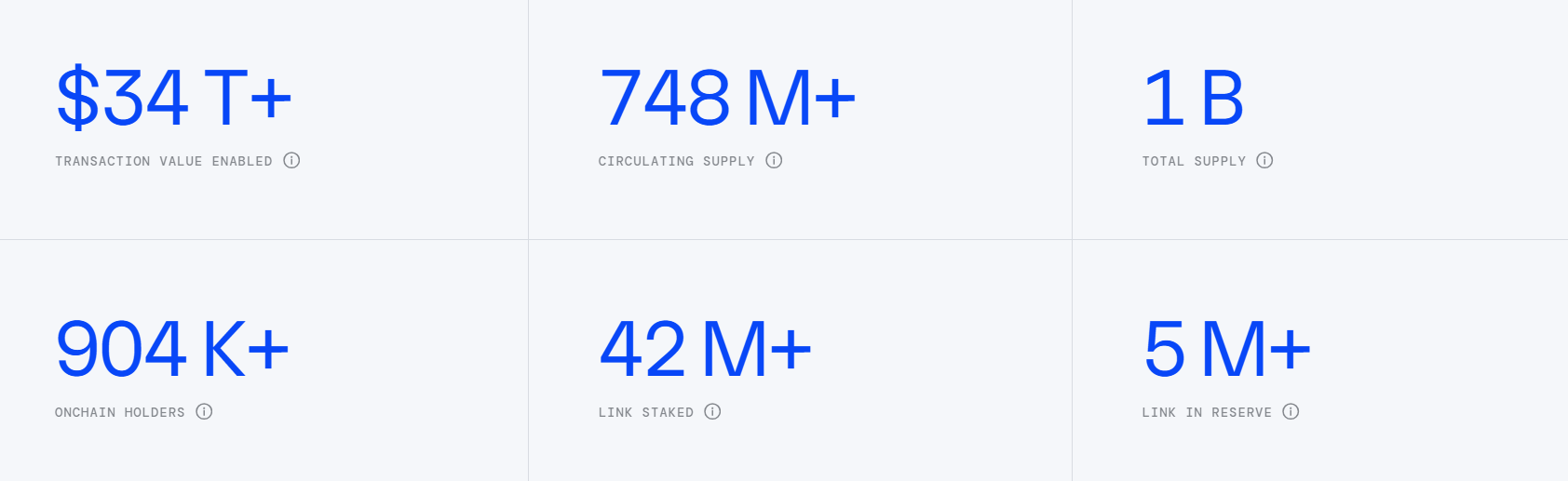
Chainlink's total supply is fixed. According to the project's own economics page (checked September 2026), the numbers look like this:
Metric | Reported Figure | What It Means |
Total supply | 1,000,000,000 LINK (capped) | No new LINK can be minted beyond this cap |
Circulating supply | 748 million+ LINK | Tokens currently available in the market |
Onchain holders | 904,000+ addresses | Addresses holding LINK on Ethereum |
LINK staked | 42 million+ LINK | Staked by community members and node operators |
LINK in Reserve | 5 million+ LINK | Held in the Chainlink-Reserve for long-term sustainability |
A capped supply means Chainlink can't inflate LINK through new issuance, unlike some proof-of-stake tokens. That's a structural fact, not a promise about future demand.
The Chainlink Reserve deserves its own mention. It's a strategic on-chain reserve funded through Payment Abstraction, meant as a treasury, not a yield product. Its size will shift with network revenue and market conditions.
How Does Chainlink Try to Sustain Its Economics?
Beyond staking and the Reserve, a few other mechanisms are worth knowing:
Smart Value Recapture (SVR): lets DeFi protocols reclaim oracle-related MEV that would otherwise leak to third parties.
Scale program: blockchain ecosystems chip in resources to offset the cost of running Chainlink-services, speeding up developer adoption.
Transaction value enabled (TVE): the project's metrics page put this at roughly $34 trillion as of September 2, 2026, the cumulative USD value of transactions that have used a Chainlink-oracle.
That $34 trillion figure is project-reported, not independently audited. It measures data usage, not money currently locked or Chainlink's market cap. Confusing the two is a common mistake.
What Makes Chainlink Different From Other Oracles?
A few things set Chainlink apart from a typical oracle provider:
Institutional adoption: Partnerships with names like Swift, DTCC, Euroclear, and Mastercard, alongside DeFi protocols such as Aave, Compound, and Lido.
Product breadth: Beyond price feeds, it covers cross-chain messaging, compliance tooling, and tokenized real-world asset data.
Security certifications: SOC 2 Type 2 and ISO 27001, standards more common at enterprise infrastructure firms than crypto projects.
None of this guarantees Chainlink stays ahead of cheaper alternatives. Competing oracle networks keep launching, and today's partnerships don't guarantee tomorrow's usage.
What Are the Main Risks to Consider?
Data source risk: An oracle is only as good as the data providers and nodes feeding it.
Smart contract risk: Like any on-chain system, Chainlink's contracts could have vulnerabilities, even after years of running without issue.
Adoption risk: Enterprise pilots and partnership announcements don't always turn into sustained, revenue-generating usage.
Token supply dynamics: A large share of LINK's 1 billion supply isn't circulating yet, and reserve or unlock movements can affect the available supply over time.
General market risk: LINK's price, like any crypto asset, can swing hard regardless of how well the network itself is performing.
A Chainlink-price feed being accurate says nothing about whether LINK the asset is a good investment. Those are separate questions.
Conclusion
It is an oracle network that lets smart contracts access real-world data, from asset prices to cross-chain messages, that blockchains can't generate on their own. LINK pays for that infrastructure, secures it through staking, and is designed to capture value as usage grows.
Published tokenomics show a fixed 1 billion supply, with roughly 748 million LINK in circulation as of September 2026. The institutional partnerships and product range are genuine differentiators, but they don't remove the ordinary risks of any crypto asset. Verify current figures on Chainlink's own site before drawing conclusions.
Disclaimer
This article is for informational purposes only and does not constitute financial advice. Cryptocurrency investments carry significant risk, and readers should do their own research before making any decisions.
0
0

 从同一位置管理所有加密资产、NFT 和 DeFi 资产
安全地关联您正在使用的投资组合,以开始交易。


