
Tether and Opera Boost Stablecoin Access With MiniPay Wallet

0
0
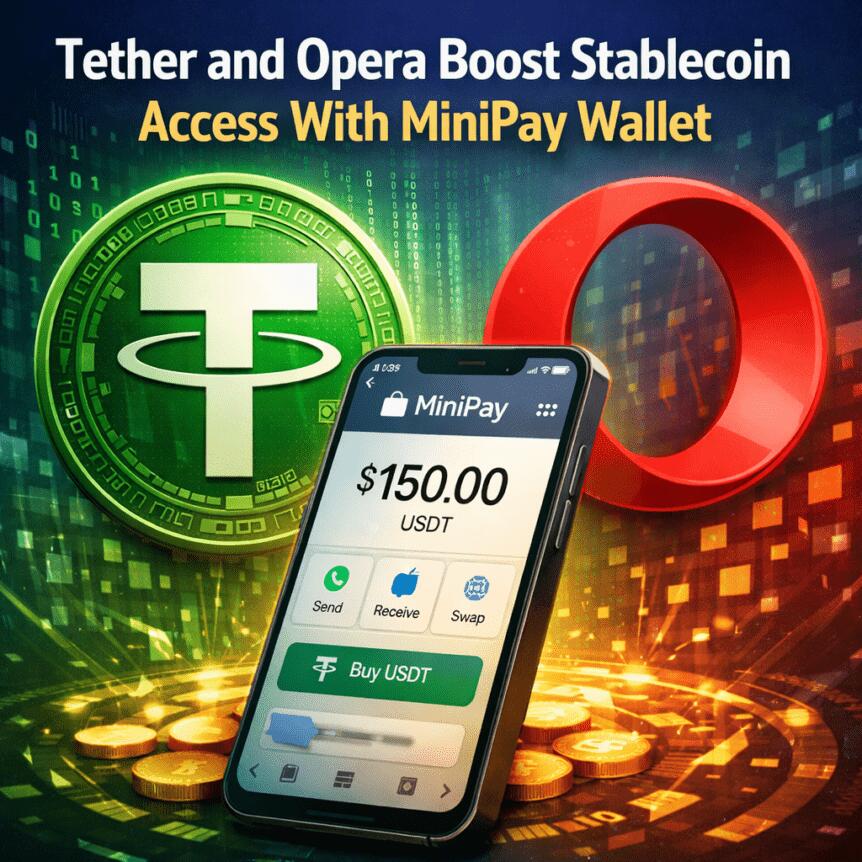
Stablecoin issuer Tether and Opera have announced a collaboration to expand financial access in developing markets through MiniPay, a self-custodial wallet built on the Celo blockchain. The partnership adds USDt and Tether Gold XAUT to MiniPay’s repertoire, targeting users in Africa, Latin America, and Southeast Asia who rely on stable value for savings and remittances. Tether says the initiative aligns with its mission to provide simple, reliable access to stable value. MiniPay, which the company describes as active in 60 countries with 12.6 million wallets and 350 million transactions, reported a 50% surge in users during the fourth quarter, driven largely by emerging markets.
Key takeaways
- Tether expands USDt and XAUT support within MiniPay, broadening access to dollar-linked value on a mobile wallet built on Celo.
- MiniPay reports 60 countries of operation, 12.6 million activated wallets, and 350 million transactions, with 50% user growth in Q4 driven by emerging markets.
- The move underscores rising demand for stablecoins and tokenized gold in mobile-first regions seeking inflation-resilient savings and low-friction transfers.
- Despite regional demand, broader stablecoin market capitalization and exchange flows have contracted amid a wider crypto market downturn.
- XAUT has traded near all-time highs amid gold-market strength, illustrating continued interest in tokenized assets as risk hedges.
Tickers mentioned: $USDT, $XAUT
Market context: The expansion arrives as stablecoin flows and overall liquidity in the crypto space wobble after a period of growth. CryptoQuant data show stablecoin inflows to exchanges have largely turned negative, while crypto markets remain subdued from their October peak, when the total market capitalization briefly touched $4.4 trillion. The environment has raised questions about flows, risk appetite, and the pace of adoption for dollar-denominated rails in emerging markets.
Why it matters
The partnership between Tether and Opera signals a continued push to broaden financial inclusion through crypto-driven rails. For users in regions with uneven banking infrastructures, MiniPay’s accessibility—requiring only a mobile phone number to activate—offers a path to hold and move value in USDt and tokenized gold without a traditional bank account. The inclusion of USDt, the world’s dominant dollar-pegged stablecoin, and XAUT, a tokenized form of physical gold, expands the set of on-chain instruments available to savers and remitters, potentially reducing friction and settlement times compared with legacy remittance channels.
From a strategic standpoint, the arrangement strengthens Tether’s footprint in emerging markets by diversifying the ways people access stable value. For Opera, the collaboration deepens MiniPay’s utility and reinforces the browser-maker’s push into non-custodial wallet capabilities on mobile devices. The combination of stability and accessibility aligns with a broader trend: users in developing regions increasingly rely on stablecoins and tokenized assets to preserve purchasing power amid local currency volatility and to facilitate cross-border payments with reduced risk and cost.
The broader market narrative remains mixed. While regional usage of stablecoins and tokenized assets grows, analysts note that sustained stability and liquidity depend on institutional engagement, regulatory clarity, and the evolution of on-ramps and off-ramps in target markets. A recent CryptoQuant analysis highlighted that stablecoin-to-exchange inflows have been largely wiped out after an initial surge, suggesting a shift in how market participants perceive risk and allocate capital in a risk-off environment. In parallel, a quoted assessment attributes recent flows to a “rise in risk aversion,” with some participants withdrawing stablecoins from exchanges. These dynamics will shape how MiniPay’s expansion translates into durable user adoption and cross-border payout activity.
“Recent months clearly reflect a rise in risk aversion, or even capitulation among later entrants, who have chosen to withdraw their stablecoins from exchanges.”
Beyond the macro backdrop, XAUT’s presence on MiniPay taps into a broader appetite for tokenized real-world assets. Tether Gold has posted strong interest, with a circulating supply of 712,747 XAUT and a market capitalization around several billions, reflecting demand for inflation hedges and a diversified exposure within crypto wallets. The token’s performance has mirrored gold markets, with notable price action around late January as gold broadly traded higher. This layout—stablecoins paired with tokenized commodities—illustrates how wallet ecosystems are converging on multiple layers of value within a single interface.
What to watch next
- Expansion milestones: Monitor MiniPay’s rollout across additional markets and any new currency or asset support tied to USDt or XAUT.
- User adoption: Track wallet activation rates, transaction volumes, and transfer sizes in regions targeted by the partnership.
- Regulatory signal: Observe any regulatory guidance or policy changes in Africa, Latin America, and Southeast Asia that could affect stablecoins and tokenized assets.
- Market flows: Keep an eye on CryptoQuant’s stablecoin flow data for evolving inflow/outflow dynamics and their impact on on-chain activity.
Sources & verification
- Tether and Opera expand financial access in emerging markets through MiniPay — official announcement: https://tether.io/news/tether-and-opera-expand-financial-access-in-emerging-markets-through-minipay/
- MiniPay usage metrics: “operational in 60 countries, 12.6 million activated wallets, and 350 million transactions” and Q4 growth data referenced in the announcement.
- Tokenized gold data for XAUT: CoinGecko page for Tether Gold (XAUT): https://www.coingecko.com/en/coins/tether-gold
- Stablecoin flow analysis: CryptoQuant research noting collapsing stablecoin-to-exchange inflows: https://cryptoquant.com/insights/quicktake/697fb27df9e47748502fe83b-Stablecoin-flows-collapse
- Related coverage on tokenized gold demand and dollar stress: https://cointelegraph.com/news/gold-digital-rally-mirrors-rising-stress-dollar
- Tether stability and USDT-related topics in public materials: https://cointelegraph.com/news/tether-stablecoin-usdt-profits-us-treasury-holdings-annual-report
MiniPay expansion highlights demand for dollar-linked wallets in emerging markets
In summary, the collaboration between Tether and Opera to bolster MiniPay’s wallet offerings for USDt and XAUT demonstrates how stablecoins and tokenized assets are increasingly embedded in mobile-first economies. The approach aims to provide accessible, low-friction ways to store value and transfer remittances in dollar terms, a use case that gains traction as users in emerging markets navigate currency volatility and uneven financial infrastructure. By integrating USDt and XAUT into a widely used wallet on the Celo network, the initiative seeks to blend stability with accessibility, potentially widening the audience for on-chain savings and cross-border payments while highlighting the evolving role of tokenized assets in everyday financial activity.
This article was originally published as Tether and Opera Boost Stablecoin Access With MiniPay Wallet on Crypto Breaking News – your trusted source for crypto news, Bitcoin news, and blockchain updates.
0
0


 Manage all your crypto, NFT and DeFi from one place
Securely connect the portfolio you’re using to start.


