
Robinhood Chain News: $4.5M Fees Paid, Ethereum Gets Just $400

0
0

Robinhood Chain News how Did $4.5M Fees Become Just $400 for Ethereum?
Here's a piece of Robinhood Chain news that highlights a growing tension in how Layer 2 networks actually work.
According to a detailed investigation from Bitquery, Robinhood Chain collected roughly $4.5 million in transaction fees on September 3, while paying Ethereum just $398 for data posting and proof costs that same day.
That's a ratio of about 11,400 to 1, and it raises real questions about where all this Layer 2 growth is actually generating value.
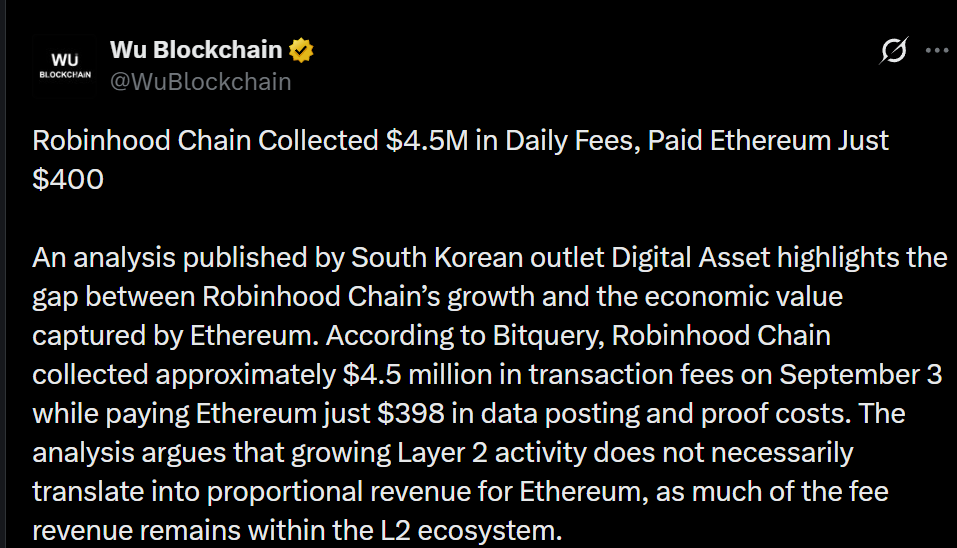
Source: WuBlockchain on X
What Actually Caused the Fee Spike
Robinhood Chain's gas price didn't creep up gradually; it broke sharply. On August 24, the chain's base fee left its usual floor and never came back, eventually climbing 25 times higher within 11 days.
A typical swap that cost about a cent on August 22 was costing 48 cents by September 3.
Here's the scale of the shift:
| Metric | August 22 | September 3 |
| Gas price | 0.020 gwei | 0.511 gwei |
| Daily gas used | 1,091 billion units | 3,393 billion units |
| Fees collected | $54,701 | $4,503,705 |
Demand roughly tripled over that window, but because of how Robinhood Chain's pricing formula works, fees collected jumped 82 times.
That's not a glitch, it's the pricing mechanism deliberately punishing congestion once demand crosses a certain threshold.
Who Actually Caused the Surge
This wasn't thousands of ordinary users driving up demand. Per Bitquery's on-chain analysis, just eight contract addresses accounted for 79% of the entire increase in gas usage.
Three specific pieces of infrastructure did most of the work:
-
A swap router that processed 1.7 million transactions on September 3 alone, paying 24.3% of all fees collected that day
-
A settlement contract used by 31 wallets, nearly all funded by a single source wallet, contributing another 15.4% of total fees
-
Account abstraction infrastructure (ERC-4337) handling around 650,000 bundled wallet operations daily
Meanwhile, roughly 382,000 ordinary wallets paid fees that day too, all charged the exact same network price as the heavy trading contracts, since Robinhood Chain has no tipping system that lets anyone pay to jump the line.
Where the Money Actually Goes
This is the core of what makes this Robinhood Chain news noteworthy. Unlike Ethereum, which burns a portion of every transaction fee, Robinhood Chain burns nothing.
Every fee collected splits between two accounts the chain itself designates, one for the base floor price and one for the congestion surcharge, and roughly 99% of what users paid landed in a single account holding thousands of ether.
Against that, the chain's actual cost of operating, posting transaction data back to Ethereum for security, came to just $396 for data posting plus $2 for proof costs on September 3.
Robinhood Chain was actually one of Ethereum's heaviest blob-space buyers that day, sending 36% of all blob transactions across the entire Ethereum network, yet that entire bill still amounted to a rounding error against the $4.5 million collected.
What This Means for the Layer 2 Economic Model
The investigation's broader point cuts to the heart of an ongoing debate in blockchain infrastructure: growing Layer 2 activity doesn't automatically translate into proportional revenue for Ethereum itself.
A few implications worth understanding:
-
Blob space, the mechanism Ethereum sells for L2s to post data cheaply, is currently priced low enough that even massive fee collection barely registers as a cost to the L2 operator
-
Most of the economic value generated by rising Layer 2 usage stays entirely within that L2's own ecosystem
-
Ordinary users on the chain absorb the congestion costs equally, regardless of whether they're behind the demand spike or not
Why Failed Transactions Tell Their Own Story
One interesting side effect Bitquery highlighted: failure rates on the chain actually halved during this period, dropping from roughly one in five transactions failing on August 21 down to one in ten by September 3.
When gas was nearly free, automated trading software could afford to fire off transactions speculatively and eat the losses from failures.
Once fees became real money, that same software got noticeably more careful, which the investigation calls the clearest evidence that participants are actively reacting to the price changes in real time.
Conclusion
This round of Robinhood Chain news reveals a genuine structural gap in how Layer 2 economics currently work.
A network can collect millions of dollars daily from its users while paying its underlying settlement layer, Ethereum, only a few hundred dollars for the same period.
Whether this gap narrows as blob space becomes more expensive, or whether it simply reflects how thin Ethereum's current revenue share from L2 activity really is, remains an open question the data alone can't fully answer.
Disclaimer
This article is for educational and informational purposes only and should not be considered financial or investment advice. Always conduct your own research before making investment decisions.
0
0

 Tüm kripto, NFT ve DeFi varlıklarınızı tek bir yerden yönetin
Kullanmaya başlamak için portföyünüzü güvenli bir şekilde bağlayın.


