
Is Ethereum at Risk? Vitalik Buterin Admits Major Design Mistake

0
0

This article was first published on The Bit Journal.
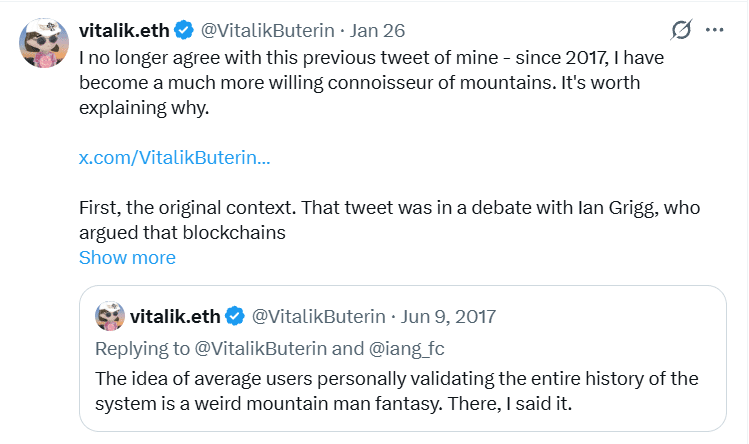
Vitalik Buterin’s Ethereum verification is now at the center of a public reassessment by the Ethereum co-founder, who has stepped back from a design view he strongly supported nearly a decade ago. In remarks shared by Buterin this week, he explained how Ethereum needs to better safeguard regular users as the network becomes lighter, more modular, and more reliant on outside services.
The discussion is not about immediate danger or panic, but about building strength that lasts over time. He also pointed out that Ethereum’s path since 2017 has revealed clear differences between how security is expected to work in theory and how it actually functions in real-world situations.
Should users rely on intermediaries or verify themselves?
The main question now is whether users should have to rely on intermediaries to ensure their funds are secure. Back in 2017, Buterin argued that expecting ordinary users to fully verify Ethereum’s entire history was impractical. He called full verification unrealistic for most people and favored designs that lowered the amount of local computation and storage required.

Today, Vitalik Buterin Ethereum verification is seen in a new light. Rather than being something users must do every day, self-hosted verification is considered a backup option that should always be available when other systems or services fail.
Why did Buterin reject his earlier framing?
He now thinks his earlier view missed how users can get trapped in real situations. Ethereum’s design lets users check balances or contract data using Merkle-style proofs without going through the entire chain. This method only works if users trust the network’s consensus and depend on intermediaries like RPC providers, archival hosts, or proof services.
Buterin recognized that this setup can leave users with a tough choice: either rely on an intermediary or try the impractical task of replaying the full blockchain. Vitalik Buterin Ethereum verification in his revised perspective is meant to eliminate this dead-end and give users a reliable fallback.
How do new cryptographic tools change the situation?
These tools make it possible to check correctness without high costs. Buterin highlighted advances in zero-knowledge proofs as a major turning point. They allow users to confirm that the blockchain is accurate without re-running every transaction. Back in 2017, using this method would have meant limiting Ethereum’s capacity to keep verification practical.
Today, zero-knowledge systems are part of Ethereum’s public roadmap. Development on ZK-based light clients shows that devices can sync using compact proofs instead of depending on a constantly online gateway. Vitalik Buterin Ethereum verification is now achievable without making users give up convenience or usability.
What real-world risks pushed this shift?
These risks exist outside of ideal assumptions and simple threat models. Buterin pointed to issues like degraded peer-to-peer networking, long-running services shutting down, validator concentration, and informal governance pressure that make developer intervention the default solution.
He mentioned censorship pressures around Tornado Cash to show how intermediaries can quietly limit access. In these situations, he said users should still be able to interact directly with the blockchain. Vitalik Buterin Ethereum verification is designed to protect against these subtle points of failure.
How do client changes affect user security?
These changes lower storage requirements while introducing new questions about verification. Execution clients are moving toward partial history expiry. The Ethereum Foundation has noted that users can reduce disk usage by around 300–500 GB by removing pre-Merge block data, making nodes practical on a 2 TB disk.
Light clients already follow a formal trust model using a sync committee of 512 validators that rotates approximately every 1.1 days. This approach makes low-resource verification possible but also links user experience to data availability and reliable relays.
Verkle trees are central to longer-term plans, as they reduce proof sizes and allow validation without storing large amounts of local state. As more storage shifts outward, Vitalik Buterin Ethereum verification focuses less on who holds all the data and more on who can independently confirm correctness when default paths fail.
What paths does Buterin see over the next few years?
The possible outcomes range from stronger decentralization to new forms of dependency. One scenario is wallets moving from trusting the RPC to verifying the proof, even if producing proofs becomes concentrated in a few optimized systems. Another scenario is that proof-based verification becomes common, supported by multiple implementations.

Tools would make it easy to switch between providers. A less favorable scenario would occur if pruning and modularity advance faster than verification usability, leaving only a small group able to operate independently. In that case, fallback options would exist in theory but would not be practical for most users.
Conclusion
Vitalik Buterin Ethereum verification is viewed as Ethereum’s safety valve rather than the standard way to operate. Buterin described the mountain cabin as a place users rarely use, but one they must always be able to access.
Simply having it available reduces the control intermediaries can exert and influences incentives across the entire ecosystem. He emphasized that keeping this option functional is part of maintaining Ethereum itself. It is not intended for daily use by everyone, but its existence ensures the system remains secure and reliable when conditions worsen.
Glossary
Zero-Knowledge Proofs (ZK Proofs): Prove info is correct without showing everything.
Verkle Trees: Make verification faster and save storage space.
Merkle Proofs: Confirm a blockchain item without checking all data.
Light Clients: Small apps that verify Ethereum using less data.
Statelessness: Verify transactions without storing the full blockchain.
Frequently Asked Questions About Vitalik Buterin Ethereum Verification
Why are self-hosted checks now important?
Self-hosted checks are important because they give users a backup way to verify Ethereum without relying on outside services.
Why did Vitalik change his view from 2017?
He changed his view because relying only on intermediaries can trap users, and self-verification ensures safety when services fail.
What are the new tools helping Ethereum verification?
Zero-knowledge proofs and ZK-light clients let users verify blockchain data without re-running every transaction.
What risks does Ethereum verification protect against?
It protects against risks like network problems, service shutdowns, validator concentration, and censorship by intermediaries.
How do light clients help with verification?
Light clients allow devices with less storage to verify Ethereum using a small group of rotating validators and compact proofs.
Sources
Read More: Is Ethereum at Risk? Vitalik Buterin Admits Major Design Mistake">Is Ethereum at Risk? Vitalik Buterin Admits Major Design Mistake
0
0

 Manage all your crypto, NFT and DeFi from one place
Securely connect the portfolio you’re using to start.


0
0


0
0