
Crypto Weekly Market Wrap April 6: Drift Hack, Policy Shifts, Bitcoin Treasury Moves, and Global Regulation

0
0

The crypto market delivered a week of developments, including major security failures, new rules, fundraising plans, and new products, which drove attention across the sector. Regulators in the United States, Europe, Asia, and the Middle East pushed policy changes. Meanwhile, financial firms and crypto platforms expanded custody, trading, and payment services. Let’s discuss the major events that made headlines last week.
Drift Protocol Breach Hits Solana Markets
Drift Protocol lost over $285 million on April 1 after attackers drained vaults within about an hour. Initially, some users dismissed alerts because the breach surfaced on April Fools’ Day, delaying the alarm. Investigators said the attacker used Solana durable nonces to pre-sign transfers weeks earlier.
Stolen assets included JLP, USDC, and cbBTC before swaps into ETH. Drift opened on-chain talks with the wallets tied to the exploit and also linked the operation to a North Korean group after publishing its weekend postmortem across Solana DeFi.
Tether Revives Talks for Huge Fundraise
Tether revived fundraising talks around a proposed $500 billion valuation and gave investors fourteen days to commit. The plan returned the stablecoin issuer to the center of private market debate. Earlier talks pointed to a raise between $15 billion and $20 billion, though later reports suggested smaller targets.
According to The Information, Tether is making a final push for a new funding round, targeting a massive valuation of approximately $500 billion. The firm has reportedly asked potential investors to submit their capital commitments within the next two weeks. If successfully… pic.twitter.com/kyBrQk4oW9
— Wu Blockchain (@WuBlockchain) April 4, 2026
Paolo Ardoino previously rejected claims of urgent funding pressure and described the plan as part of a broader expansion. Instead, Tether linked its growth strategy to stablecoins, artificial intelligence, energy, commodities, communications, and media.
Coinbase Wins Conditional OCC Trust Approval
Coinbase received conditional preliminary approval from the Office of the Comptroller of the Currency to form a national trust bank. The company, therefore, moved closer to a single federal framework for custody and settlement activity.
The proposed charter would support digital asset custody, tokenized asset management, and transaction settlement services. Additionally, a federal trust structure could reduce dependence on fragmented state rules for Coinbase’s institutional clients and tokenized market infrastructure offerings across U.S. markets. Meanwhile, US community bankers raised concerns regarding the approval, saying that it could put US consumers at risk.
Labor Proposal Opens 401(k) Crypto Access
The U.S. Labor Department proposed a rule that would ease restrictions on alternative assets in 401(k) plans. Under the draft, fiduciaries could consider private equity and crypto after reviewing core risk factors with more detail.
The proposal also offers safe harbor protection for fiduciaries who follow the required process. As a result, employers may face lower litigation risk when considering these assets during the public comment period now underway in Washington for sponsors.
Alabama Grants Legal Status to DAOs
Alabama became the second U.S. jurisdiction after Wyoming to recognize certain decentralized autonomous organizations. Governor Kay Ivey signed the DUNA Act, which gives qualifying nonprofit DAOs formal legal status under state law.
Eligible groups must have at least 100 members and pursue a nonprofit collective purpose. Additionally, recognized DAOs may hold property, sign contracts, face lawsuits directly, and record proposals and votes on-chain through blockchain-based governance systems after years of legal uncertainty for organizers.
Dubai Sets Rules For Retail Derivatives
Dubai’s Virtual Assets Regulatory Authority introduced a new framework for crypto derivatives trading. Under the rules, retail users may participate after financial and experience assessments. However, leverage stays capped at five times under the new regime.
VARA has introduced a comprehensive framework for Exchange Traded Derivatives (ETDs) in virtual assets – positioning Dubai among the first jurisdictions globally to regulate this evolving segment with enforceable, sector-specific rules.
Read the updated rulebook here:… pic.twitter.com/8inF9esbpO
— Virtual Assets Regulatory Authority (VARA) (@varadubai) April 3, 2026
VARA also kept broad intervention powers during exceptional volatility. For example, the regulator may suspend products, raise margin requirements, or order liquidations. Dubai is expanding access while preserving direct tools to control risk across retail derivatives markets for investors.
New Hampshire Plans Bitcoin-Backed Bond Issue
The New Hampshire Business Finance Authority plans to issue about $100 million in municipal bonds backed by Bitcoin-related collateral. Moody’s assigned the product a Ba2 rating, below investment grade, as planning continued this week.
Principal and interest would come from funds generated by Bitcoin-collateralized assets rather than state taxes or credit. Moreover, the structure includes liquidation triggers designed to protect repayment if Bitcoin prices fall sharply during the bond term under the proposed bond structure.
Hong Kong Delays First Stablecoin Licenses
Hong Kong did not announce its first batch of stablecoin issuer licenses by 31 March, despite earlier expectations. Previously, officials had suggested that a small number of approvals could arrive before the month-end for leading applicants.
The Hong Kong Monetary Authority later said it continued to advance the licensing process and would announce results in due course. Meanwhile, Eddie Yue had said thirty-six applications were received by regulators before the expected first list by late March.
Metaplanet Expands Bitcoin Treasury
Metaplanet said it bought 5,075 bitcoin for about $405.48 million during the first quarter of 2026. According to its latest disclosure, the firm indicated an average purchase price per coin of $79,898 during that period.
As of 31 March, Metaplanet said it held 40,177 bitcoin in total. Moreover, the company put its total cost near $4.18 billion and said the year-to-date bitcoin yield for 2026 stood at 2.8% through quarter-end.
Cambodia Targets Crypto Scam Networks Hard
The National Assembly of Cambodia enacted the first cybercrime bill against scam compounds and crypto-related laundering activity. The law addresses transnational fraud, data gathering, and recruitment associated with criminal activities against victims in the region.
Cambodia’s parliament has passed its first cybercrime law targeting scam compounds, focusing on cross-border fraud and money laundering involving crypto. The law sets penalties of 2–5 years in prison and fines for standard offenses, rising to up to 10 years for cases involving… pic.twitter.com/YTxpPOd9ay
— Wu Blockchain (@WuBlockchain) April 3, 2026
The law establishes a two-to-five-year prison sentence for general fraud and severe punishment for gang cases or more than two victims. However, the measure still needs the King’s signature before taking effect across Cambodia’s legal system, before royal approval arrives.
Bitmine Speeds Up Ethereum Treasury Buying
Bitmine Immersion Technologies continued its ether accumulation by adding 71,179 ETH. That figure exceeded its earlier weekly average and extended its treasury strategy for another active reporting period. As of 30 March, Bitmine said it held 4.73 million ETH, about 3.92% of the supply. Additionally, more than 3.1 million ETH had been allocated to staking through its MAVAN infrastructure and related validator operations internally.
Clarity Act Talks Move Toward Compromise
Momentum returned to U.S. stablecoin legislation after Coinbase’s chief legal officer said a CLARITY Act deal stood forty-eight hours away. The bill remains one of the year’s most disputed crypto measures in Washington.
Senators Thom Tillis and Angela Alsobrooks have led the talks with input from banking and crypto representatives. Meanwhile, revised language reportedly focuses on which stablecoin rewards remain permissible under a compromise between rival industry groups and lawmakers after recent staff meetings.
Russia Advances New Retail Crypto Limits
Russia’s Ministry of Finance said the government approved a package of crypto regulation bills for formal consideration. Under the proposals, non-qualified investors would face annual purchase limits and must pass a specialized test before trading.
Qualified investors would also need to take the test, although they would avoid the cap. Additionally, retail users could trade only highly liquid digital assets from the central bank’s approved list under the proposed framework on each brokerage platform annually.
Senators Push Mined In America Measure
U.S. Senators Bill Cassidy and Cynthia Lummis introduced the Mined in America Act to support domestic cryptocurrency mining and related infrastructure. The bill would create a voluntary certification system for mining facilities across the country.
U.S. Senators Introduce “Mined in America Act” to Localize Crypto Mining and Codify Strategic Bitcoin Reserve
U.S. Senators Bill Cassidy and Cynthia Lummis have introduced the Mined in America Act, which proposes a voluntary certification program to promote domestic development… pic.twitter.com/m5OFuo2I3y
— Wu Blockchain (@WuBlockchain) March 30, 2026
Certified operators would need to phase out mining equipment linked to foreign competitors. Meanwhile, the legislation would use existing energy and rural development programs and codify President Donald Trump’s bitcoin reserve executive order into federal law for certified miners.
Cuba Approves Crypto Payments for Enterprises
Cuba’s central bank approved ten enterprises to use cryptocurrencies for international payments, marking the first direct licenses of this kind. The group includes nine smaller businesses and one joint venture under the new approvals. The licenses appeared in the Official Gazette on 23 March and remain valid for one year. However, firms may use crypto only for cross-border payments tied to their core business and must file quarterly reports with regulators under central bank oversight.
Schwab Opens Waitlist for Spot Crypto
Charles Schwab launched a waitlist on Schwab Crypto, a service that will enable its clients to directly purchase and sell bitcoin and ether. A limited second-quarter 2026 rollout to early eligible customers remains the goal of the firm. It will involve an account with Charles Schwab Premier Bank instead of a regular brokerage account.
Also, it will not be available in New York, Louisiana, U.S. territories, and international jurisdictions in the initial stages, with further expansion coming later in stages.
IMF Warns Tokenization Could Speed Crises
The International Monetary Fund warned that tokenized finance could make financial crises unfold faster than central banks can respond. Its report described tokenization as a structural shift in market architecture with broader policy implications.
The IMF’s policy roadmap for tokenization calls for anchoring settlement in safe money, applying consistent global standards, ensuring legal clarity, promoting interoperability, and updating liquidity and crisis tools to safeguard stability. Learn more: https://t.co/JnpWurNJos
— IMF (@IMFNews) April 2, 2026
The report said instant settlement removes timing buffers that once helped authorities mobilize liquidity. Moreover, it flagged stablecoins as a weak point during stress and urged stronger legal standards, interoperability, and emergency overrides across critical financial infrastructure for financial regulators worldwide.
Circle Plans New Wrapped Bitcoin Token
Circle unveiled plans for cirBTC, a wrapped bitcoin token designed for institutional use across tokenized finance markets. The company said the asset will remain backed one-to-one by actual bitcoin at launch and afterward. Circle said cirBTC will launch first on the Ethereum mainnet and its Arc network. Additionally, the token will connect with Circle Mint and target desks, market makers, lending protocols, and other institutional users seeking neutral wrapped bitcoin exposure for institutional bitcoin utility needs.
Telegram Wallet Adds In-App Perpetual Futures
Wallet in Telegram rolled out perpetual futures trading through an integration with the decentralized exchange Lighter. The feature lets users open leveraged positions on more than fifty assets without leaving the app or separate platforms.
The product supports leverage up to fifty times through an integrated custodial wallet. However, the rollout excludes the United States and the United Kingdom and focuses first on emerging markets with limited brokerage access for retail traders inside the Telegram interface.
SoFi Launches A Hybrid Banking Platform
SoFi introduced Big Business Banking, a platform that combines fiat and crypto operations in one system. The product targets enterprise clients that need round-the-clock payments and settlement. The platform runs through SoFi’s nationally chartered bank and includes deposits, API payments, SoFiUSD, and selected cryptocurrencies. Launch partners include Cumberland, Bullish, BitGo, B2C2, Fireblocks, Wintermute, Galaxy, and Jupiter.
Today, we announced the launch of SoFi Big Business Banking—regulated infrastructure that gives enterprises the power to hold deposits, move money across fiat and digital assets, and settle transactions 24/7 instantly.
“To be competitive businesses today must operate in a…
— SoFi (@SoFi) April 2, 2026
eToro Finally Activates Crypto in New York
Crypto and stock trading platform eToro launched crypto trading in New York years after receiving a BitLicense. The platform started with about twenty approved tokens in the state. The company said it expects to add more assets and eventually offer staking there. Executives said the post-FTX regulatory climate slowed activation after the license approval.
March Hack Losses Rise Across Crypto Markets
On-chain investigation platform PeckShield said crypto hacks and exploits caused $52 million in losses across twenty major incidents in March. That figure marked a sharp increase from February’s reported losses. A large share came from the Resolv Labs attack, which involved unbacked stablecoin minting. PeckShield also warned about shadow contagion across linked DeFi protocols after major exploits.
Australia Requires Licenses For Crypto Platforms
Australia passed legislation requiring crypto platforms to hold financial services licenses under a new legal framework. The bill covers digital asset platforms and tokenized custody providers. The law requires firms to act efficiently, honestly, and fairly while protecting customer assets. The framework is expected to start twelve months after Royal Assent, with a transition period.
BREAKING: AUSTRALIA HAS OFFICIALLY ENTERED THE CRYPTO REGULATION ERA
Australia has passed its first crypto law, requiring all exchanges and custody providers to hold a financial services licence.
The parliament passed the Digital Assets Framework Bill on April 1, ending years… pic.twitter.com/JnAMd9PI9u
— BSCN (@BSCNews) April 1, 2026
Strategy Pauses its Weekly Bitcoin Purchases
Strategy paused its weekly bitcoin buying between 23 March and 29 March, according to a new filing. The company still held 762,099 BTC at the end of the period. That stash represented more than 3.6% of bitcoin’s fixed supply. The filing also said the company made no at-the-market share sales during the same week.
KuCoin Operator Settles with the CFTC
A U.S. court ordered Peken Global, an operator of KuCoin, to block U.S. users permanently unless registered. The consent order also imposed a $500,000 civil penalty. The CFTC said Peken Global cooperated during the investigation and related proceedings. The order dismissed several other claims and marked another major U.S. regulatory resolution for KuCoin.
Bitcoin Price Performance
Bitcoin held a positive outlook last week, recording a gain of more than 2% despite the broad market volatility. BTC traded in a range between $65k and $69k before stabilizing around $67k towards the end of the week. Currently, the asset is exchanging hands at around $69,480, with a market capitalization of $1.39 trillion. Moreover, its trading volume has skyrocketed by 100% to $34 billion.
Looking at the technical perspective, BTC displays a bullish reversal from the prolonged downtrend. Green candlesticks are forming from the support zone at the $65K zone, indicating a shift in the current trend. Meanwhile, indicators such as the Relative Strength Index (RSI) and Moving Average Convergence Divergence (MACD) point to a bullish turnaround.
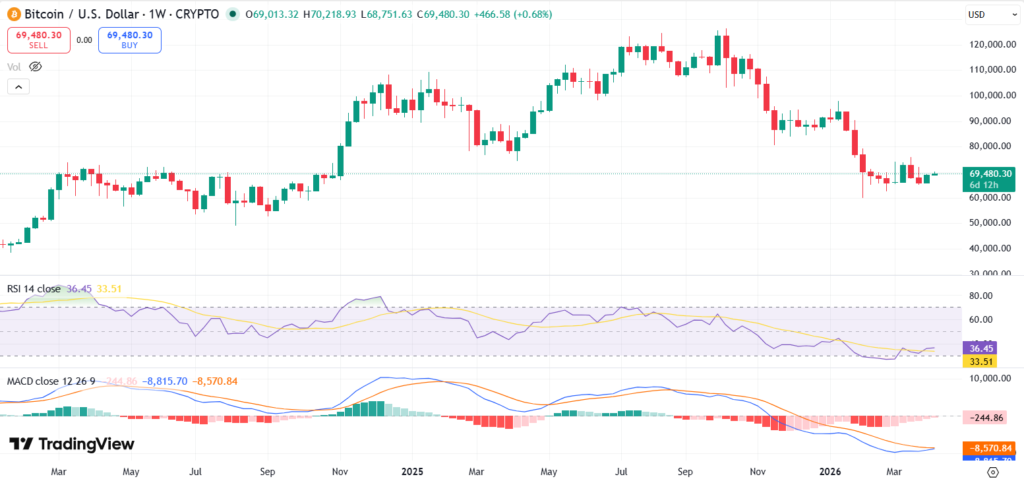
The 14-day RSI has bounced from the oversold region, currently at 36 levels, indicating increased buying pressure. Moreover, the MACD line is on the verge of making a crossover above the signal line. Should the current trend hold, BTC could surpass the $70k key level and push for a new rally toward the resistance at $71, 780.

eToro Platform
Best Crypto Exchange
- Over 90 top cryptos to trade
- Regulated by top-tier entities
- User-friendly trading app
- 30+ million users

eToro is a multi-asset investment platform. The value of your investments may go up or down. Your capital is at risk. Don’t invest unless you’re prepared to lose all the money you invest. This is a high-risk investment, and you should not expect to be protected if something goes wrong.
0
0


 Manage all your crypto, NFT and DeFi from one place
Securely connect the portfolio you’re using to start.


0
0

0
0

0
0