
What KuCoin’s Transparency Data Reveals About Trust in Crypto Exchanges

0
0

On February 19, 2026, Austria’s FMA noted that KuCoin EU Exchange GmbH needed to complete certain AML/CTF and sanctions compliance staffing arrangements, including deputy roles.
During this process, the regulator indicated that the firm should temporarily refrain from onboarding new customers, deposits, or trading activities. The decision is not yet final, and on March 3, 2026, the FMA said it had opened a review of the publication’s legality at KuCoin’s request.
KuCoin EU had already voluntarily and proactively paused platform operations on February 4, prior to the regulator’s notice.
Against this backdrop, the most useful place to look is the data. Independent transparency benchmarks provide a measurable way to evaluate exchanges based on reserves, reporting practices and security frameworks.
With crypto brokers and exchanges in the inspection bay, we set out to do some myth-busting regarding KuCoin. After all, KuCoin EU had only recently been authorized as a MiCA crypto-asset service provider under an administrative decision dated November 27, 2025.
CryptoQuant and its Litmus Test
We’ll start with a heavy-hitter.CryptoQuant’s Annual Exchange Leader Report 2025 is essentially a check on centralized exchanges, looking at how platforms stack up across structural transparency, trading performance, reserves, and proof-of-reserves (PoR) standards.
In other words, it tries to separate exchanges that are easy to evaluate from the outside from those that require blind trust.
In KuCoin’s case, the report recognized it as the PoR transparency leader, with a 96.7 (A+) score, far above Binance, Coinbase, and Gate.io.
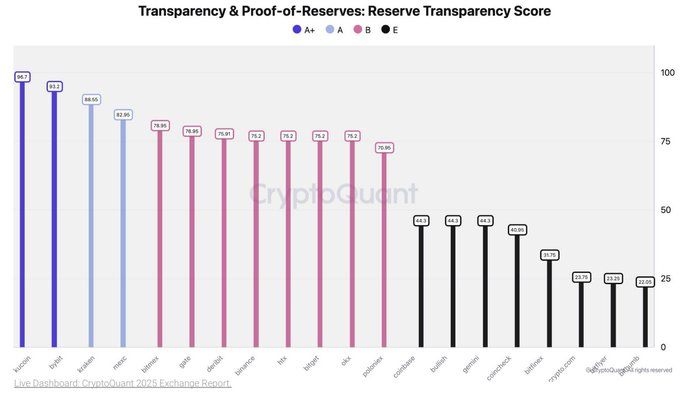
That specific transparency score is driven by factors such as public wallet disclosure, user-level balance verification, reporting cadence, third-party attestations, and how recent the disclosures are.
It means that KuCoin’s reserves are something users and analysts can repeatedly verify on a schedule.
More on KuCoin’s PoR
If you strip away the marketing, Proof-of-Reserves only matters if it is both repeatable and checkable.
CryptoQuant’s transparency criteria reward exchanges that publish enough on-chain and cryptographic evidence for outsiders to verify a snapshot of solvency, then do it again on a predictable schedule.
In KuCoin’s case, the disclosure model described in the report combines three moving parts: public wallet disclosure, a Merkle-tree-based PoR process that supports user-side balance verification, and independent third-party validation.
Operationally, KuCoin publishes monthly Merkle-tree PoR reports, with verification performed by Hacken. This means that the exchange aggregates user balances into a single cryptographic summary so users can confirm their balance was included in the snapshot without exposing everyone else’s account data.The latest update referenced in the release is dated February 6, 2026, paired with a February attestation, and framed as part of 39+ consecutive monthly reports with reserve ratios disclosed above 100%.
More Trust
Proof-of-Reserves is one thing, but what about repeatable controls, documented processes, and third-party validation across security, privacy, and operational risk?
KuCoin seems to have packaged that all up into its $2B Trust Project, launched at TOKEN2049 in Dubai 2025.This is a multi-year investment plan that funds the unglamorous parts of running an exchange safely at scale. For example, improving security systems and monitoring, tightening internal controls and incident readiness, expanding compliance capability, and putting more third-party validation around how the platform operates.
Audits look good too. KuCoin points to a stack of recognized frameworks and certifications: SOC 2 Type II (controls evaluated over a period, not a one-off point in time), ISO 27001:2022 for information security management, and ISO 27701 for privacy information management, plus CCSS (Cryptocurrency Security Standard) for crypto-specific operational security practices. In parallel, it highlights external benchmarking, including a CER.live rating showing AAA with a 100% security score on KuCoin’s exchange page.
DYOR
If you’re judging an exchange in 2026, the most useful question to ask is whether an outsider can verify key trust claims on a schedule. CryptoQuant’s PoR transparency criteria are a good framework to follow:
- Wallet disclosure: Are reserve wallets publicly disclosed so observers can monitor balances over time?
- User verification: Can individual users verify their balances were included in the PoR snapshot?
- Cadence: Is reporting consistent (monthly is meaningfully stronger than ad hoc)?
- Third-party validation: Is there an independent attestation layer and is it recent?
- Recency: When was the last snapshot and when was it last attested?
Final Thoughts
KuCoin’s PoR leadership, as described in the CryptoQuant report write-up, is built on public disclosure, monthly Merkle-tree-based reporting, user-side verification, and third-party attestations, with a long reporting streak and recent updates.
For readers who want to go deeper, the next clicks should be:
- The CryptoQuant report itself,
- KuCoin’s Proof-of-Reserves page,
- The Trust Project and certification announcements that outline the broader control stack (SOC 2 Type II, ISO 27001:2022, ISO 27701, CCSS).
As transparency expectations rise across the crypto industry, verifiable disclosures are becoming the foundation of trust. Proof-of-reserves reporting, security certifications, and independent benchmarks provide measurable ways to evaluate exchange credibility – and platforms that consistently deliver on these standards are likely to shape the industry’s next phase of trust
0
0


 Manage all your crypto, NFT and DeFi from one place
Securely connect the portfolio you’re using to start.

0
0

0
0

0
0
