
Sber Considers USDT Lending as Digital Ruble Demand Comes Under Scrutiny
0
0
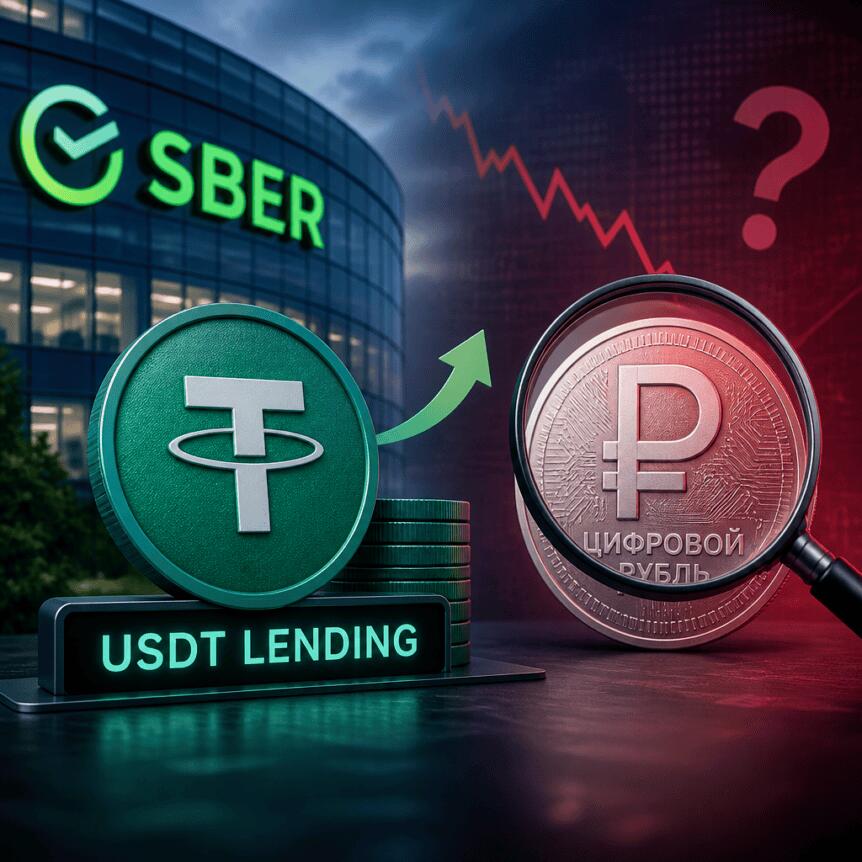
Russia’s largest bank, Sber, is preparing to widen its crypto-backed lending by allowing additional collateral types, including Tether’s USDt stablecoin and Ether, alongside Bitcoin. The expansion is expected to roll out as Russia’s new regulated crypto market framework takes effect and the central bank authorizes which assets may be traded on regulated venues.
In a report carried by TASS, Sber deputy chairman Anatoly Popov said the bank will adjust its existing lending products and expand them gradually once the regulatory conditions are met. Specifically, Sber plans to add USDt and Ether as collateral after the Bank of Russia permits these assets for public exchange trading.
Key takeaways
- Sber plans to accept Tether’s USDt and Ether as collateral for crypto-backed lending, in addition to Bitcoin.
- The timing depends on Bank of Russia authorization for USDt and Ether to trade on regulated exchanges.
- Russia’s regulated crypto framework is tied to provisions taking effect Sept. 1, following a law signed by Vladimir Putin on Aug. 4.
- The move signals increased institutional use of major crypto assets in Russia’s banking sector under regulation.
- Sber leadership has been more cautious about demand for the digital ruble than for broader crypto-linked services.
How Sber’s collateral plan fits Russia’s regulated crypto rollout
Russia’s approach to digital assets is moving toward a more structured market, with the Bank of Russia playing a central role in determining which cryptocurrencies can be traded on regulated exchanges. The law signed by President Vladimir Putin on Aug. 4 establishes the framework for regulated crypto activity, with core provisions scheduled to begin on Sept. 1.
According to TASS, Popov said Sber will “adapt its existing products” and extend their scope over time as the new rules come into force. The practical hinge is the Bank of Russia’s permission for specific assets to be listed for public trading on regulated platforms—once those approvals are granted, Sber intends to allow those same assets to be used as lending collateral.
This matters for borrowers and lenders because collateral eligibility can directly affect borrowing availability, loan terms, and the range of customers a bank can serve. If USDt and Ether are treated as eligible assets, Sber would be able to support a broader set of market participants than a Bitcoin-only model.
Bank of Russia’s exchange-eligibility criteria and the proposed asset list
The Bank of Russia’s regulatory work is focused on which crypto assets qualify for trading on regulated exchanges. Cointelegraph previously reported that the central bank proposed Bitcoin, Ether, and USDT (Tether’s token) for regulated exchange trading on Aug. 11. That proposal was said to include requirements such as market capitalization, trading volume, and a minimum of five years of price history on overseas markets.
While Sber’s lending plan is framed conditionally—collateral will be added after the Bank of Russia permits these assets—Sber’s readiness to expand suggests the bank is tracking the central bank’s evaluation closely. For market participants, the key question is not whether these assets are being discussed, but whether they ultimately receive authorization for regulated exchange trading under the final rubric.
If the approvals proceed as outlined in earlier proposals, it would create a clearer pipeline from regulated trading eligibility to mainstream institutional credit use, potentially reducing friction for clients who want to borrow against widely used crypto assets.
Bitcoin-first, then stablecoins and Ether: what changes for borrowers
Sber’s stated direction is incremental rather than abrupt: the bank will “gradually” expand its offerings as the legal framework takes effect. The inclusion of both a major stablecoin and Ether is notable because it would diversify collateral beyond a single volatile asset and—at least in principle—offer alternative risk profiles to borrowers.
Stablecoins like USDt are often treated by institutions as a more operationally convenient collateral type than assets that swing sharply with market conditions, though the exact risk treatment depends on the lender’s internal models and haircuts. Ether as collateral can similarly broaden access for users who hold or transact in DeFi- and smart-contract ecosystems.
In practical terms, adding USDt and Ether could also improve Sber’s ability to match lending demand with collateral supply among different customer groups—especially as Russia’s regulated crypto environment develops and more participants look to use compliant on-ramps and trading channels.
Sber’s separate stance on the digital ruble
Beyond crypto-backed lending, Sber’s leadership has also spoken about Russia’s central bank digital currency, the digital ruble. TASS reported that Sber’s chief financial officer Taras Skvortsov expressed skepticism about broad demand ahead of a wider rollout on Sept. 1.
Skvortsov reportedly said there was “little evidence of broad demand” for the digital ruble, arguing that there was no clear push from retail, corporate clients, or financial institutions. TASS further attributes the view to a lack of active interest beyond the central bank’s own role.
That contrast—cautious posture toward the CBDC while planning expansion of crypto-collateral lending—highlights the different adoption dynamics each instrument may face. While the digital ruble is designed as a regulated form of central bank money, Sber appears to be focusing on expanding services around crypto assets that already have established market behavior and (potentially, once authorized) clearer exchange rules.
For observers, the tension is worth watching: Russia’s financial system may see more immediate institutional utility from crypto assets (under regulation) than from CBDC adoption, depending on user demand, product usefulness, and how operational workflows fit into banks’ offerings.
What to watch next
Investors and market participants should closely monitor whether the Bank of Russia’s authorization process leads to USDt and Ether being approved for regulated exchange trading—because Sber’s ability to accept those assets as collateral depends directly on that decision. With core provisions of the crypto law set to begin on Sept. 1, the next key developments are the central bank’s final determinations and how quickly major banks translate regulatory eligibility into new lending terms.
This article was originally published as Sber Considers USDT Lending as Digital Ruble Demand Comes Under Scrutiny on Crypto Breaking News – your trusted source for crypto news, Bitcoin news, and blockchain updates.
0
0


 Manage all your crypto, NFT and DeFi from one place
Securely connect the portfolio you’re using to start.


