
Crypto Oracles: 3 Roles Developers Must Secure to Prevent Exploits

0
0

Crypto oracles are services that connect smart contracts to real-world data and external systems, letting onchain code act on offchain facts it cannot access alone. A blockchain has no native way to know an asset’s price, a flight’s status, or the result of a sports match. Oracles supply that missing link, and the design of that link, whether centralized or decentralized, directly determines how secure and trustworthy the applications built on top of it turn out to be.
TL;DR:
- Relying on a single data source increases manipulation risk, so using multi-source aggregation is essential for securing oracle feeds.
- Decentralized oracle networks use multiple layers of independent providers and nodes to reduce the chance of invalid data entering the blockchain.
- Off-chain data aggregation techniques, like volume-weighted medians and off-chain reporting, help minimize gas costs and improve data integrity.
- Continuous monitoring and fallback mechanisms are critical to prevent exploitation caused by stale or delayed oracle data during high-volatility events.
- The industry’s worst oracle failures show that security measures, such as diversity and proper incentives, are vital for reliable smart contract operation.
What Does a Crypto Oracle Actually Do?
Blockchains are closed systems by design. They cannot reach outside their own network to check a stock price or verify a shipment arrived. That isolation is a feature, not a bug. It’s what makes consensus possible. But it also means smart contracts are functionally blind until something feeds them outside information.
Oracles solve this by taking on one of three roles, according to Ethereum’s own developer documentation:
- Input oracles pull offchain data onto the chain, like a lending protocol checking ETH’s dollar price before approving a loan.
- Output oracles let a smart contract reach outward, such as a contract firing a webhook that unlocks a smart lock or triggers a bank settlement once conditions are met.
- Compute oracles handle verifiable off-chain computation, running an operation too expensive or too sensitive to execute directly onchain, then returning a proof the contract can trust.
Most DeFi activity depends on input oracles, since almost every lending, trading, or derivatives protocol needs a live, accurate price before it lets money move.
Why Is the Oracle Problem Such a Big Deal?
Blockchains run on deterministic consensus. Every node must reach the same answer from the same inputs, every time. External data breaks that assumption the moment it enters the picture, because a price feed, a weather report, or a game result is not something the network can independently verify the way it verifies a signature.
This is the oracle problem: an oracle sits outside the blockchain’s core consensus, so it can never offer the same guarantees the chain gives itself. As Wikipedia’s entry on blockchain oracles notes, that outside position means developers are always trading off cost, speed, and decentralization rather than picking a solution with zero risk. A single manipulated data source, famously exploited in early DeFi flash-loan attacks, can distort a price feed just long enough to drain a lending pool before anyone notices.
Pro Tip: Never trust a protocol’s oracle setup just because it says “decentralized.” Ask specifically how many independent data sources and node operators feed the final price, since that number is what actually resists manipulation.
Centralized vs. Decentralized: Which Oracle Model Fits?
Oracle architecture generally falls into two camps, with several mechanisms layered inside each.
Centralized oracles pull data from a single provider. They’re fast and cheap to run, which makes them tolerable for low-stakes applications like a game reading a random seed for cosmetic loot. They’re a poor fit for anything holding real money, since one compromised source can feed bad data straight into a contract with no check against it.
Decentralized oracle networks (DONs) spread trust across multiple layers. Chainlink’s explanation of blockchain oracles describes three layers worth understanding separately:
- Data-source layer: multiple independent providers report the same data point, so no single feed can skew the result.
- Node-operator layer: independent operators run the aggregation logic, removing any one party’s ability to alter the outcome.
- Network layer: the DON itself acts almost like its own consensus system sitting alongside the blockchain it serves.
Beyond architecture, oracles also differ in delivery mechanism:
- Push-based feeds update on a schedule or when a price moves past a set deviation threshold, ideal for steady use cases like lending collateral checks.
- Pull-based feeds (sometimes called streams) deliver data on request, better suited to high-frequency trading or applications where every millisecond of latency has a cost.
Picking between them comes down to how often your application needs fresh data and how much gas you’re willing to spend getting it.
How Do Oracles Actually Get Data Onto the Blockchain?
A price update looks instant to a user, but underneath it runs through a defined sequence. First comes a trigger, either a scheduled heartbeat or a deviation threshold being crossed. Off-chain nodes then fetch the raw data from multiple providers, filter outliers, and aggregate the results into a single value, often a volume-weighted median that resists any one bad input skewing the outcome.
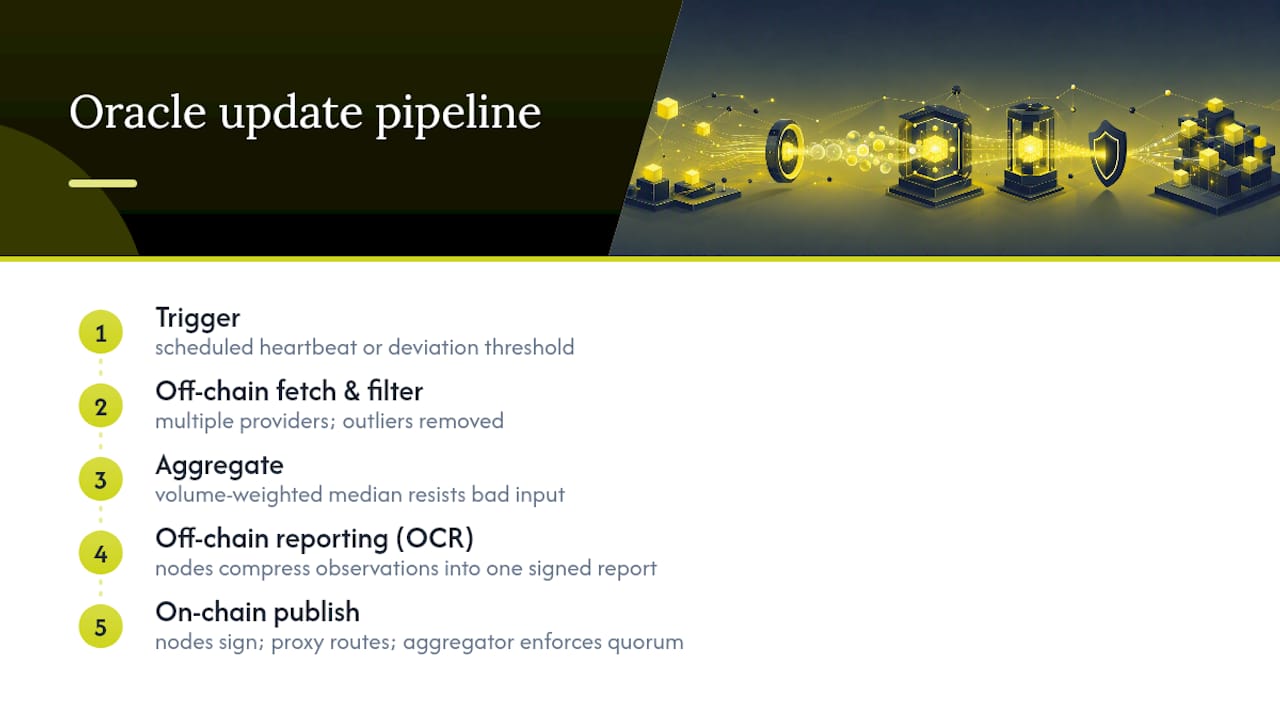
That aggregated value gets reported onchain through a set of contracts working in sequence: node operators sign off, a consumer contract or dApp queries the result, a proxy contract routes the request, and an aggregator contract enforces minimum node-response counts before publishing anything. Chainlink’s documentation on decentralized data feeds confirms that aggregators will not update a value until enough independent nodes agree, a safeguard against a handful of compromised operators forcing a bad number through.
The efficiency piece comes from off-chain reporting (OCR), which lets nodes compress dozens of individual observations into one signed report before it ever touches the chain. According to Chainlink’s writeup on decentralized data feeds, OCR cuts gas costs sharply compared to having every node post its answer onchain individually, while still preserving a verifiable signature trail. Two operational knobs govern how often this cycle runs: the heartbeat interval and the deviation threshold, both tuned to balance data freshness against transaction cost.
Where Are Crypto Oracles Actually Used?
The clearest use case is still DeFi price feeds. Lending platforms check collateral values in real time, and derivatives protocols use the same feeds to determine liquidation points. Chainlink notes that aggregating many independent sources meaningfully reduces the risk of the flash-loan-style manipulations that plagued early DeFi, since no single exchange’s temporary price glitch can move the aggregate median enough to matter.
Beyond price feeds, oracle use has expanded into several other categories:
- Proof of Reserve and tokenized real-world assets, where oracles verify that a token backed by gold, treasury bills, or credit is actually collateralized as claimed.
- Cross-chain messaging, where oracles help move value and state safely between separate blockchain networks that otherwise can’t talk to each other directly.
- Verifiable randomness, used for fair NFT mints, lottery draws, and gaming mechanics that need an outcome nobody, including the node operators, can predict in advance.
- Privacy-preserving compute, where sensitive calculations happen offchain and only a verifiable proof of the result gets published.
Tokenized real-world assets have grown into one of the busier corners of this space, and ongoing reporting on tokenized credit platforms shows how much that growth depends on oracles reporting accurate offchain collateral data.
How Do You Reduce the Risk of a Bad Oracle Feed?
No oracle setup is risk-free, but several practices meaningfully cut exposure. Aggregating multiple data sources rather than relying on one exchange or API is the single biggest lever, since it removes the easiest manipulation path. Node independence matters just as much. If every operator runs identical infrastructure from the same cloud provider, a regional outage takes the whole feed down at once.
Monitoring and fallback logic round out a solid setup. Teams should watch feed health continuously and have a fallback value or circuit breaker ready if an oracle goes stale. It’s also worth understanding oracle extractable value (OEV), a cousin of the more familiar MEV, where sophisticated actors try to profit from the exact moment an oracle updates a price, often at the expense of the users being liquidated.
- Use multi-source aggregation, never a single upstream feed.
- Confirm node operators run on genuinely independent infrastructure.
- Build monitoring and a fallback path for stale or delayed data.
- Test against oracle downtime before mainnet deployment, not after.
Pro Tip: Before integrating any oracle, check its update history on a block explorer. A feed that goes quiet during high volatility, exactly when accuracy matters most, is a warning sign no marketing page will tell you about.
Which Oracle Projects Actually Dominate the Market?
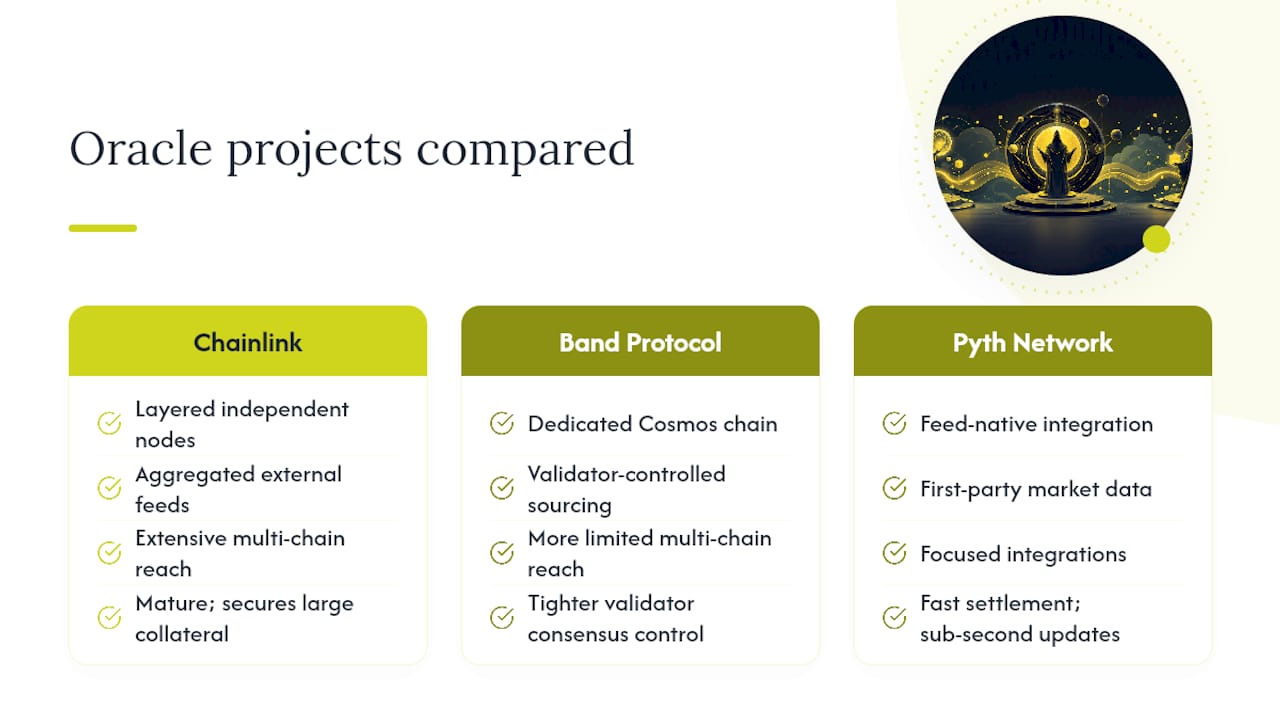
Chainlink remains the most widely integrated oracle network, and its footprint spans price feeds, Proof of Reserve, cross-chain messaging through CCIP, and verifiable randomness through VRF. Its distinguishing feature is scale: Chainlink’s own materials describe a network built around multiple layers of independent nodes and data sources feeding into an off-chain reporting pipeline, which is why it’s become the default choice for protocols securing large amounts of collateral.
Band Protocol takes a different architectural route, building its oracle layer on a dedicated Cosmos-based blockchain rather than operating purely as middleware bolted onto existing chains. That design gives Band tighter control over its own validator set and consensus process, though it trades some of the multi-chain reach that Chainlink has built up over time.
Pyth Network has carved out a distinct niche by sourcing data directly from trading firms, exchanges, and market makers rather than relying primarily on independent node operators pulling from public APIs. This “first-party data” model, often framed as the core of the Pyth vs. Chainlink debate, trades some decentralization at the sourcing layer for speed, since data comes straight from the institutions generating it rather than passing through intermediary aggregators first.
The practical differences between these platforms boil down to sourcing philosophy and settlement speed. A developer building a lending protocol on Ethereum might lean toward Chainlink’s maturity and integration depth. A high-frequency derivatives platform chasing sub-second price updates might lean toward Pyth’s direct sourcing model instead. Neither approach is universally superior. It depends entirely on what the application actually needs.
How Do Oracle Networks Keep Node Operators Honest?
Oracle networks rely on economic incentives, not just technical design, to keep participants honest. Node operators typically earn fees for accurate, timely reporting, paid in the network’s native token or in service fees collected from the contracts consuming the data.
The flip side is penalty exposure. Many decentralized oracle networks require operators to stake collateral, an arrangement often called chainlink staking in Chainlink’s specific implementation, which can be slashed or forfeited if an operator submits bad data, goes offline too often, or otherwise fails to meet service commitments. That staked collateral turns dishonesty into a direct financial loss rather than an abstract reputational risk.
This incentive structure works because it aligns two things that used to pull in opposite directions: an operator’s profit motive and the network’s need for accurate data. A node that reports honestly earns steady fees over time. A node that tries to cheat risks losing its stake outright, plus the future income stream that comes with continued participation. The math generally favors playing it straight, especially as the value secured by a given feed grows and the potential penalty grows with it.
Reputation systems add a second layer on top of pure economics. Networks track uptime, accuracy, and response consistency, and consumer contracts can weight or exclude nodes with poor track records when new aggregation rounds form. None of this eliminates risk entirely, but it raises the cost of dishonesty high enough that, for most well-designed networks, cooperation remains the more profitable strategy.
What Oracle Failures Have Taught the Industry?
Some of DeFi’s costliest exploits trace back to oracle weaknesses rather than flaws in the core lending or trading logic itself. Attackers have repeatedly used flash loans to briefly distort the price on a single exchange, then exploited a protocol that relied on that one venue’s spot price to approve an undercollateralized loan or trigger a favorable liquidation. The pattern repeated across multiple incidents in DeFi’s early years, and the common thread was always the same: a protocol trusting a single, thin data source instead of an aggregate drawn from several venues.
The lesson the industry absorbed, slowly and expensively, is that data-source diversity isn’t optional once real money is at stake. Protocols that survived the worst of these attacks were generally the ones using time-weighted or volume-weighted median prices pulled from multiple exchanges, which made momentary price distortions far harder to weaponize. Protocols that skipped this step and leaned on a single feed learned the trade-off the hard way.
A second recurring failure mode involves stale data. When an oracle feed stops updating during a network congestion event or a provider outage, contracts that don’t check for staleness can keep operating on outdated numbers, sometimes for just long enough to be exploited. That risk is part of why monitoring and fallback logic have become standard advice rather than an afterthought for teams building on oracle infrastructure. The takeaway across nearly every documented incident is consistent: the oracle layer deserves the same security scrutiny as the smart contract logic it feeds, not less.
Are Crypto Oracles Facing New Regulatory Scrutiny?
Oracles occupy an unusual spot in the regulatory conversation because they don’t hold custody of user funds and don’t execute trades themselves. That has kept them mostly outside the direct line of fire that exchanges and stablecoin issuers have faced. But that position is shifting as oracles take on more functions tied to compliance and asset verification.
Proof of Reserve services, which oracles use to verify that a tokenized asset is actually backed as claimed, sit closer to territory regulators care about, since they touch questions of financial disclosure and asset attestation. As tokenized real-world assets grow, expect oracle providers supplying that reporting layer to face more scrutiny about accuracy standards and audit trails, even if the oracle itself never touches customer funds directly.
Jurisdictions are also tightening rules around crypto infrastructure more broadly, which indirectly affects oracle providers operating in or serving those markets. Regulatory shifts in major crypto markets can reshape how infrastructure providers, oracles included, structure their operations and disclosures going forward. Nothing here amounts to oracle-specific regulation yet in most jurisdictions, but the direction of travel suggests that will change as tokenization and RWA reporting grow more central to how oracles get used.
What’s Next for Oracle Technology?
Compute oracles are the clearest growth area to watch. As more applications need verifiable off-chain computation, everything from private data checks to complex financial modeling, oracle networks are expanding beyond simple data delivery into full computation layers that return cryptographic proofs alongside their answers.
Cross-chain interoperability is the second major front. As more value spreads across dozens of separate blockchains, oracles are increasingly the connective layer that lets one chain verify what happened on another, whether that’s confirming a deposit, relaying a message, or synchronizing state between ecosystems that otherwise have no way to communicate.
Proof of Reserve and RWA reporting will likely keep expanding too, given how much institutional capital is flowing into tokenized treasuries, credit, and commodities. Each of those instruments needs continuous, trustworthy attestation that the backing assets actually exist, and that’s squarely an oracle problem. The direction is toward oracles becoming less of a simple price pipe and more of a general trust layer that touches nearly every corner of onchain finance.
Techgaged’s Take on Where Oracle Coverage Is Headed
Understanding oracle mechanics matters, but tracking how specific networks perform in practice matters just as much. Node behavior, feed reliability, and protocol integrations shift constantly, and price feeds tied to whale activity or sudden liquidity moves can signal changes worth watching before they show up in headlines.
Techgaged covers these developments as they happen, from tokenized credit trends shifting across blockchains to signals from major oracle-network token holders. A few habits worth building if you’re serious about tracking this space:
- Check a project’s official documentation and a block explorer directly rather than relying on secondhand summaries of feed addresses.
- Follow protocol-specific announcements for changes to heartbeat intervals or aggregation logic, since these shift quietly and often without much fanfare.
- Watch onchain activity patterns, not just price, for early signs of stress in an oracle-dependent protocol.
For ongoing analysis of how oracle infrastructure intersects with broader market moves, Techgaged’s crypto news coverage tracks these stories as they develop.
Sources
- Oracles | Ethereum Developer Documentation
- What Is an Oracle in Blockchain? » Explained | Chainlink
- Decentralized data model | Chainlink Documentation
FAQ
What Is the Best Crypto Oracle?
There’s no single “best” oracle for every use case. Chainlink leads on integration depth and multi-chain reach, Pyth emphasizes direct institutional data sourcing for speed, and Band Protocol offers a dedicated blockchain architecture. The right choice depends on your application’s latency, cost, and decentralization needs.
What Are the Main Types of Oracles?
Oracles are typically categorized as input oracles (bringing offchain data onto the chain), output oracles (letting contracts trigger offchain actions), and compute oracles (performing verifiable off-chain computation), according to Ethereum’s developer documentation. Architecturally, they range from centralized single-provider setups to decentralized oracle networks aggregating many independent nodes.
How Do Crypto Oracles Actually Work?
Oracles fetch data from off-chain sources, aggregate and filter it to resist manipulation, then publish a verified result onchain through node operators and aggregator contracts. Many networks use off-chain reporting to compress this process into a single signed transaction, cutting gas costs while preserving security.
What Determines an Oracle Token’s Price?
Oracle-network token prices, like those of Chainlink or Pyth, move based on broader crypto market conditions, network adoption, staking demand, and shifts in total value secured by the network’s feeds. For live pricing and market analysis, check a current market tracker or Techgaged’s ongoing coverage rather than a static figure, since crypto prices change constantly.
Recommended
- Harmony Faces Another Security Shock — The Market Is Watching
- New York proposes law to tackle rug pulls and private key theft
- Zcash Just Closed Four Security Gaps — This Could Be A Turnaround For ZEC
- EU banking watchdog issues new draft guidelines on crypto risks
The post Crypto Oracles: 3 Roles Developers Must Secure to Prevent Exploits appeared first on TechGaged.com.
0
0
 Manage all your crypto, NFT and DeFi from one place
Securely connect the portfolio you’re using to start.