
Crypto Weekly Market Wrap March 23: Major Crypto Trends, Institutional Growth, Regulation, and Market Volatility

0
0

The crypto market moved through a busy week shaped by regulation, fresh institutional moves, exchange shake-ups, and stablecoin developments. U.S. agencies offered clearer rules for major tokens, while companies expanded treasury holdings and new trading products launched. Meanwhile, the ongoing market volatility and security concerns kept investors cautious throughout. In this article, we will take a look at the major developments that made headlines over the last week.
SEC and CFTC Draw a Clearer Line Around Tokens
The SEC and CFTC issued an interpretive document that named 16 crypto assets as digital commodities. The list included Bitcoin, Ether, Solana, XRP, Cardano, Avalanche, and Chainlink. Moreover, the agencies said those tokens do not fall under the securities category, marking a notable shift in U.S. regulatory treatment.
As a result, the guidance gave markets a stronger classification framework for several major assets. The list also covered Litecoin, Dogecoin, Bitcoin Cash, Stellar, Hedera, Tezos, Polkadot, Shiba Inu, and Aptos. Furthermore, issuers and exchanges received a clearer signal on where federal oversight could now sit for these coins overall.
South Korea’s Opposition Pushed to Scrap Crypto Taxes
South Korea’s main opposition party proposed a bill that would fully abolish the crypto capital gains tax. The tax had been scheduled for 2027 after earlier plans targeted last year. Under the previous structure, authorities would have charged 22% on profits above 2.5 million won, or roughly $1,865.
JUST IN: SOUTH KOREA OPPOSITION MOVES TO SCRAP 2027 CRYPTO TAX ENTIRELY
South Korea's opposition party has introduced a bill to fully abolish the planned 22% crypto capital gains tax scheduled for 2027.
The party argues that it creates an unfair disparity, given that stock… pic.twitter.com/BunESTNyVS
— BSCN (@BSCNews) March 19, 2026
In addition, the proposal referenced U.S. guidance that treated most crypto assets as commodities. Party lawmakers argued that crypto should not be regulated as a security product. Meanwhile, the Democratic Party of Korea responded, saying that they will discuss the issue.
Vietnam Moves Toward Local Crypto Market Controls
Vietnam drafted regulations that would stop citizens from trading on overseas platforms such as Binance and OKX. Officials planned to pilot compliant domestic exchanges as early as this month. According to a Ministry of Finance document, five companies passed preliminary review for the coming test phase.
Those companies included units tied to Techcombank, VPBank, and LPBank, alongside VIX Securities and Sun Group. Meanwhile, Chainalysis data showed Vietnam ranked fourth worldwide in crypto activity, with annual trading volume reportedly exceeding $200 billion. Therefore, the planned shift would redirect a huge local user base toward regulated domestic venues instead.
Nasdaq Wins Approval for Tokenized Settlement Testing
Nasdaq received SEC approval for rule changes that permit the clearing and settlement of securities in tokenized form. The work will operate under the DTC Tokenization Pilot framework. Eligible participants may choose tokenized settlement through an order flag. However, the securities must match traditional versions in rights, obligations, symbol, and CUSIP.
Initially, the pilot will cover Russell 1000 stocks and major index ETFs. Moreover, tokenized and traditional versions will trade on the same order book with equal priority. That design keeps market structure intact while adding new settlement rails.
Crypto Treasury Firms Expand Holdings
Strategy announced the purchase of 22,337 BTC for $1.57 billion, setting a weekly record for 2026. This acquisition pushed the overall holdings to 761,068 BTC. The company funded most of the move through sales of STRC floating-rate perpetual preferred shares. From 9 March to 15, it sold 11.818 million ATM shares and raised proceeds of $1.1804 billion.
Bitmine bought 60,999 ETH last week, marking its largest weekly Ethereum purchase for 2026. The company also bought 5,000 ETH over the counter from the Ethereum Foundation. After the purchase, Bitmine’s total holdings reached 4,595,562 ETH, or about 3.81% of the circulating supply. Around 66% of that balance is staked.
JUST IN: BITMINE REVEALS $11.5B CRYPTO HOLDINGS WITH OVER 4.5M $ETH
Bitmine ( $BMNR ) has released its March 16 holdings update, disclosing $11.5B in total crypto and moonshot assets.
The portfolio is anchored by the following:
– 4,595,562 $ETH valued at $2,185 each
– 196… pic.twitter.com/LzNyuxupDD— BSCN (@BSCNews) March 16, 2026
Strive announced the acquisition of 317 BTC, bringing its holdings to 13,627.9 BTC as of 17 March. That increase pushed the company into the top 10 public bitcoin treasury holders. The jump moved Strive above CleanSpark, according to Bitcoin Treasuries data. Meanwhile, Strive reported a GAAP net loss of $393.6 million, driven mostly by fair-value declines in bitcoin holdings.
Morgan Stanley Advances its Spot Bitcoin ETF Filing
Morgan Stanley filed an amended S-1 for its Bitcoin ETF application. The filing noted the Morgan Stanley Bitcoin Trust would trade on NYSE Arca under the ticker MSBT. It also disclosed a 10,000-share creation unit, an initial seed of 50,000 shares, and a $1 million offering estimate.
The filing named BNY Mellon as the Bitcoin custodian and Coinbase for related functions. Although the amendment does not guarantee approval, it shows the application is moving forward. If approved, Morgan Stanley would become the first U.S. bank to launch a spot Bitcoin ETF.
Crypto Firms Cut Staff While Leaning Harder on AI
Several crypto companies announced layoffs as they pushed for leaner operations and the use of artificial intelligence. Gemini cut about 30% of its workforce this year, leaving 445 employees. The company also reported a loss of about $585 million last year. Crypto.com also said it laid off about 12% of staff in roles that could not adapt to its AI-led environment. Meanwhile, the Algorand Foundation reduced around 25% of its employees. Each company cited efficiency, market pressure, or macro uncertainty.
Today, the Algorand Foundation made the difficult decision to reduce our workforce by 25%. This decision was not taken lightly and is in response to the uncertain global macro environment as well as the broader downturn in crypto markets.
These employees have been best-in-class…
— Algorand Foundation (@AlgoFoundation) March 18, 2026
PayPal Expands Stablecoin Access Across New Markets
PayPal said users in 70 countries can now hold, send, and receive PYUSD in their wallets. The expansion introduced access across parts of South America, Africa, and Asia. Markets mentioned included Uganda, Colombia, and Peru. Previously, only users in the United States and the United Kingdom could hold the stablecoin.
In addition, users in new markets can earn rewards on their PYUSD balances. That change widened PayPal’s stablecoin strategy beyond its core jurisdictions. As a result, PYUSD moved from a limited product to a broader cross-border wallet feature. The rollout also placed stablecoin utility closer to mainstream consumer payments.
CFTC Opens the Door for Crypto as Collateral
The CFTC issued guidance that lets futures commission merchants handle crypto assets and stablecoins as margin collateral. Under the framework, holdings in Bitcoin, Ether, and stablecoins may count toward margin requirements in derivatives accounts. However, the policy includes haircuts, reporting obligations, and a three-month restriction on accepted assets.
The framework assigns a 20% capital charge to Bitcoin and Ether positions, while stablecoins receive a 2% charge. Weekly reporting will also apply during the initial phase. Although crypto remains ineligible for uncleared swaps, the move marked progress.
Resolv Stablecoin Depegs After a Flawed Minting Attack
Resolv’s USR stablecoin lost its peg after an attacker exploited a flaw in its minting contract. The exploit created 80 million USR from $200,000 in USDC. Soon after, USR crashed to $0.025 on Curve before recovering near $0.85. RESOLV also dropped 9%.
Breaking: According to @ai_9684xtpa, ResolvLabs’ stablecoin USR appears to have suffered a suspected exploit after an address minted 50 million USR with only about 100k USDC, sending USR down 74.2% to $0.257 before rebounding to around $0.78. The attacker has been converting the… pic.twitter.com/9TOQFbGpmt
— Wu Blockchain (@WuBlockchain) March 22, 2026
On-chain analysts said the flaw involved a minting role controlled by one external account without limits or oracle checks. The attacker used the minted stablecoins to buy 11,409 ETH worth $23.7 million. Meanwhile, Resolv Labs paused protocol functions and said its collateral pool remained intact.
Coinbase Rolls out Stock Perpetual Futures Overseas
Coinbase launched stock perpetual futures for traders outside the United States, adding leveraged exposure to U.S. equities. The products offer round-the-clock access to stocks and ETFs. Launch names included Apple, Microsoft, Alphabet, Amazon, Nvidia, Meta, and Tesla, alongside products tied to equity indexes. Single-stock contracts offer up to 10x leverage, while ETF-based perpetuals offer up to 20x leverage. Settlement takes place in USDC, and the products support cross-margining across spot and perpetual positions. Coinbase said the rollout fits its goal of building an everything exchange.
BTQ Tests a Quantum Defence for Bitcoin
BTQ Technologies said it deployed the first working implementation of Bitcoin Improvement Proposal BIP-360 on its Bitcoin Quantum Testnet. The proposal aims to reduce the quantum threat facing Bitcoin. Its core feature introduces Pay-to-Merkle-Root, which lowers the exposure risk tied to elliptic curve public keys.
The company rolled out the feature on version 0.3.0 of its testnet. Earlier this year, developers merged BIP-360 into the Bitcoin BIP repository. Therefore, the testnet deployment moved the proposal from theory into a functioning environment. That step gave the quantum-resistance debate a more practical footing.
WLFI Unveils a Payment Toolkit for Agents
WLFI launched AgentPay SDK as an open-source and self-custodial toolkit for AI agents. The software lets agents hold, transfer, and transact with USD1 on EVM-compatible chains. It includes local signing, policy-based authorization, self-custodial key management, and a plugin system for broader integrations.
Donald Trump-backed (@realDonaldTrump) World Liberty Financial (@worldlibertyfi) has introduced a new payment toolkit for AI agents.
The AgentPay SDK is open-source and self-hosted. It allows AI… pic.twitter.com/ygU1S8VBki
— BSCN (@BSCNews) March 20, 2026
The SDK works locally and does not send user data to WLFI. It also connects with tools such as Claude Code, Codex, and Cursor. Right now, it supports Ethereum and BSC with USD1 already configured. The roadmap includes gas-free transactions, payment standards, broader plugins, and cross-chain settlement features.
Hyperliquid’s Non-Crypto Markets Draw Heavy Demand
Open interest across Hyperliquid’s HIP-3 markets climbed above $1.43 billion and reached a record high. The strongest performance came from the WTI crude oil perpetual contract. Its 24-hour trading volume hit $1.39 billion, ranking second on the platform. Only Bitcoin traded more during the same period.
The figures also showed how far the platform has moved beyond crypto pairs. Only seven of Hyperliquid’s 30 most active markets were crypto assets. Most of the rest involved tokenized products tied to stocks, indexes, and metals. Meanwhile, Hyperliquid knocked Cardano out of the top 10 assets by market capitalization during the week,
Grayscale Files for a Fund Tied to HYPE
Grayscale filed to list the Grayscale HYPE ETF, a fund designed to track Hyperliquid’s native token. According to the S-1 filing, the ETF would trade on Nasdaq under the ticker GHYP if approved. The filing said Coinbase Custody would serve as custodian for the product. The document also noted staking remains prohibited for now, although a future staking condition could be met later. Hyperliquid has grown quickly as a Layer 1 network focused on decentralized perpetual futures.
Evernorth Moves Ahead With Its Public Merger Plan
Evernorth filed an S-4 registration statement with the SEC for a merger with Armada Acquisition Corp. II. After the deal, the combined company plans to operate as Evernorth Holdings Inc. It expects to list on Nasdaq under the ticker XRPN for common stock and XRPNW for warrants.
The filing said the merged company would hold at least 473 million XRP at launch. That amount would include contributions from Ripple and open-market purchases funded through the transaction. Previous reports said the deal could raise more than $1 billion. As a result, the merger would create a large XRP-focused treasury vehicle.
Digital Asset Investment Products Market Overview
According to CoinShares’ latest report, digital asset funds drew $230 million last week, far below earlier levels. Early demand looked firm, with $635 million arriving before Wednesday. The sentiment, however, turned after the Fed meeting, triggering $405 million in outflows. Traders appeared to read the decision as a hawkish pause.
Digital asset investment products recorded $230m in inflows last week, a notable slowdown compared to prior weeks. pic.twitter.com/5L7HTQ92u3
— LondonCryptoClub (@LDNCryptoClub) March 23, 2026
The United States led regional inflows with $153 million for the week. Germany followed with $30.2 million, while Switzerland added $27.5 million. Those gains showed steady demand across major exchange-traded products. Bitcoin captured $219 million and stayed at the centre of flows. Short-bitcoin products still added $6 million, showing split market views. Solana brought in $17 million, extending its seven-week streak. Ethereum lost $27.5 million after three weeks of gains. Chainlink and Hyperliquid also posted smaller inflows.
Bitcoin Price Performance
Bitcoin witnessed a setback last week despite the bullish momentum observed across the broad market. The optimism had seen the leading asset reach a new monthly high above the $75K mark. This upward rally continued to deteriorate during the week, with the asset sliding to lows of $68,270.
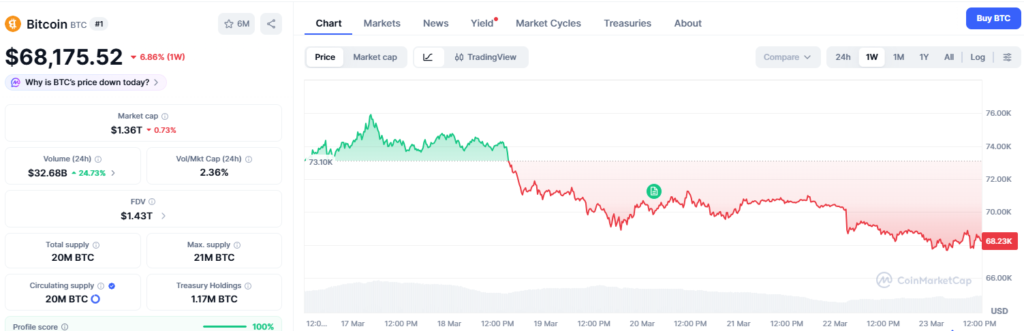
On the weekly chart, BTC declined by more than 6%, erasing all the gains on the monthly chart. At the time of this writing, BTC is trading around $68,175, down by 0.85%. Moreover, its market capitalization and trading volume have dropped to $1.36 trillion and $32 billion, respectively.
Looking at the technical indicators on the weekly chart, BTC continues to extend its downtrend, forming a descending channel pattern. The recent bullish momentum witnessed last week saw the price nearly test the upper trendline of the pattern, but it retreated after bulls lost momentum.
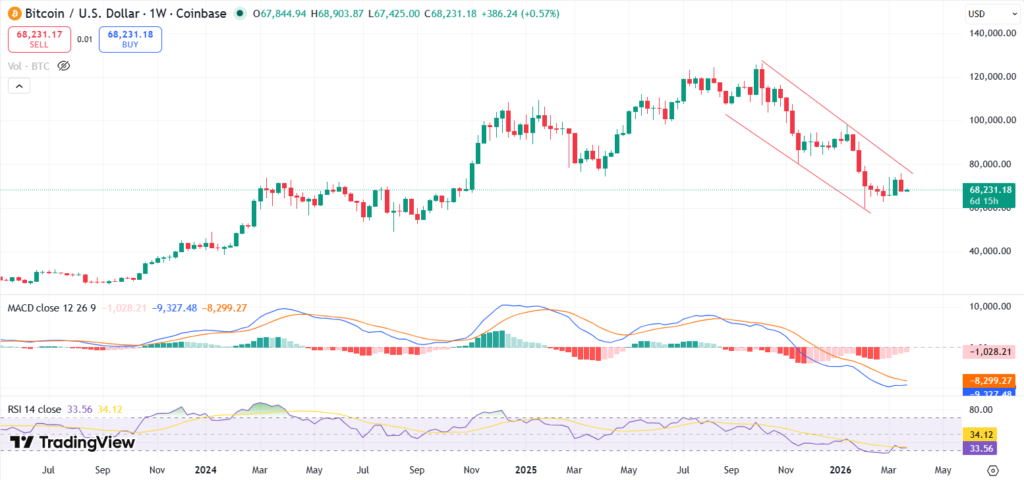
Meanwhile, indicators such as the RSI and MACD align with the ongoing downtrend as they continue heading into the negative territories. The 14-day RSI is currently hovering slightly above the oversold region at 33 levels, while the MACD line drops further below the signal line, indicating strong bearish sentiment.

eToro Platform
Best Crypto Exchange
- Over 90 top cryptos to trade
- Regulated by top-tier entities
- User-friendly trading app
- 30+ million users

eToro is a multi-asset investment platform. The value of your investments may go up or down. Your capital is at risk. Don’t invest unless you’re prepared to lose all the money you invest. This is a high-risk investment, and you should not expect to be protected if something goes wrong.
0
0
 Manage all your crypto, NFT and DeFi from one place
Securely connect the portfolio you’re using to start.