
Nearly $500B In Bitcoin Faces Future Quantum Risk, Glassnode Finds

0
0

Bitcoin’s long-term quantum-risk debate now has a hard onchain baseline: 6.04 million BTC, or 30.2% of issued supply, already has public-key exposure on-chain. At Bitcoin’s latest price near $77,700, that exposed supply is worth roughly $469 billion.
The figure does not mean Bitcoin is facing an immediate quantum attack. It measures coins whose public keys are already visible while the coins remain at rest. Under today’s cryptographic assumptions, deriving a private key from a public key is not practical with conventional machines. The future concern is that a sufficiently capable quantum computer running Shor’s algorithm could theoretically reverse that protection for coins where the public key is already known.
That distinction separates exposed coins from the rest of the supply. Roughly 13.99 million BTC, or 69.8% of issued supply, has no public-key exposure at rest under this framework. Those coins are not described as post-quantum-proof, but their public keys are not currently visible on-chain in the same way.
The finding lands while Bitcoin is already trading near the $77,000 range, where price action has been pressured by weaker spot demand and renewed attention on exchange-side flows. The quantum issue is not a short-term price catalyst in the same way as ETF flows or exchange selling pressure, but it adds a deeper security layer to the discussion around long-term Bitcoin custody.
Structural And Operational Exposure Split The Risk
The exposed supply falls into two major buckets. Structural exposure covers 1.92 million BTC, or 9.6% of issued supply. These coins sit in output types that reveal public keys by design, including early pay-to-public-key outputs, legacy bare multisig structures and Taproot outputs where the output key is visible on-chain. Some of that supply may be difficult to migrate if the coins are lost, abandoned or controlled by inactive holders.
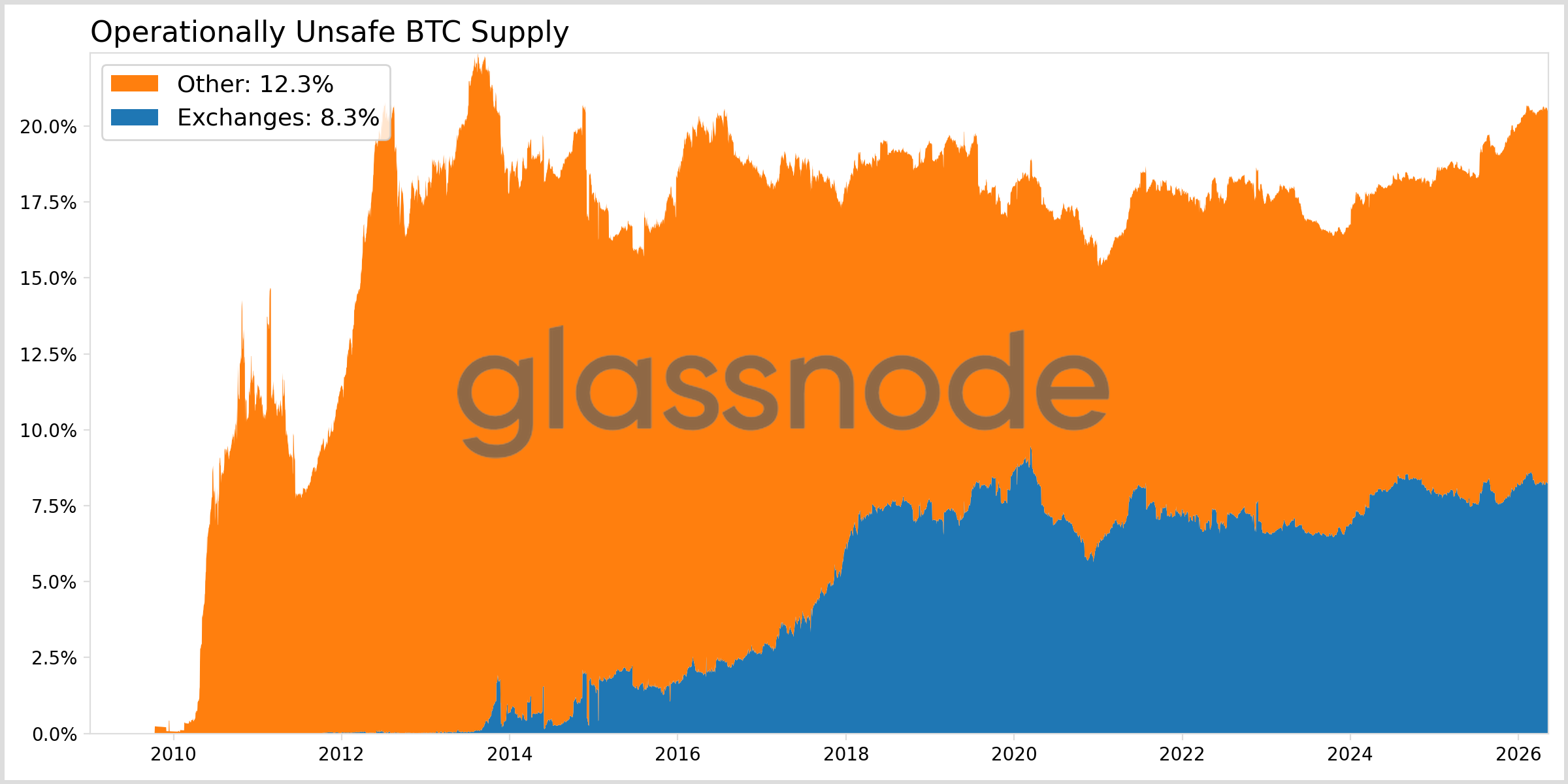
Operational exposure is larger at 4.12 million BTC, or 20.6% of issued supply. This category is more tied to wallet behavior than old address design. Coins can become exposed when users reuse addresses, partially spend from a key, or leave remaining balances connected to a public key that has already appeared on-chain.
Exchange-related balances make the operational issue more important. Within the operationally unsafe bucket, 1.66 million BTC is exchange-related, equal to 8.3% of total issued supply and roughly 40% of all operationally unsafe BTC. That does not rank exchanges by solvency or imply an immediate custody failure. It shows that wallet management, reserve design and address hygiene leave a visible footprint on-chain.
The same dataset shows large differences between labeled entities. Some custodians appear to keep most balances in non-exposed structures, while others hold a much larger share of labeled BTC where public keys are already visible. Government-held BTC tracked in the dataset shows near-zero public-key exposure, while exchanges face a more complex custody problem because they handle deposits, withdrawals, change outputs and reserve movements at scale.
Quantum Readiness Becomes A Custody Issue
The practical implication is not panic over an active exploit. It is that a meaningful share of Bitcoin’s measurable future exposure can still be reduced through present-day wallet practices. Avoiding address reuse, rotating change outputs, modernizing custody infrastructure and planning migration paths can lower operational exposure without waiting for a full post-quantum Bitcoin upgrade.
The harder problem sits with structurally exposed and possibly dormant coins. If old coins cannot move voluntarily, they may remain visible targets in any future quantum environment unless the network eventually debates a broader protocol-level response. Proposals such as Pay-to-Merkle-Root aim to reduce long-exposure public-key risk for future output designs, but they do not automatically move existing exposed coins or solve the broader post-quantum migration challenge.
Future quantum hardware still has to cross a major technical threshold before this becomes an active threat. A March 2026 Google Quantum AI paper sharpened the debate by estimating lower resources for attacks against elliptic-curve cryptography than older assumptions suggested, while also stressing the difficulty of migration across decentralized systems.
Bitcoin’s exposed-supply map now gives exchanges, custodians, wallet developers and long-term holders a clearer place to start. The number to watch is not only 6.04 million BTC. It is whether the operational bucket, especially exchange-linked exposure, starts shrinking as major holders clean up address reuse, rotate reserves and prepare for a security problem that remains theoretical today but would be expensive to solve only after quantum hardware reaches production strength.
The post Nearly $500B In Bitcoin Faces Future Quantum Risk, Glassnode Finds appeared first on Crypto Adventure.
0
0


 Manage all your crypto, NFT and DeFi from one place
Securely connect the portfolio you’re using to start.


0
0

0
0

0
0