
Robinhood Chain Daily Fees and Revenue Both Clear $4 Million

0
0
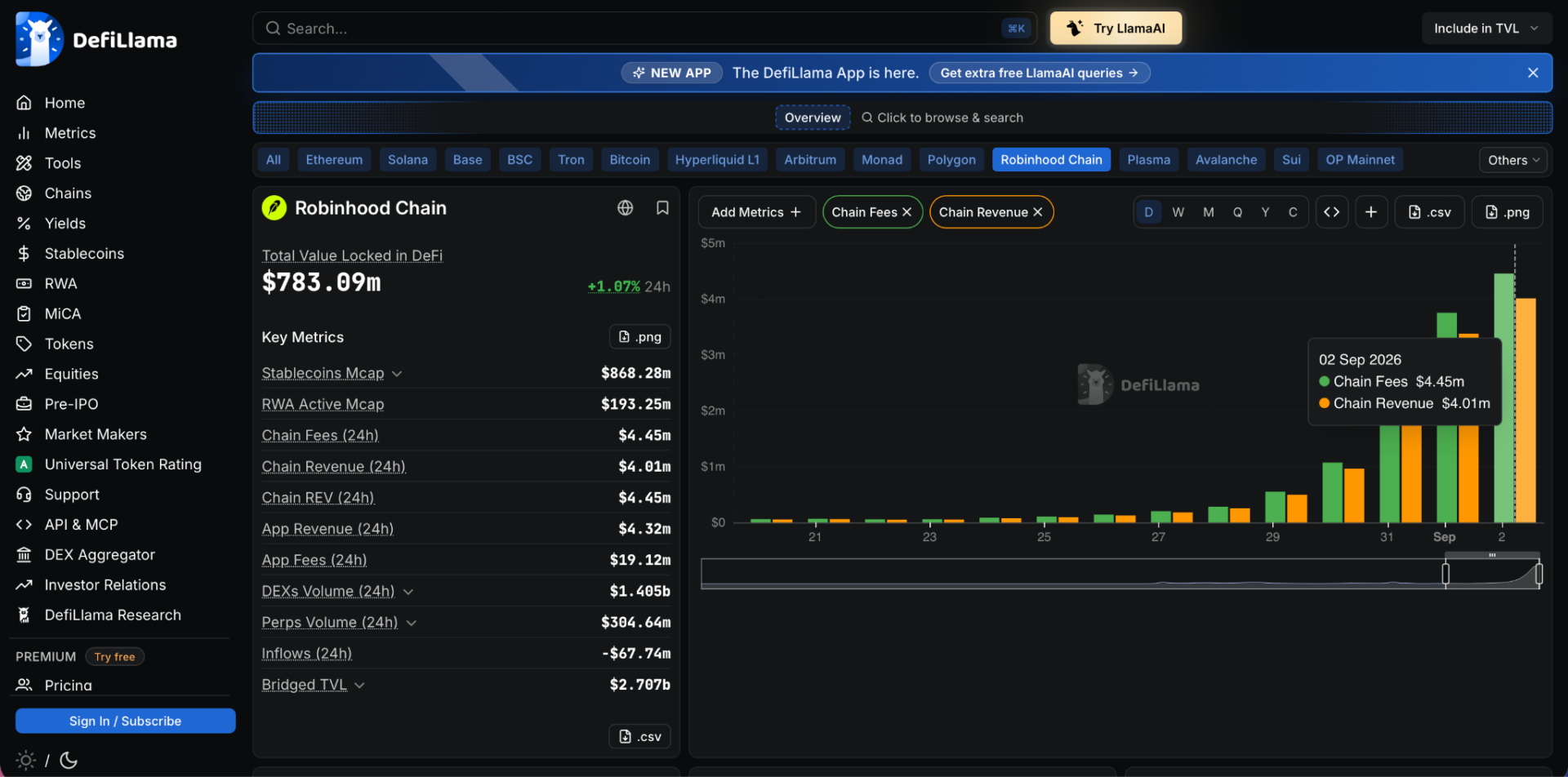
Robinhood Chain is seeing parabolic growth over the past week. It is currently the leading fee-generating chain in crypto and only second to Solana when it comes to chain revenue. On September 2, the network collected $4.45 million in chain fees and kept $4.01 million of that as revenue, according to data from DefiLlama. This makes it the fourth consecutive day where we’ve seen fees and revenue grow at a rapid rate. Just six days ago, chain fees were at $200,211 and revenue stood at $179,815. That’s around a 22x increase in under a week.
Source: DefiLlama
What Chain Fees and Chain Revenue Actually Measure
Chain fees refers to the total amount of gas users paid to transact on the network. Whatever Robinhood keeps after covering its own costs, which includes posting transaction data back to Ethereum and the 10% of net protocol revenue it owes Arbitrum for running an Orbit chain, is the Chain revenue. 8% of the protocol revenue goes to the Arbitrum DAO while the remaining 2% to the Developer Guild. The cut is charged on profit and not on gross throughput.
The gap between the two lines is thin. On August 27 it came to $20,396, which implies Ethereum costs of roughly $400 that day. The Arbitrum payment was effectively the entire spread. On September 1, the Arbitrum ecosystem’s take from Robinhood Chain was around $370,000. Arbitrum One itself did under $15,000 in fees the same day.
Where the Fee Growth is Coming From
Pons is a token launchpad on the Robinhood Chain that launched 12 days after its mainnet went live on July 1. Fast forward to the end of August and the platform took 63.9% of every dollar in launchpad fees across crypto.
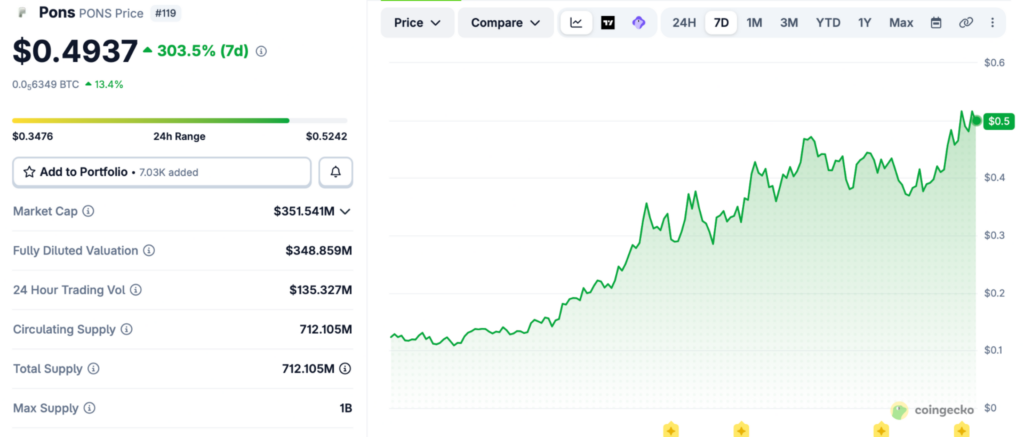
Pons V2 launched August 3. It charges a launch fee, then collects swap fees twice over, once on the bonding curve and again in the Uniswap v4 pool that graduating tokens land in. 80% of the V1 protocol cut goes toward buying and burning PONS. The team said on August 29 that 29% of the original supply had been retired. The token is up over 300% on the week and printed an all-time high near $0.50 alongside the fee record.
Source: CoinGecko
Uniswap Is Getting Paid on Every Graduation
Every Pons graduation ends up in a Uniswap pool. The v4 and v3 deployments on Robinhood Chain pulled $2.68 million and $1.45 million in fees over 24 hours and together account for 81% of the chain’s DEX volume. Robinhood Chain now handles 51% of all Uniswap v4 volume across every network Uniswap runs on.
Tokenized Assets Are the Smallest Number on the Chain
TVL sits at $783.09 million, with $868.28 million in stablecoins and $2.707 billion bridged in. 24 hour DEX volume is $1.405 billion, with another $304.64 million in perps. RWA active market cap is $193.25 million. A network built to host tokenized equities is currently operating as a memecoin venue.
The Gas Subsidy Runs Out on September 29
Chain revenue is not Robinhood revenue. CFO Shiv Verma told analysts on the Q2 call that the company earns a few basis points per transaction with roughly half shared with Arbitrum, without disclosing a rate or any reconciliation.
All of this also happened while gas was being subsidized. Robinhood cut the gas sponsorship threshold in its Wallet from $5 to $0.50, and the program runs until September 29, the end of the original 90-day window. Whether these numbers hold once users start paying their own gas is the question worth watching.
The smartest crypto minds already read our newsletter. Want in? Join them.
0
0

 Manage all your crypto, NFT and DeFi from one place
Securely connect the portfolio you’re using to start.


