
Monero Use Persists Despite Delistings as Darknet Markets Move to XMR

0
0
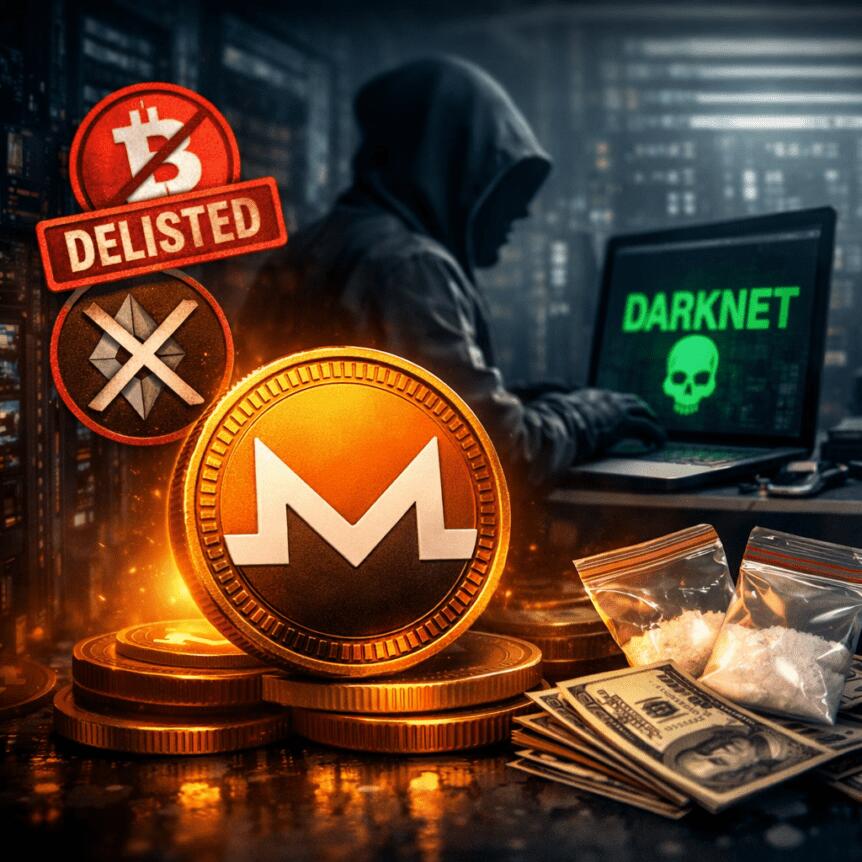
New findings from TRM Labs indicate that Monero activity has remained resilient even as major exchanges pulled back on the privacy-focused token. The research shows that transaction usage in 2024 and 2025 stayed above pre-2022 levels, suggesting demand persisted despite delistings and increased compliance pressure. The Dubai International Financial Centre’s (DIFC) regulatory stance this year, which banned privacy coins on licensed platforms, underscored a widening regulatory arc around anonymity tools. Against this backdrop, the broader market has shown a complex mix of risk appetite and regulatory scrutiny as observers watch how privacy-oriented assets navigate liquidity and enforcement forces.
Key takeaways
- TRM Labs reports persistent Monero activity in 2024–2025, with on-chain usage higher than pre-2022 benchmarks despite exchange constraints.
- Major platforms like Binance and Kraken moved to delist or phase out Monero over compliance concerns, while Dubai’s DIFC tightened rules on privacy coins such as Monero and Zcash.
- Bitcoin (CRYPTO: BTC) remains the dominant currency for real-world ransom payments, even though operators sometimes request Monero (CRYPTO: XMR) and offer discounts for it.
- Darknet markets showed a notable shift in 2025, with 48% of newly launched markets reportedly supporting only Monero, a marked increase from previous years.
- Monero’s Fluorine Fermi update (v0.18.4.3), released in October 2025, aims to bolster privacy and network security by refining peer selection and steering wallets toward safer nodes.
- Researchers found that roughly 14–15% of Monero nodes exhibited timing and connectivity patterns that could reveal how transactions propagate, signaling network-level privacy considerations beyond on-chain cryptography.
Tickers mentioned: $BTC, $XMR, $ZEC
Market context: The privacy-coin narrative remains shaped by regulatory pushback and shifting liquidity. While on-chain privacy protocols continue to operate, platform-level delistings and country-level prohibitions are pressuring the ecosystem to adapt, even as users and operators push for greater operational privacy and alternative exchange pathways.
Why it matters
Monero’s continuing activity highlights a tension in crypto between cryptographic privacy and the realities of regulatory compliance. Even as exchanges reduce access to privacy coins, real-world demand persists among users who prize anonymity, financial sovereignty, and resilience against surveillance. The divergence between on-chain privacy guarantees and network-level visibility underlines a nuanced risk for users: even when a transaction is cryptographically shielded, the manner in which it travels through the network can still leak clues about origin and routing if nodes observe traffic patterns.
The October 2025 Fluorine Fermi upgrade signals ongoing development within the Monero ecosystem to mitigate such risks. By improving peer selection and steering wallets away from potentially compromised segments of the network, the update aims to reduce exposure to “spy nodes” that could correlate IP addresses with transaction activity. This move illustrates a proactive stance from developers to harden anonymity without compromising the protocol’s foundational cryptography.
Beyond technical improvements, the trend in darknet markets—where a growing share launched in 2025 with Monero-only support—highlights a continued demand for privacy-centric channels in illicit or quasi-illicit activity. While this fact fuels ongoing debates about the societal costs and benefits of privacy coins, it also underscores the pragmatic realities of how these tools are used in the wild. The broader policy implications are evolving as regulators balance enforcement with the need for legitimate use cases and user protections.
What to watch next
- Follow any updates to the Fluorine Fermi roadmap and subsequent privacy-focused enhancements from the Monero project, including potential changes to node behavior and network-monitoring defenses.
- Track regulatory developments in the Dubai DIFC and other jurisdictions, particularly any clarifications or expansions of rules governing privacy coins on licensed platforms.
- Monitor darknet market dynamics for shifts in Monero-centric usage and the resilience of privacy-centric marketplaces amid enforcement pressures.
- Look for independent research from analytics firms on network-layer privacy and transaction propagation to gauge evolving anonymity assumptions.
Sources & verification
- TRM Labs research on Monero activity in 2024–2025, with insights into persistent usage and network-layer observations.
- News coverage documenting delisting and phase-outs of Monero by major exchanges, including actions taken by Binance and Kraken.
- Reports on Dubai’s DIFC ban on privacy coins such as Monero and Zcash (ZEC).
- Monero’s Fluorine Fermi update (v0.18.4.3) released in October 2025, focusing on privacy and anti-spy-node measures.
- Research noting that 48% of newly launched darknet markets in 2025 supported Monero-only usage.
Monero’s privacy and the evolving network landscape
Bitcoin (CRYPTO: BTC) continues to be the predominant on-ramp for ransom payments in the criminal-leaning segments of the ecosystem, even as operators occasionally request Monero (CRYPTO: XMR) and offer discounts for it. The usage data from 2024 and 2025, which stayed above pre-2022 levels, suggests that demand for privacy-preserving tools has not receded in the face of platform restrictions. Several exchanges that previously hosted Monero—such as Binance and Kraken—took steps to delist or phase out the coin, reflecting a tightening regulatory regime and a preference for compliance-driven asset lists. In parallel, Dubai’s DIFC moved to ban privacy coins on licensed platforms, reinforcing the cross-border complexity of privacy technologies’ compliance landscape. Zcash (CRYPTO: ZEC), another privacy-oriented coin, faced similar regulatory scrutiny in the same environment.
On the supply and usage side, the darknet ecosystem appears to be reinforcing the monetization of privacy tools. Data shows that nearly half of the darknet markets launched in 2025 supported only Monero, suggesting that privacy-centric rails remain attractive for dark market operators and participants despite broader enforcement actions elsewhere. This trend occurs even as the on-chain cryptography of Monero remains robust; observers warn that network-level observations—how transactions propagate across nodes—can still expose information about origin, timing, and routing paths. About 14%–15% of Monero nodes exhibited atypical timing and connectivity patterns, a signal that some participants may run numerous connected nodes to map propagation paths. While this does not imply a breach of Monero’s cryptography, it raises questions about how much anonymity can be preserved in practice when network visibility is visible to watchful observers.
The response from the Monero project has been to bolster defenses at the network level. The Fluorine Fermi release introduced a more selective peer-management approach, steering wallets away from suspicious nodes and toward safer parts of the network. This update is part of a broader effort to reduce the feasibility of linking transactions to IP addresses via node observation, an area that has grown more salient since reports of surveillance-capable nodes circulated in 2024. Taken together, the developments signal a pragmatic approach: maintain strong cryptographic privacy while acknowledging and addressing potential leaks at the network layer. The ongoing dialogue among researchers, practitioners, and policymakers will shape how privacy-focused assets like Monero navigate compliance, user protections, and market demand in the coming years.
This article was originally published as Monero Use Persists Despite Delistings as Darknet Markets Move to XMR on Crypto Breaking News – your trusted source for crypto news, Bitcoin news, and blockchain updates.
0
0

 Manage all your crypto, NFT and DeFi from one place
Securely connect the portfolio you’re using to start.

0
0


