
Why gold is falling: dollar strength and oil surge weigh

0
0
Gold prices slipped as oil surged to $100 per barrel on Iran war fears, while inflation concerns also weighed on sentiments.
The yellow metal is currently caught between the typical safe-haven demand dynamics and the dollar’s strength due to surging oil prices.
Analysts expect gold prices to remain in the current trajectory until there is a clearer picture about the war in the Middle East.
Additionally, the dollar’s strength against a basket of major currencies also dragged down bullion prices on Thursday.
A stronger dollar makes commodities priced in the greenback more expensive for overseas buyers.
Many market observers have been puzzled by gold's performance since the start of the conflict.
Puzzled by gold’s movement
Despite its historical role as a dependable safe-haven asset during geopolitical crises, gold has unexpectedly fallen by about $200 since the initial airstrikes on February 28, going against the typical market response.
“The explanation lies in the immediate aftermath of the strikes, when the US dollar surged as the primary beneficiary of flight-to-safety flows, effectively crowding out gold's typical role,” Gary Wagner, technical market analyst at Kitco said in a report.
The market's focus has recently shifted. Attention is now centered on how an extended conflict, disrupting energy supplies, could alter the Federal Reserve's path for monetary policy.
This change in focus has, in turn, become a significant factor influencing the price of gold.
Higher inflation weigh on gold
Following Iran's strike on merchant ships on Wednesday, Tehran said the global community should be ready for $200 per barrel.
In response to what is being described as one of the most severe oil shocks since the 1970s, the International Energy Agency (IEA) has urgently called for a substantial release of strategic reserves.
Amid the ongoing US-Israeli conflict with Iran, supplies from the Gulf remain restricted, causing oil prices to surge in early trading and intensifying inflationary pressures.
Furthermore, Iran has reportedly deployed about a dozen mines in the narrow waterway of the strait.
This action threatens to significantly complicate efforts to reopen this critical passage for global shipments of oil and liquefied natural gas.
Producers in the Middle East have suspended oil output because storage is nearing capacity, leaving tankers stranded in the Strait of Hormuz for over a week.
The conflict's impact extends beyond financial mechanisms, underscoring evolving geopolitical concerns regarding the security of supply chains.
The Strait of Hormuz is a vital choke point; it traditionally handles the transit of roughly 20 million barrels of oil daily, accounting for over a quarter (25%) of the world's seaborne oil trade.
Notably, Asian markets rely heavily on this passage, receiving close to 90% of the crude and condensate exports that move through it.
On the other hand, US economic data showed on Wednesday that the Consumer Price Index (CPI) climbed by 0.3% in February, meeting forecasts and marking an acceleration from the 0.2% rise seen in January.
Annually, CPI increased by 2.4% through February, which was also aligned with expectations.
Attention now shifts to the delayed release of the January Personal Consumption Expenditures (PCE) index, which investors anticipate on Friday.
Inflation is expected to be significantly affected.
Any suggestion of cooling energy costs in February's data is likely to be quickly undone, with March and April's reports expected to show a sharp reversal as supply disruptions impact the market, according to Wagner.
“That prospect has made the Fed's rate path considerably murkier, and it is this uncertainty — more than the geopolitical headlines themselves — that appears to be weighing most heavily on gold.”
Near-term outlook
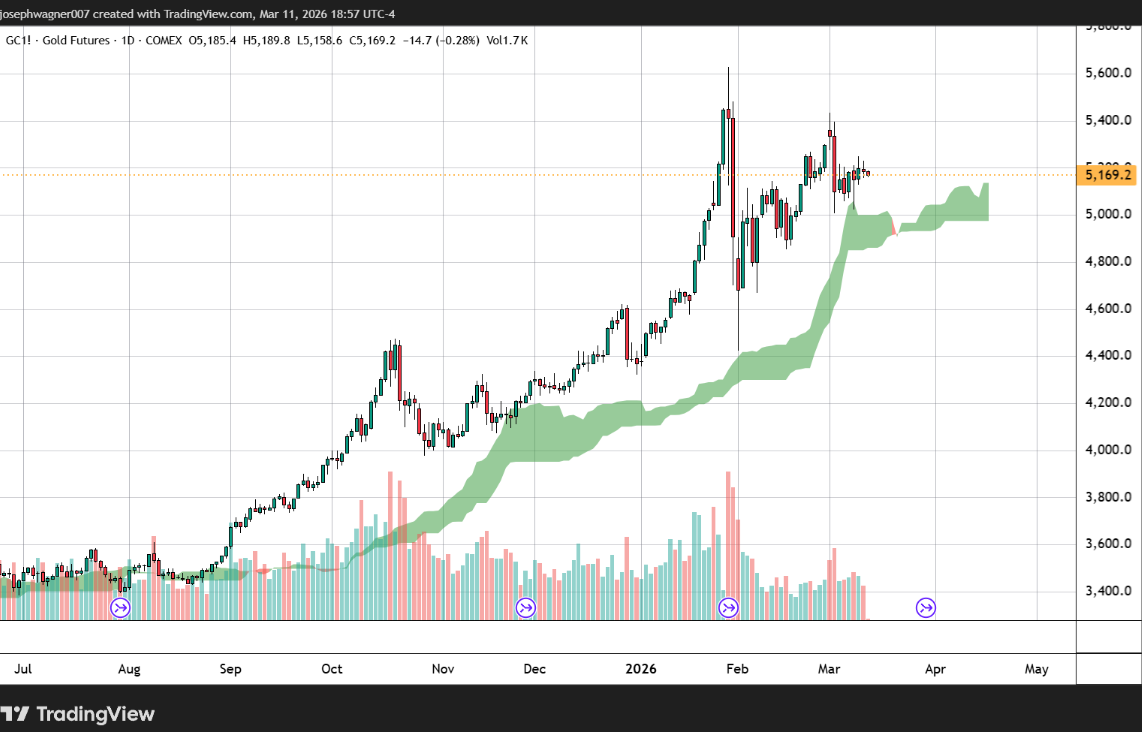
Gold futures experienced a decline, initially dropping $14.80 on Wednesday.
This downward trend continued into overnight trading on Thursday, with the contract falling an additional $12.00 to trade at $5,166.00 in overseas markets.
“The pattern suggests persistent selling pressure as long as the dollar remains firm and the market debates how far a Middle East energy shock might push the Fed off course,” Wagner added.
Market participants, including traders and analysts, are focused on two key developments: signals of de-escalation from diplomatic talks and the stabilisation of oil price volatility, which is currently a major factor in determining the inflation risk for Fed policy expectations.
“Until either question is resolved, gold is likely to remain caught between its traditional geopolitical premium and the dollar-strength headwind that has defined its trading since late February,” Wagner further said.
At the time of writing, the COMEX gold contract was at $5,160.26 per ounce, down 0.4%, while silver was at $85.480 per ounce, down 0.1%.
The post Why gold is falling: dollar strength and oil surge weigh appeared first on Invezz
0
0


 Manage all your crypto, NFT and DeFi from one place
Securely connect the portfolio you’re using to start.

0
0

0
0

0
0

0
0