
Bitcoin to test $78.3K support as US crude rises to 3-month high

0
0
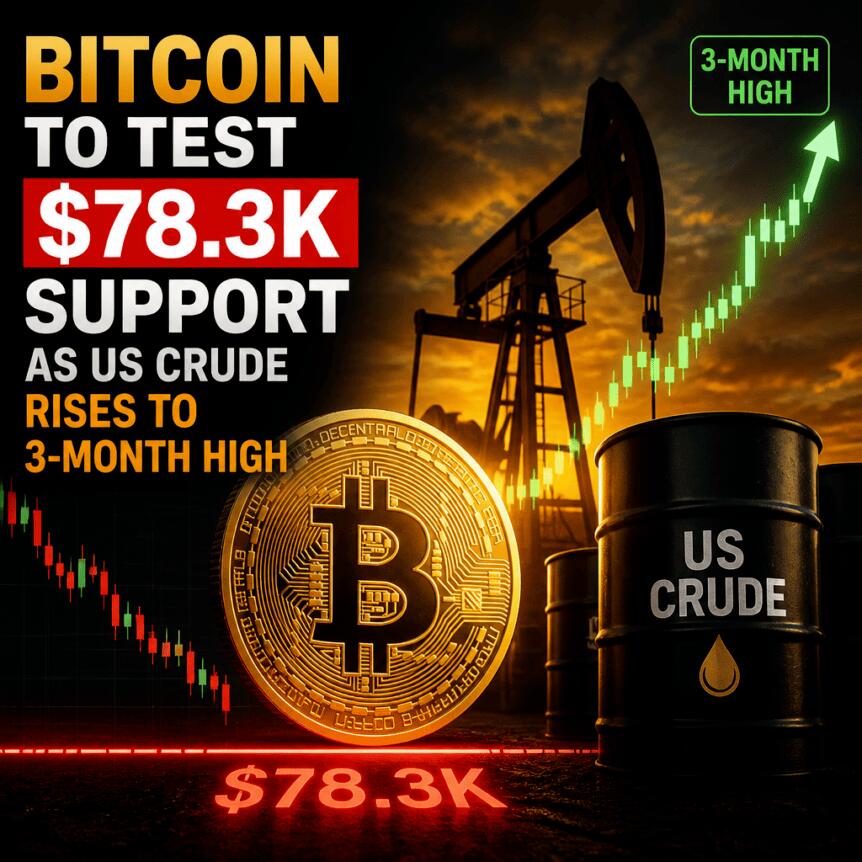
Bitcoin slid beneath the $78,000 level at the Wall Street open on Tuesday, under pressure from a broader risk-off move that followed renewed Middle East tensions. The drop marked Bitcoin’s first move under $78,000 since Sept. 3, with BTC/USD hitting as low as $77,600 before a modest rebound.
Macro conditions appeared to be the main driver. US equity markets fell in early trading, while crude oil jumped sharply—adding fresh inflation concerns ahead of upcoming US data.
Key takeaways
- BTC briefly traded under $78,000 for the first time since Sept. 3 after equities weakened at the start of the Wall Street session.
- WTI crude surged toward $95 per barrel, while Brent pushed toward the $100 area, intensifying inflation sensitivity.
- Trader Rekt Capital said the market is “copying” the failed May breakout scenario, with $78,300 highlighted as a key support level.
- A weekly close below ~$78,300 followed by a bearish retest would likely strengthen the case for another breakdown.
Risk assets weaken as oil spikes on renewed tensions
According to TradingView data cited in market coverage, BTC/USD dropped to $77,600 before attempting to recover. The move came alongside declines in US stocks right after the Labor Day holiday, as news tied to Houthi strikes on Saudi cities and oil-related infrastructure pressured sentiment.
At the time of writing, the S&P 500 was down about 0.5% and the Nasdaq Composite was down roughly 0.4%, reflecting the typical spillover from geopolitical risk into equities and, by extension, liquidity conditions that can affect crypto.
Oil reacted more forcefully. WTI crude climbed toward the $95 per barrel mark, reported as the highest level since June 8, while Brent crude targeted $100 for the first time since July 24. This matters for Bitcoin because higher energy costs tend to feed into inflation expectations, which can pressure broader risk appetite—especially when markets are already looking ahead to fresh economic prints.
Trade publication The Kobeissi Letter pointed to a similar theme, noting that a rise in diesel costs is contributing to “inflation expectations” building. Earlier coverage from Cointelegraph also tied these worries to CPI expectations, flagging that the CPI release is scheduled for Friday.
Inflation expectations return to the spotlight
Rising energy prices can quickly become a crypto market issue because they influence rate expectations and the discount rate applied to speculative assets. While the immediate driver of Bitcoin’s move was risk sentiment, the oil surge raised the stakes for investors focused on interest-rate trajectory and inflation momentum.
The market narrative is also complicated by politics. In a Monday Truth Social post, US President Donald Trump played down the oil spike and suggested prices could fall sharply in the future, claiming: “Oil prices will drop precipitously.” While such comments may influence sentiment, oil is still trading as a concrete input into inflation expectations, and that can’t be hand-waved away in the short term.
BTC’s chart setup echoes a “failed May breakout”
Beyond the macro backdrop, the day’s price action also fed technical debate. Trader and analyst Rekt Capital suggested that Bitcoin’s behavior is resembling the market structure that followed a failed breakout in May.
As described in Rekt Capital’s earlier analysis, BTC/USD had reached about $82,800 before reversing, then consolidating around $78,300 before eventually falling to new macro lows near $57,000. In his current view, the retest of the ~$78,300 area is now in progress, based on a post on X.
Rekt Capital warned that if this zone does not hold, the market could print yet another lower high. He framed the risk as part of a broader sequence extending back to October 2025, reinforcing what he described as an ongoing bear-market condition into 2026.
Importantly, his threshold was specific: he argued that a weekly close below $78,300, followed by a bearish retest “just like in early May,” would likely confirm a breakdown. For traders and investors, this distinguishes between an intraday dip—which can often be bought on mean reversion—and a more durable technical failure that tends to reset expectations.
What to watch next around $78,300
With BTC briefly trading under $78,000, attention has shifted to whether the broader support structure around $78,300 can withstand renewed volatility. The next catalyst will likely be a combination of market-wide risk appetite and incoming US data that could change how investors price inflation and potential rate moves.
For now, the crucial question remains whether Bitcoin can reclaim stability above the key support area—or whether the May-style sequence repeats, turning Tuesday’s dip into a larger technical breakdown.
This article was originally published as Bitcoin to test $78.3K support as US crude rises to 3-month high on Crypto Breaking News – your trusted source for crypto news, Bitcoin news, and blockchain updates.
0
0

 Manage all your crypto, NFT and DeFi from one place
Securely connect the portfolio you’re using to start.


