
GramNetwork Tokenomics: How the 500M GRM Supply Breaks Down

0
0
GramNetwork Tokenomics: What You Need to Know
GramNetwork is one of the newer names showing up in Telegram mining circles, and it's built around a simple pitch: mine now, claim GRM later. But the Gramnetwork tokenomics behind that pitch matter more than the mining animation on your phone screen. They decide who actually controls the supply once the token goes live.
According to the project's own materials, GRM has a hard cap of 500 million tokens, with nearly half set aside for the mining community. That's an unusually large community share for a project still in its pre-launch phase.
This article breaks down where the numbers come from, what's confirmed versus what's a stated plan, and what to watch before the token's expected Q4 2026 debut. As of August 2026, GRM is not yet trading on any exchange.
What Is GramNetwork and How Does GRM Mining Work?
GramNetwork describes itself as a decentralized protocol aiming to move Telegram-based users from simple app usage into an on-chain Web3 setup. That's the project's own framing, not an independently verified claim.
The mechanics are familiar to anyone who has used a tap-to-earn Telegram app. Users mine GRM through a bot, complete tasks for bonus coins, and refer friends for extra rewards. None of this happens on a blockchain yet.
The project says mined balances sit in an off-chain GRM-Wallet until the official Token Generation Event, or TGE. At that point, according to the stated plan, balances convert into on-chain GRM at a 1:1 ratio on the TON blockchain.
That "1:1 at TGE" promise is common across mining apps of this type, and it's worth treating as a stated intention rather than a locked-in guarantee until the mainnet is live and verifiable.
How Is the 500M GRM Supply Distributed?
The project's published tokenomics point to a fixed total supply of 500 million Token. Here's how that supply is said to be split, based on the project's own tokenomics documentation:
Allocation | Percentage | Tokens | Stated Purpose |
Mining Community | 44% | 220M | PoW / DePIN mining rewards |
Ecosystem Development | 20% | 100M | Development and marketing |
Core Team | 15% | 75M | Locked allocation |
Liquidity | 11% | 55M | CEX/DEX liquidity provisioning |
Institutional Partners | 10% | 50M | Strategic partnerships |
Token allocation is not just a pie chart. It tells you who can move the market once trading starts. A large mining allocation spreads GRM across many small holders instead of a handful of early backers, at least on paper.
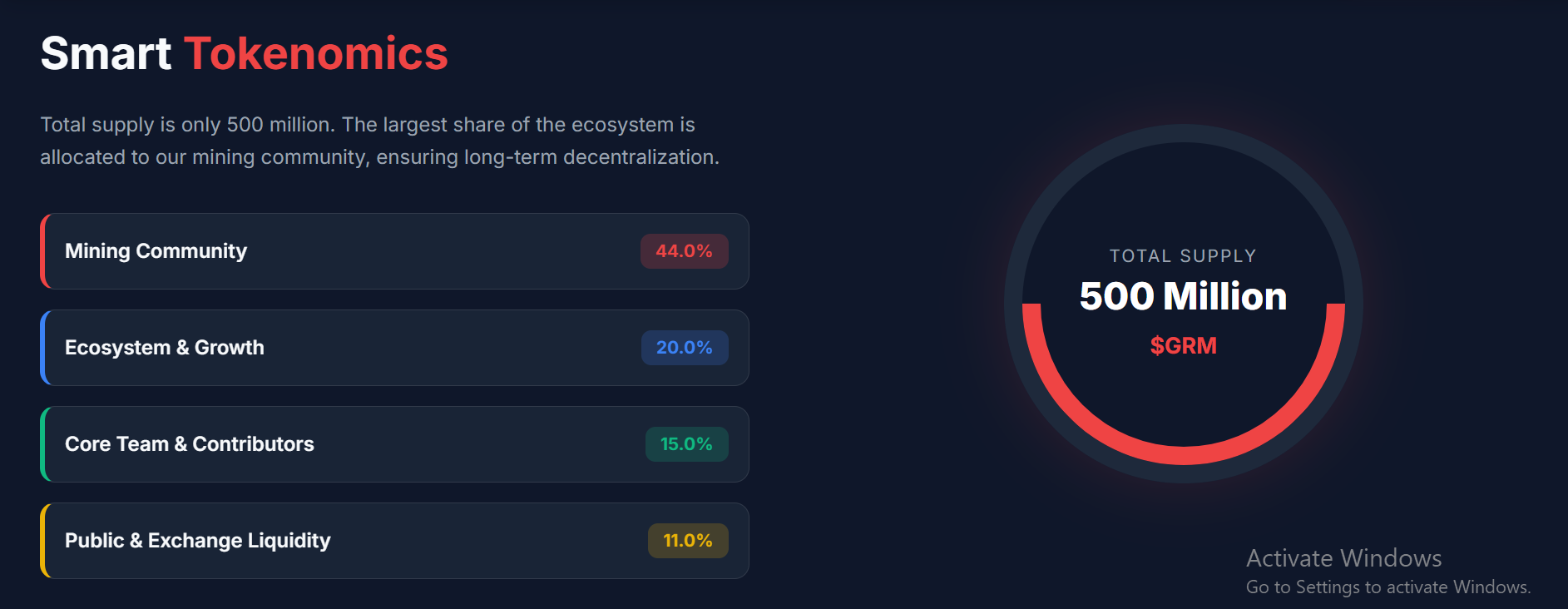
The team and institutional slices, at 15% and 10% respectively, are smaller than what many venture-backed presale projects reserve for insiders. The project describes the core team's share as locked, though it hasn't published a public vesting schedule with exact unlock dates. Until that schedule is confirmed, readers shouldn't assume a specific release timeline for those tokens.
Why Does the Mining Community Receive 44% of GRM?
GramNetwork's stated reasoning for the 44% mining allocation is decentralization. By putting the biggest slice of GRM in the hands of individual miners rather than a company treasury, the project argues that governance power stays spread out.
There's a real logic to that argument. Wide distribution can reduce the odds of one wallet controlling enough supply to swing the price. But wide distribution alone doesn't prevent whale accumulation after listing, especially if early miners sell into a thin market.
It's also worth separating intent from outcome. A project saying it wants decentralized ownership is different from a project actually achieving it. That gap only closes once real, on-chain data is available after launch.
How Does the GRM-Mining and Reward Model Work?
Token vesting is the schedule that controls when tokens become available. GramNetwork doesn't use a classic vesting cliff for its mining rewards; instead, it uses a mining schedule with built-in halvings.
The project says mining rewards halve every 12 months, similar to Bitcoin's issuance model. It also describes an "anti-whale memory-hard" mining algorithm, intended to make mining harder to dominate with specialized hardware.
On top of base mining, the project offers:
Task Center bonuses for completing social or partner campaigns
Referral rewards for inviting new users
A built-in GRM Wallet for storing mined balances and, per the roadmap, fee-free peer-to-peer transfers
Staking is listed as a future feature rather than something live today. Readers should treat it as a roadmap item, not a current utility.
What Is the GramNetwork Roadmap for the GRM Launch?
The project's published roadmap runs in three phases:
Phase 1 – Foundation (Q1–Q2 2026): Smart contract audits and a public testnet. The project's whitepaper, dated June 2026, is part of this phase.
Phase 2 – Network Genesis (Q4 2026+): Mainnet launch, genesis block creation, and the start of on-chain mining for the 44% community allocation.
Phase 3 – Market Horizon (Q4 2026+): The TGE itself, followed by the stated plan to pursue listings on centralized and decentralized exchanges.
What Makes GramNetwork's Token Distribution Different?
Compared to a typical presale-driven launch, GramNetwork leans more toward earned distribution than upfront fundraising.
No public sale round. Supply moves to users mainly through mining, not through buying rounds.
Halving-based issuance. Mining rewards halve every 12 months, similar to Bitcoin's shrinking block reward.
Smaller insider allocation. At a combined 25%, the team and institutional shares are lower than many venture-backed launches set aside for early stakeholders.
Telegram-native distribution. Mining through a bot lowers the entry barrier compared to presale platforms that need wallets and upfront capital.
What Do the GRM Tokenomics Reveal?
The stronger signal is the supply cap itself. A fixed 500 million tokens, with 44% earmarked for miners, is a genuinely community-heavy structure compared to many presale-driven launches.
The main concern is verification. Nearly everything about GRM today, including the total supply figure, rests on the project's own website and whitepaper rather than on-chain data, since the token hasn't launched.
The biggest unknown remains execution. Smart contract audits, mainnet stability, and exchange listings are all still ahead. Mining app history is mixed: some projects convert mined balances into real tokens with real liquidity, others stall out or launch to thin, illiquid markets.
Conclusion
GramNetwork's tokenomics center on a capped 500 million GRM supply, with the largest share going to miners rather than insiders. The stated roadmap points to a Q4 2026 mainnet and TGE, following audits and testnet work earlier in the year.
What stands out is the size of the community allocation. What remains uncertain is everything downstream of it: audit results, mainnet performance, and whether exchanges actually list the token. Readers should check the project's official channels for audit reports and mainnet updates before assuming any of the current mining activity has guaranteed value.
Disclaimer:
This article is for informational and educational purposes only and is not financial or investment advice. GRM is a pre-launch, unaudited token, and its stated tokenomics and roadmap may change. Always do your own research before acting on any crypto-related information.
0
0
 Manage all your crypto, NFT and DeFi from one place
Securely connect the portfolio you’re using to start.