
Market Analysis: Why Bitcoin and Global Markets Just Collapsed

0
0

The global financial markets just witnessed one of the most brutal, synchronized sell-offs in recent history. In a single trading session, an astonishing $2.5 trillion in market value was completely erased across equities, precious metals, and digital assets.
This was not a series of isolated corrections; it was a systemic liquidity event where everything broke simultaneously. While traditional markets bled heavily, Bitcoin ($BTC) found itself directly in the crosshairs, plunging over 6% to retest critical support lines before staging a fragile relief bounce to roughly $62,100.
Here is an analytical breakdown of exactly how a macro perfect storm, an artificial intelligence panic, and a hidden liquidity crunch broke the markets all at once.
The Macro Trigger: A Blistering May Jobs Report
The initial domino fell with the release of the U.S. employment data. The U.S. economy added 172,000 jobs in May, obliterating Wall Street's consensus expectation of 88,000.
Under normal economic conditions, a robust labor market is celebrated. However, in the current macroeconomic climate, it serves as an inflation accelerant. With headline inflation already sticky at 3.8% and crude oil hovering stubbornly at $90 per barrel, a hot labor market signals to the Federal Reserve that the economy is running too hot to justify loosening monetary policy.
Consequently, the market’s implied probability of an additional Fed interest rate hike this year surged from 40% to 57% in a single day. Higher interest rates reduce the present value of future corporate cash flows, making high-growth tech stocks and speculative risk assets less attractive. Investors reacted instantly by pricing in a hawkish regime, sparking an aggressive flight to cash.
The mathematical damage across major asset classes tells the story:
- Nasdaq: Down -2.60% (-$1.11 trillion)
- S&P 500: Down -1.65% (-$1.14 trillion)
- Gold: Down -3.38% (-$1 trillion)
- Silver: Down -6.90% (-$280 billion)
- Bitcoin ($BTC): Down -15.31% (-$80 billion)
The AI Trade Cracks: Broadcom, Nvidia, and Semiconductor Panic
For over a year, the artificial intelligence boom has single-handedly carried major stock indices. Today, that narrative cracked.
The trouble began when Broadcom ($AVGO) reported its earnings. Despite posting stellar numbers—including a 48% jump in overall revenue and a 143% increase in AI chip sales—the stock plummeted 12.6%. The catalyst? Broadcom failed to raise its forward-looking AI revenue guidance for the rest of the year. For an overextended market pricing in flawless exponential growth, a lack of an upward revision was treated as an outright failure.
The anxiety escalated rapidly following a research report published by boutique firm SemiAnalysis. The report revealed that Nvidia’s ($NVDA) next-generation AI architecture will require significantly less high-bandwidth memory (HBM) than previously anticipated—roughly half of what the market had priced in.
The structural implications for supply chain monopolies were immediate:
- SK Hynix fell nearly 10% in Asian trading.
- Samsung dropped over 6%.
- South Korea's KOSPI index collapsed 5.5% in a single session.
To add fuel to the fire, AI startup Anthropic published a sobering safety paper warning that artificial intelligence systems are rapidly approaching a threshold where they can recursively optimize and improve their own code without human intervention. The firm called for a coordinated global pause on advanced AI development, amplifying fears that the technological expansion is moving far faster than viable commercial business models can sustain.
The Hidden Liquidity Crunch: The Race for Fresh Cash
Beneath the surface of the macroeconomic headlines lies an institutional liquidity squeeze that few are openly discussing.
A wave of mega-cap private tech companies are preparing to drain market liquidity via initial public offerings (IPOs). SpaceX is slated to go public next week at a staggering $1.75 trillion valuation, while both Anthropic and OpenAI are actively structuring their own public market debuts. Combined, these three market entrants represent between $4 trillion and $5 trillion in prospective market capitalization.
Institutional fund managers who intend to secure allocations in these generational listings require vast amounts of liquid capital. However, aggregate institutional cash reserves are currently sitting at their lowest levels since early 2024. Because fund managers cannot buy new shares with illiquid assets, they are forced to sell what they already own. This structural rotation explains why even historical safe havens like gold and silver were heavily sold off alongside equities and crypto.
Bitcoin's Critical Technical Battle at $60,000
As a hyper-sensitive barometer for global liquidity, Bitcoin felt the full brunt of the liquidation wave. Derivative markets experienced a massive squeeze, with over $1.5 billion in leveraged crypto long positions wiped out within 24 hours, according to data from Coinmarketcap.
The relentless selling pressure forced $BTC down to briefly breach the psychological $60,000 support level, hitting intraday lows that triggered deep demand blocks.
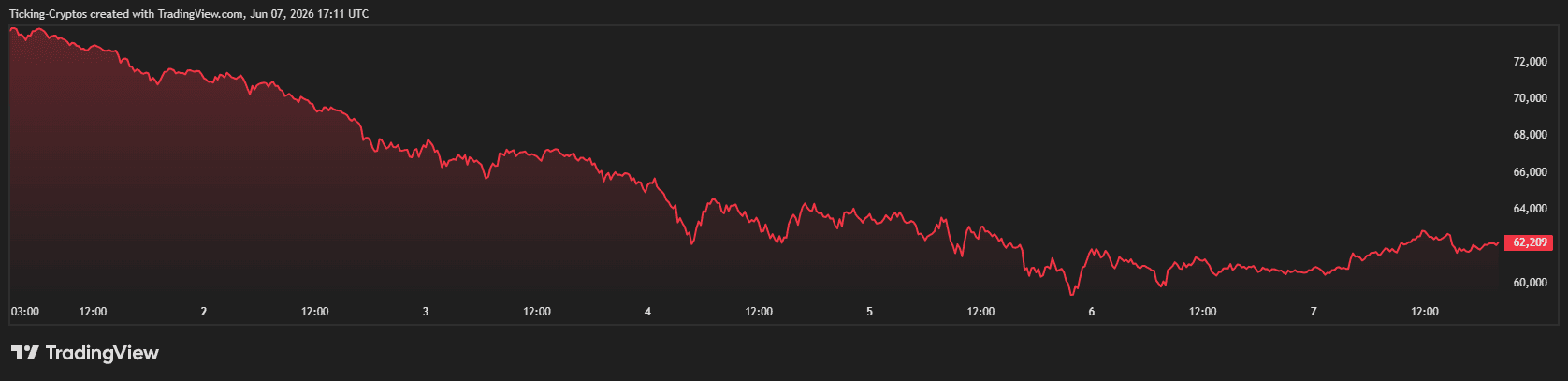
From a technical perspective, the $60,000 region represents a vital structural floor. Buyers stepped in aggressively at this level, allowing Bitcoin to print a slight relief bounce to $62,100. Maintaining this level is paramount for bulls; a decisive daily close below $60,000 opens the technical trapdoor for a deeper correction toward the $53,000 macro liquidity pocket.
The Warsh Factor: Unpredictability Ahead
Adding to the pervasive market anxiety is the impending Federal Open Market Committee (FOMC) meeting in 11 days, which will be chaired for the first time by the newly appointed Fed Chair, Kevin Warsh.
While Warsh was originally appointed under political expectations of a dovish, rate-cutting agenda, he now walks into a monetary minefield defined by sticky inflation, $90 oil, and an unyielding labor market.
Faced with an entirely unpredictable central bank leadership shift in less than two weeks, institutional investors are adopting a defensive posture. In a market governed by uncertainty, the safest and most logical operational play is to de-risk immediately—and that is exactly what the world did today.
0
0


 Manage all your crypto, NFT and DeFi from one place
Securely connect the portfolio you’re using to start.


0
0
