
EU Stablecoin Rule Too Narrow: Issuers Push for USD Tokens

0
0
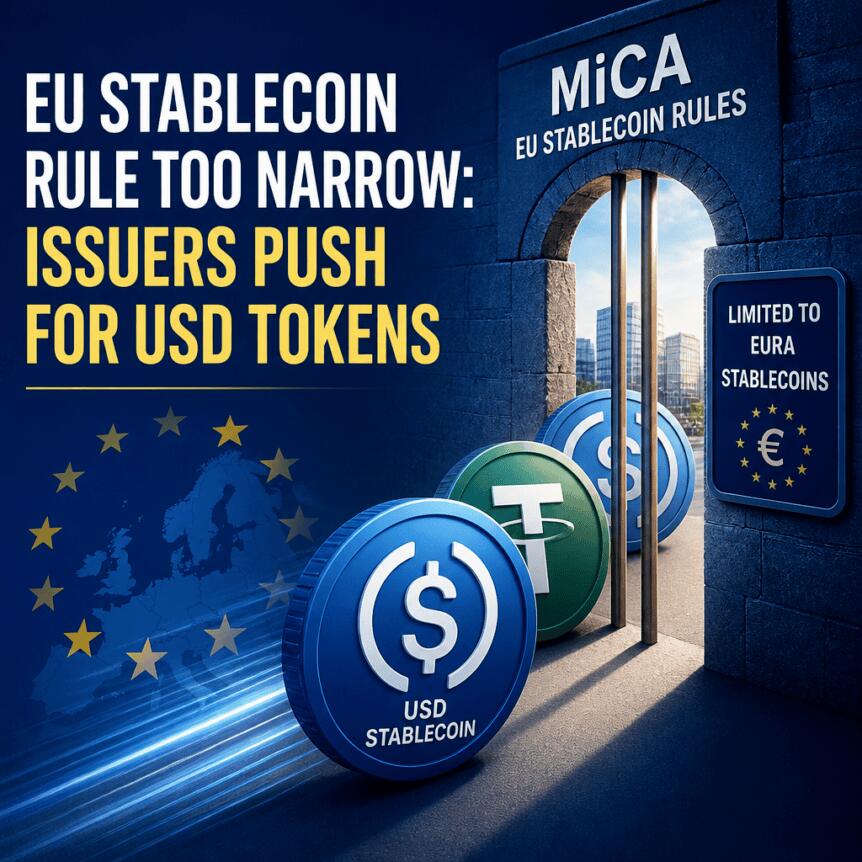
European stablecoin issuers are positioning regulated US dollar tokens as a complement to, rather than a replacement for, euro-pegged offerings. Their argument: cross-border commerce still runs on dollar liquidity, and MiCA-compliant frameworks can address that demand without forcing a zero-sum “euro versus dollar” debate.
On Wednesday, German issuer AllUnity expanded its MiCA-regulated lineup by launching US dollar-pegged stablecoin USDAU. The company said a euro-only approach can leave European corporates with gaps in settlement and payment flows that involve the US and other dollar-dependent markets.
Key takeaways
- AllUnity launched USDAU, a US dollar-pegged stablecoin, as part of its MiCA-regulated product range.
- Issuers argue dollar demand in Europe is driven by real cross-border business and settlement needs, not speculation.
- Some European market participants say the policy objective should be a diversified stablecoin ecosystem with both euro and dollar options.
- Even with new entrants, European-issued dollar stablecoins remain small versus Tether’s USDT and Circle’s USDC, according to CoinGecko.
Why euro-only stablecoin strategies miss the point
AllUnity’s push into a regulated dollar token is rooted in the practicalities of global trade and foreign exchange. Its CEO, Alexander Höptner, told Cointelegraph that the dollar functions as a “glue” currency across international markets, particularly for payments and FX execution. He argued that offering only a euro stablecoin is not enough for European corporates that need to move value globally.
The launch also arrives as the EU continues to refine and scrutinize the Markets in Crypto-Assets (MiCA) framework, while the European Central Bank has repeatedly raised concerns about stablecoins that could “reinforce the dollar’s global dominance.” Earlier coverage from Cointelegraph has highlighted that debate as a key backdrop to the market’s shifting stablecoin strategies.
Demand that regulation can shape, not erase
Other European issuers echoed the same theme: dollar stablecoin usage is anchored in where transactional and settlement demand already sits. Stable Mint CEO James Bennett said that Europe cannot simply steer businesses away from dollar-linked flows. In his view, policymakers and regulators can influence who provides dollar tokens and under which rules, but not remove the underlying need for dollar liquidity in cross-border operations.
Stable Mint’s own USDSM stablecoin illustrates the kind of usage these companies are pointing to. The issuer provided figures to Cointelegraph stating USDSM has moved more than $380 million on-chain across 3.8 million transfers, and is held by more than 2,600 addresses, as of Wednesday.
Fiat Republic CEO Adam Bialy similarly tied demand to operational needs rather than speculative behavior. He said regulated dollar tokens can reduce friction in cross-border settlement between Europe, the UK, and North America—an environment where businesses often need predictable liquidity and faster settlement compared with traditional banking rails.
“Not euro versus dollar”: diversification over confrontation
Not all European actors frame the issue as a directional contest between currencies. Societe Generale’s digital asset subsidiary, Societe Generale-FORGE (SG-Forge), said the right goal is a resilient ecosystem that supports access to both euro- and dollar-denominated digital cash solutions under a strong regulatory umbrella.
In a statement to Cointelegraph, a spokesperson said SG-Forge does not view the emergence of dollar stablecoins as something to oppose. Instead, the company emphasized coexistence: users should be able to access stablecoin liquidity across currencies without undermining regulatory standards.
SG-Forge also referenced its own product, USD CoinVertible (USDCV), launched in 2025. The company said it has drawn interest for trading, settlement, collateral management, and treasury operations—areas where stablecoin rails can be used as infrastructure rather than purely as a speculative instrument.
European dollar stablecoins still lag global leaders
Despite the renewed focus on regulated dollar tokens, Europe-issued dollar stablecoins remain far smaller than the dominant USD stablecoins used globally. CoinGecko categorization data referenced by Cointelegraph places USDSM and USDCV at roughly $13 million each, compared with about $184 billion for USDT and $74 billion for USDC.
This scale gap matters for investors and market builders because it highlights that Europe’s regulatory push is not yet translating into dollar-stablecoin parity. While MiCA compliance may lower legal and operational friction for European-facing services, user liquidity and network effects still overwhelmingly favor the established issuers.
AllUnity’s leadership framed the opportunity as infrastructure-building rather than a geopolitical duel. Höptner said the target is to connect dollar liquidity with European banks and businesses through interoperable financial rails—an approach intended to broaden access rather than replace existing global stablecoin ecosystems.
What to watch next
As MiCA continues to evolve and the ECB’s views on stablecoin risks remain in the spotlight, the next test for Europe’s regulated dollar issuers will be whether they can scale adoption beyond early holders and a niche of settlement-focused users—especially in a market where USDT and USDC already command most of the liquidity.
This article was originally published as EU Stablecoin Rule Too Narrow: Issuers Push for USD Tokens on Crypto Breaking News – your trusted source for crypto news, Bitcoin news, and blockchain updates.
0
0
 Manage all your crypto, NFT and DeFi from one place
Securely connect the portfolio you’re using to start.