
Crédit Agricole Launches EURXT Stablecoin on Ethereum

0
0
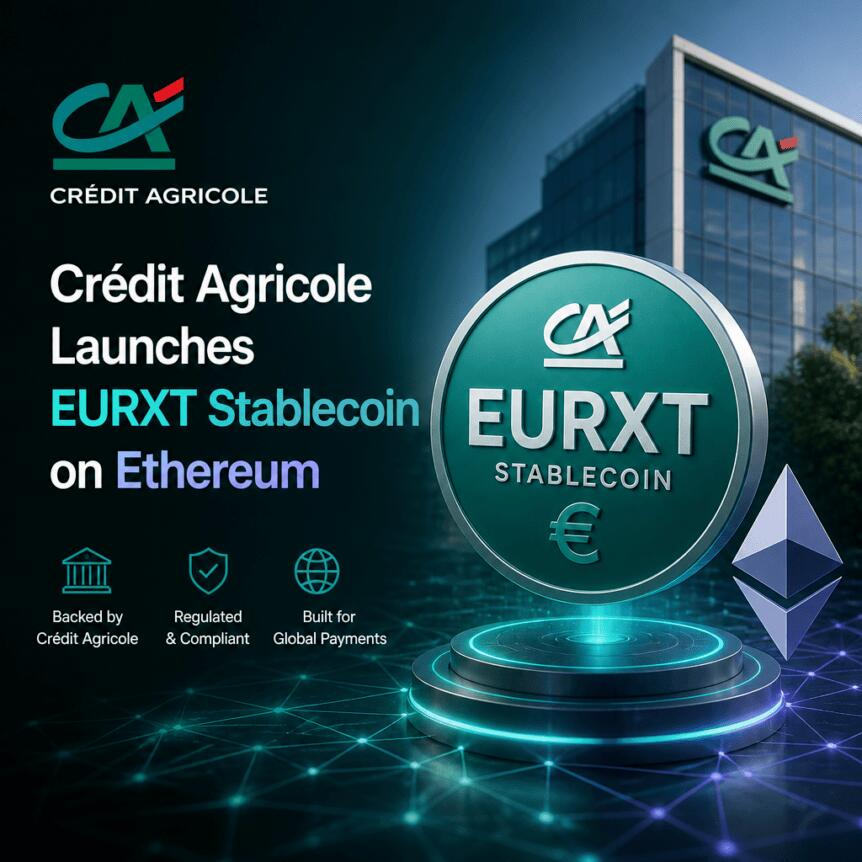
Crédit Agricole has rolled out a new euro-pegged stablecoin, the EURO eXchange Token (EURXT), through its asset servicing arm CACEIS. The launch is part of a broader effort by traditional banks to bring tokenized settlement into mainstream financial workflows, with initial access aimed at institutional investors and corporate clients.
According to a Wednesday announcement from CACEIS, the first subscription into EURXT was made into a tokenized Amundi Money Market Fund. EURXT is issued as an electronic money token (EMT) on the Ethereum blockchain and is designed to be pegged 1:1 to the euro.
Key takeaways
- Crédit Agricole’s CACEIS has launched EURXT, a euro-pegged stablecoin issued on Ethereum as an EMT.
- The token is initially targeted at institutional investors and corporate clients, with early integration into an Amundi tokenized money market fund.
- EURXT is structured without a hard cap on issuance, with supply expected to scale based on demand via its smart contract system.
- CACEIS says the launch is compliant with the EU’s MiCA framework, citing authorization from France’s ACPR even as ESMA’s public register lags.
How EURXT is designed to work
EURXT is issued through CACEIS Bank, with the project describing it as a euro-denominated electronic money token. In an accompanying white paper, the project states that there is no hard limit on issuance. Instead, the amount of EURXT in circulation is expected to expand or contract in line with market demand.
The supply/reserve setup at launch is documented on the project’s website. At the time of issuance, 20.02 million EURXT tokens were reportedly in circulation, backed by roughly 20.02 million euros held in reserves by CACEIS Bank, reflecting the intended 1:1 peg.
For investors and token users, this “mint to demand” model is a meaningful operational detail: it suggests the token supply is not intended to be capped at launch, which could affect liquidity, redemption expectations, and how quickly new allocations can be supported as participation grows.
MiCA compliance and the regulatory timing gap
CACEIS positions EURXT as compliant with the EU’s Markets in Crypto-Assets (MiCA) regime, which governs crypto-asset service providers and issuers across the bloc. The launch follows a prior step by CACEIS: Cointelegraph reported that the firm secured a MiCA crypto-asset service provider (CASP) authorization from French regulators in June 2025.
However, Cointelegraph noted that an EMT approval entry could not be found in the European Securities and Markets Authority (ESMA) public register at the time of writing, with the register shown as last updated on June 26. In response, a CACEIS spokesperson told Cointelegraph that the French banking regulator, the Autorité de Contrôle Prudentiel et de Résolution (ACPR), has authorized CACEIS Bank to issue EURXT. The spokesperson added that ESMA’s register had not yet been updated to reflect the latest authorization.
That discrepancy matters for market participants who rely on public registries to verify issuer status in real time. Even when a regulator grants permission, delayed updates can create uncertainty for counterparties, compliance teams, and integration partners—especially those operating under strict due diligence processes.
Tokenized money markets meet bank-issued euro settlement
The EURXT rollout is not just a standalone token launch; CACEIS says the first subscription used EURXT into a tokenized Amundi Money Market Fund. This combination underscores a key theme in the European tokenization race: stable, regulated euro instruments are being positioned as building blocks for tokenized funds and institutional cash management.
By targeting institutional investors and corporate clients, Crédit Agricole and CACEIS appear to be emphasizing bank-grade issuance and reserve backing—two elements that may reduce friction for entities accustomed to traditional custody, settlement, and compliance checks. For users already exploring tokenized money market exposure, EURXT’s integration is also a concrete signal that euro stablecoin issuance is moving toward active allocation, not just pilots.
More broadly, the new launch adds to a steady stream of regulated stablecoin initiatives across both Europe and the US. In Europe, Cointelegraph noted developments including AllUnity expanding its MiCA-compliant stablecoin offerings and Quantoz Payments continuing to roll out euro-denominated stablecoins. In the US, Cointelegraph highlighted that more than 140 companies—including large payments and crypto firms such as Visa, Mastercard, Coinbase, and Ripple—have joined the Open USD (OUSD) stablecoin project, which allows participants to mint the dollar-pegged token without cost while keeping earnings from reserves.
A competitive push toward tokenized finance
Crédit Agricole’s entry comes as European banks intensify efforts to bring blockchain-based settlement closer to mainstream markets. The bank’s move also aligns with broader industry activity: Cointelegraph noted that HSBC and BNP Paribas joined the Canton Foundation last September to accelerate tokenization of institutional real-world assets.
What is changing now is not whether institutions will explore tokenization, but how quickly they are moving from infrastructure experiments to regulated, asset-backed issuance. EURXT’s launch as an EMT with an explicitly described peg and reserve structure reflects this shift.
Even so, several practical details will likely determine adoption beyond the initial subscription. Market participants will be watching how quickly additional funds, wallets, and counterparties integrate EURXT; whether redemption and settlement flows operate smoothly at scale; and how quickly ESMA’s public register updates following ACPR’s authorization. Those steps can influence whether institutional teams treat EURXT as a fully “operational” instrument or a token that remains pending internal approvals.
Next, investors and integrators should monitor EURXT’s onboarding pace—particularly which tokenized funds and platforms add EURXT support—and keep an eye on ESMA register updates to confirm that public documentation matches ACPR’s authorization status.
This article was originally published as Crédit Agricole Launches EURXT Stablecoin on Ethereum on Crypto Breaking News – your trusted source for crypto news, Bitcoin news, and blockchain updates.
0
0

 Manage all your crypto, NFT and DeFi from one place
Securely connect the portfolio you’re using to start.


0
0